SARMs (Selective Androgen Receptor Modulators)

SARMs, which are chemical substances that mimic the effects of testosterone and anabolic steroids, are not FDA approved. Online vendors and social media influencers are using social media to make SARMs seem safe and effective.

The reality is SARMs are potentially dangerous. The FDA continues to receive adverse event reports associated with SARMS use. The real number of consumers experiencing adverse events is likely higher due to underreporting.  Because these are not approved drugs, consumers may be reluctant to report adverse events or may not be aware that they can report adverse events that they experience. In addition, they might not know that their symptoms are being caused by the product.

Studies and reports show SARMs are associated with serious or life-threatening health problems, such as:

  • Increased risk of heart attack or stroke
  • Psychosis/hallucinations    
  • Sleep disturbances
  • Sexual dysfunction 
  • Liver injury and acute liver failure 
  • Infertility
  • Pregnancy miscarriage
  • Testicular shrinkage 
FDA Warns of Use of Selective Androgen Receptor Modulators (SARMs) Among Teens, Young Adults — https://www.fda.gov/consumers/consumer-updates/fda-warns-use-selective-androgen-receptor-modulators-sarms-among-teens-young-adults

If you’ve read this far, congratulations. Now spread the word.

Troubling Trends

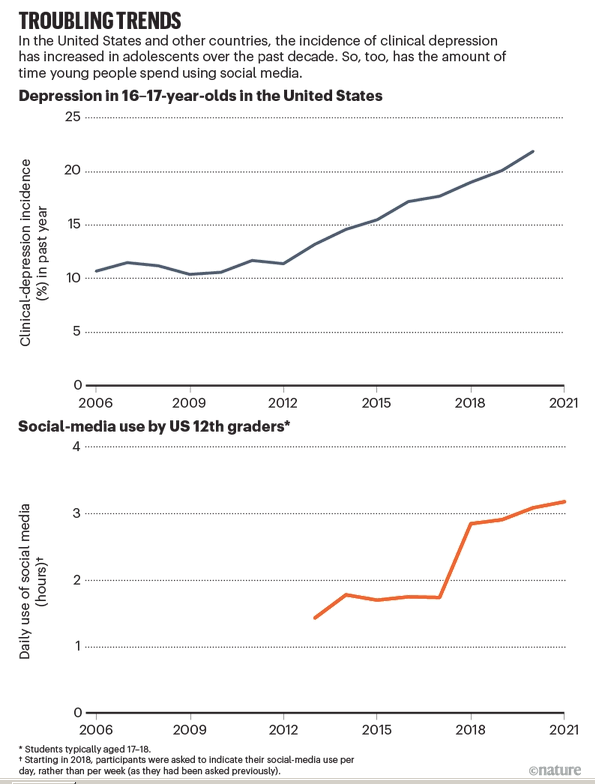
Early adolescence is characterized by wide-reaching hormonal changes, as well as physiological changes throughout the body. At the same time, all sorts of neural, cognitive and social shifts are happening. These changes could make social-media environments, such as those provided by Snapchat or TikTok, particularly alluring, but also especially impactful on mental health9–11. Several developmental-psychology studies have shown, for instance, that adolescents — particularly those in early to mid-adolescence — place increased importance on being able to interact with their peers, and on what their peers think of them12. Other studies suggest that although young children tend to view themselves positively, as they become adolescents, their ideas about themselves come to more closely align with what they perceive others to think of them13,14. Still more work has shown that being rejected or not being included has a greater impact on mood for those in early to mid-adolescence than for people older than 2515.

How social media affects teen mental health: a missing link — Nature 614, 410-412 (2023) — https://www.nature.com/articles/d41586-023-00402-9

I Thought I Told You To Put That Phone Down!

If I have to tell you one more time to Put The Phone Away…

Yikes!

Social Isolation and Dementia Risk

A study by Huang and colleagues is the first nationally representative cohort study examining the association between social isolation and incident dementia for older adults in community dwelling settings. A cohort of 5,022 older adults participating in the National Health and Aging Trends Study was followed from 2011 to 2020. When adjusting for demographic and health factors, including race, level of education, and number of chronic health conditions, socially isolated adults had a greater risk of developing dementia, compared with adults who were not socially isolated (hazard ratio, 1.27; 95% CI, 1.08 – 1.49). Potential mechanisms to explain this association include the increased risk of cardiovascular disease and depression in older adults who are socially isolated, thereby increasing dementia risk.

Mengru Wang. Geriatrician Advises on Use of Vitamin D Supplementation, Lecanemab, and Social Media for Her Patients – Medscape – Jan 20, 2023 — https://www.medscape.com/viewarticle/987285?src=rss#vp_2

One week ago we had our older adult friends over for dinner. Midweek my wife went out with her friends while I gathered with my friends. Last night was date night and we got out of the house. This evening we’re having dinner at a friend’s house.

Dementia risk reduction activities!

Fatal Fungi

This lethal lineup of mushrooms contains amatoxins, which include alpha, beta, and gamma amanitin. Amatoxin poisoning accounts for more than 90 percent of all deaths resulting from mushroom poisoning worldwide. Part of what makes them so deadly is that they can easily be confused with other, completely edible mushrooms. Death caps, for instance, can look much like straw and Gypsy mushrooms. The various destroying angels can be mistaken for button, meadow, and horse mushrooms. In Cleveland, Gholam recently treated a patient who had eaten a deadly Amanita mushroom he found in his yard after a plant identification app on his phone identified the mushroom as an edible variety. It almost killed him.

The mushrooms’ amatoxins are easily absorbed through the gastrointestinal tracts once they’ve been eaten. From there, the toxins head to the kidneys and, in particular, the liver, which is one of the most important organs in the body for making proteins. Amatoxins work by blocking a key enzyme involved in making new proteins, called RNA polymerase type II. In the liver, blocking this enzyme causes a cascade of trouble that results in cell death and tissue necrosis. While some of the toxin ultimately gets flushed in urine, some gets transported out of the liver with bile acids, where they end up back in the intestines for the process to begin again—in what’s called an enterohepatic cycle.

After ingestion, symptoms only appear six to 24 hours later, once significant damage has accumulated. Then the poisoning proceeds through three distinct phases. First, there’s gastrointestinal distress—marked by excruciating abdominal pain, nausea, vomiting, diarrhea, and blood in the urine—and can sometimes be accompanied by rapid heartbeat, low blood sugar, and dehydration. All that can last for 12 to 36 hours. Then, there’s the second, “latent” phase, when symptoms quiet down as liver and kidney damage set in at about 72 hours. In this phase, a person may be lulled into thinking they’re in the clear, potentially causing them to decline emergency medical care that could save their life.

In the three-to-five days after ingestion, things go downhill, with abrupt liver and multi-organ failure. Some patients end up needing liver transplants. Fatality rates vary but sometimes range between 10 and 20 percent, though some studies have found higher rates.

There are no specific treatments for amatoxin poisoning.

Ohio foragers are accidentally poisoning themselves with lethal mushrooms — https://arstechnica.com/science/2022/10/ohio-foragers-are-accidentally-poisoning-themselves-with-lethal-mushrooms/

“…a plant identification app on his phone identified the mushroom as an edible variety.”

Go ahead and search for the phrase “mushroom identification app” in your favorite search engine.

Foraging for wild mushrooms is a perfect example of you don’t know what you don’t know even if an app on your phone leads to believe you know.
News Addiction

The results revealed that 16.5% of people surveyed showed signs of ‘severely problematic’ news consumption. Such individuals frequently became so immersed and personally invested in news stories that the stories dominated the individual’s waking thoughts, disrupted time with family and friends, made it difficult to focus on school or work, and contributed to restlessness and an inability to sleep.

73.6% of those recognized to have severe levels of problematic news consumption reported experiencing mental ill-being “quite a bit” or “very much” — whilst frequent symptoms were only reported by 8% of all other study participants.

61% of those with severe levels of problematic news reported experiencing physical ill-being “quite a bit” or “very much” compared to only 6.1% for all other study participants.

Taylor & Francis Group. “News addiction linked to not only poor mental wellbeing but physical health too, new study shows.” ScienceDaily. http://www.sciencedaily.com/releases/2022/08/220824102936.htm (accessed October 5, 2022).

Emotional Support…Squids and Shrimp

“It has shrimp, it’s great, it’s so relaxing,” they said. “And then at the one hour and 22-minute mark, it gets inexplicably funky for about four minutes, and then goes back to being chill. It’s a whole experience.”

“Wow. This is truly the pinnacle of human creation,” one comment on the shrimp video reads. “The internet was made so I could chill alongside two shrimps.”

https://www.latimes.com/travel/story/2022-09-16/monterey-bay-aquarium-lofi-hiphop-squid-jellyfish-shrimp

I’ve got the shrimp playing now. Maybe I’ll do the squid later.

The pinnacle of human creation!

Social media use can lead to low quality sleep and harm mental health — Health Secrets of a SuperAger

Many people in today’s world live with their smartphones as virtual companions. These devices use electronic social media networks that alert users to updates on friends, favorite celebrities, and global events. Social media has become firmly integrated into a lot of people’s daily lives. According to the Pew Research Center, 72% of people in the […]

Social media use can lead to low quality sleep and harm mental health — Health Secrets of a SuperAger

Thank you Tony.

Got Kids? READ THIS

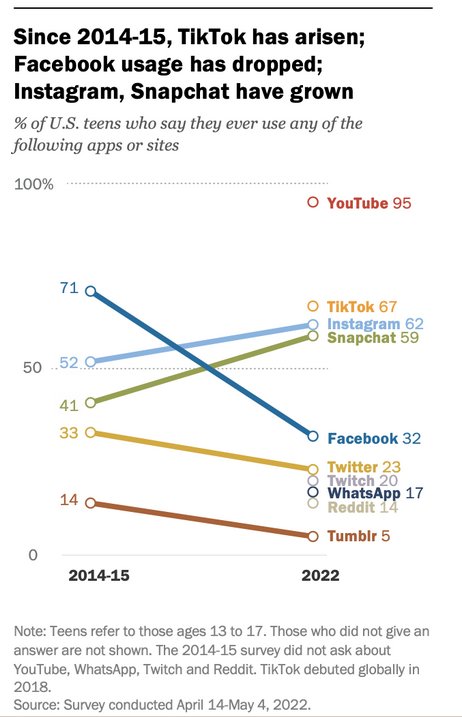
Beyond just online platforms, the new survey finds that the vast majority of teens have access to digital devices, such as smartphones (95%), desktop or laptop computers (90%) and gaming consoles (80%). And the study shows there has been an uptick in daily teen internet users, from 92% in 2014-15 to 97% today. In addition, the share of teens who say they are online almost constantly has roughly doubled since 2014-15 (46% now and 24% then).These are some of the findings from an online survey of 1,316 teens conducted by the Pew Research Center from April 14 to May 4, 2022

Teens, Social Media and Technology 2022 — https://www.pewresearch.org/internet/2022/08/10/teens-social-media-and-technology-2022/

Remember my earlier post I Thought I Told You To Put That Phone Down! This earlier post has additional links to other posts on the topic of social media addiction.

Technology addictions, also commonly known as digital addictions or internet addictions, are often overlooked due to the acceptance that society has placed on using digital devices. Technology addictions often go unnoticed by loved ones because the addicted individual may appear as though they are tending to something important such as work-related tasks on their digital device, when in reality hiding behind the screen is something extraneous. When a technological problem does develop and is noticed it is often not viewed as being an imminent risk akin to an addiction to alcohol or drugs because not only is it more acceptable, but it is also not viewed as being acute or deadly. Despite these beliefs, pathological technology use can indeed be pervasive and detrimental to one’s health and well being. In a growing digital age there is a rapid expansion of digital use and subsequent potential for problematic pathological technology use to ensue.

https://www.familyaddictionspecialist.com/blog/the-6-most-common-types-of-technology-addiction

The link provided above is neither an endorsement or evidence of a previous or existing patient-therapist relationship.

Although I will admit to a quasi-addiction to You Tube for new music.

I Thought I Told You To Put That Phone Down!

Compared with participants who used less than 120 minutes per day of social media, for example, young adults who used more than 300 minutes per day were 2.8 times as likely to become depressed within six months.The study, which will be published online Dec. 10 and is scheduled for the February 2021 issue of the American Journal of Preventive Medicine, is the first large, national study to show a link between social media use and depression over time.

University of Arkansas. “Increased social media use linked to developing depression.” ScienceDaily. http://www.sciencedaily.com/releases/2020/12/201210074722.htm (accessed December 13, 2020).

Journal Reference

  1. Brian A. Primack, Ariel Shensa, Jaime E. Sidani, César G. Escobar-Viera, Michael J. Fine. Temporal Associations Between Social Media Use and Depression. American Journal of Preventive Medicine, 2020; DOI: 10.1016/j.amepre.2020.09.014

A few more posts for your reading pleasure.