The Dangers of Self-Diagnosis and AUD (Alcohol Use Disorder)

Using naltrexone to cut back on drinking isn’t new, says Sarah Wakeman, a senior medical director for substance use disorder at Mass General Brigham. The approach dates back to the 1980s with the Sinclair method, which pairs drinking with naltrexone to blunt alcohol’s pleasurable effects. In parts of Europe, Wakeman adds, people have long used a “pill-in-the-pocket” strategy, taking the medication only when they anticipate drinking. A decades-old drug is helping people drink less alcohol—without giving it up completelyhttps://www.nationalgeographic.com/health/article/naltrexone-drink-less-alcohol? (Paywall article)

The Provider Individual who is not a doctor will see you after you answer the questionnaire (this is the self-diagnosis part).

Oar Health is an online service offering naltrexone subscriptions to those with alcohol use disorder (AUD). Users can fill out a brief assessment which is reviewed by a medical professional, then be given a naltrexone prescription if appropriate. After a one-time $50 fee, subscriptions cost $297 for three months of medication, which comes out to $99 monthly. It’s currently available in 42 US states. Beyond the naltrexone prescription, Oar Health offers ongoing access to the support of a medication prescriber, a health coach, a Facebook group for community support, and extras like educational articles and guided reflections.Oar Health Review: Pros & Cons, Cost, & My Experiencehttps://www.choosingtherapy.com/oar-health-review/

Health coaches who are “naltrexone experts”! And The Sinclair Method might not work for everyone. https://drugfree.org/article/sinclair-method/

Depending upon the online service you choose you may get naltrexone prescribed when trying to get your doctor prescribed GLP-1 filled out even when you don’t have alcohol use disorder.

Telehealth companies such as Vida Health and its rivals offer lifestyle support so people taking drugs like Wegovy and Zepbound can have the most success on the drugs. But the companies often have another job: limiting obesity drug costs for employers.

The Vida Health nurse said he was a good candidate for Zepbound but insisted he try two generic drugs first: naltrexone, a drug used to curb alcohol and opioid use, and bupropion, an antidepressant. Neither drug is approved for obstructive sleep apnea. Primary care doctors raise alarm as telehealth companies get involved in obesity drugshttps://www.npr.org/2026/06/14/nx-s1-5805984/glp1-telehealth-weight-loss-drugs

Yikes.
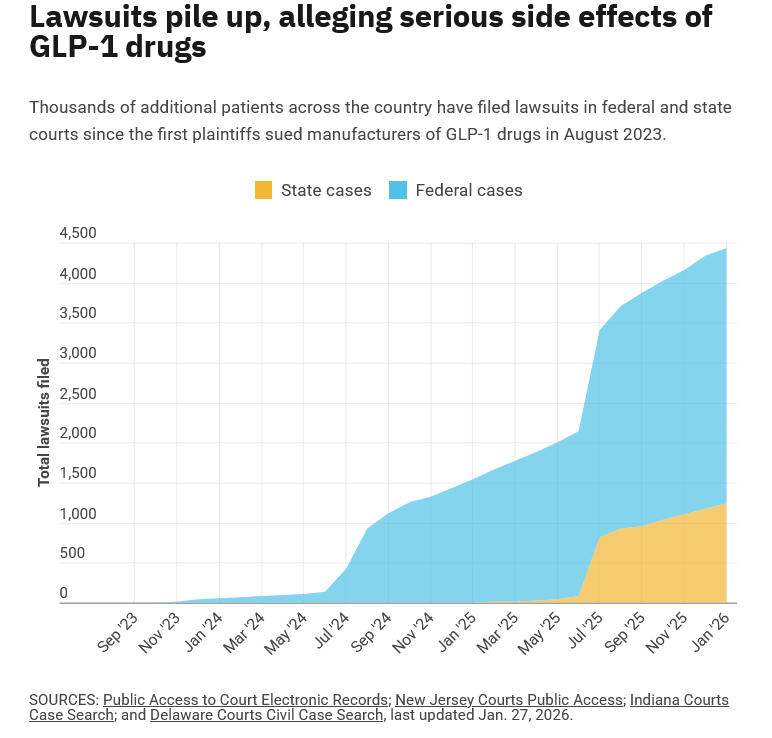
GLP-1s (it’s kind of a mess)

“But the real question is what is the quality of the weight regain and what is the shift in people’s metabolism, and it seems to be very bad,” she said. “Ongoing studies that haven’t been published yet suggest that hypertension comes back. All the inflammatory markers come back, and lipids go up. And if you have diabetes, it gets worse. Overall, it’s kind of a mess…As these studies and others showed, most people regain the weight. Whether or not they regain all the weight depends in part on diabetes and insulin and many other factors, but people will likely regain most of their weight.”

“But the message isn’t that you regain the weight. The message is that you may be less healthy when you regain the weight. That’s why we need to couple the drugs with lifestyle interventions. And it’s why people who just want to lose 5 or 10 pounds really need to consider that lifestyle change, hard as it is, is the better way to do it.”

Anne Peters, MD, professor Keck School of Medicine of the University of Southern California

Less Weight Regain, More Health Loss after Stopping GLP-1s? – Medscape – March 05, 2026 – https://www.medscape.com/viewarticle/less-weight-regain-more-health-loss-after-stopping-glp-1s-2026a10006rv?

I never envisioned developing an obsession with pharmaceuticals. And after many years of endless blogging into the void I learned I could link to previous posts like this: https://lifeunderwriter.net/tag/glp-1-receptor-agonist/

The learning never stops.

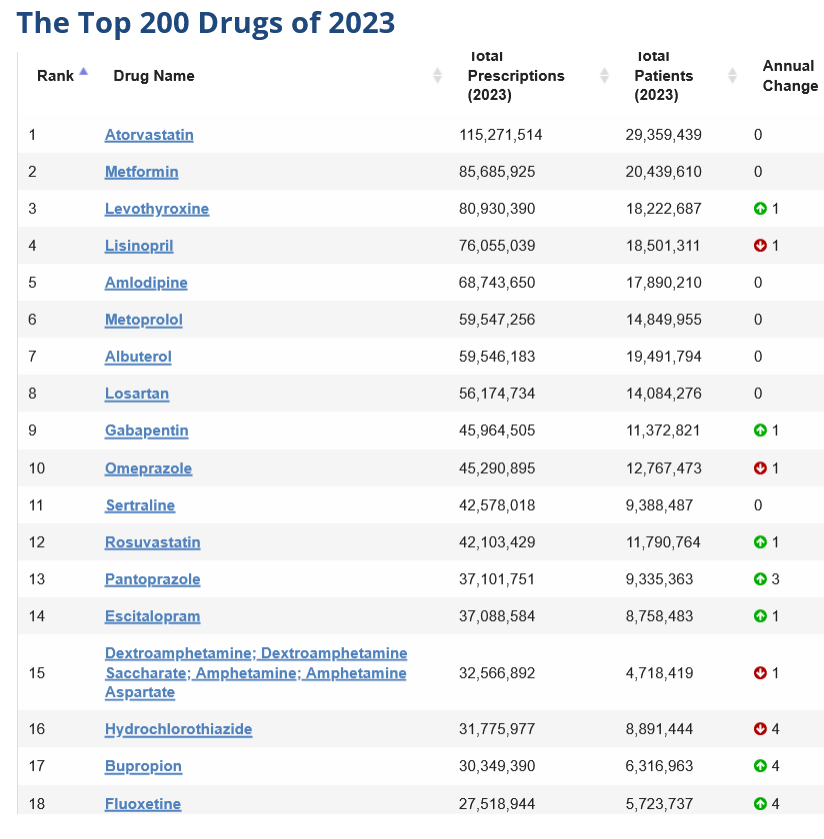
My Statin Comes From India

According to the USP, the bulk of the APIs come from India. That country is responsible for 50% of the active pharmaceutic ingredients. China is not far behind at 32%. The European Union supplies 10%. That’s a big change since 2000. Back then, European countries like France, Germany, Switzerland and Denmark supplied 42% of the APIs. Drug Recalls From India – Can You Trust Foreign-Made Generics?https://www.peoplespharmacy.com/articles/more-drug-recalls-from-india-do-you-trust-foreign-made-generics

Dozens of companies received approval from the FDA over the years to sell metoprolol and bupropion in the U.S. Yet from 2018 to 2024, the agency reported running only 2 tests on metoprolol and 7 on bupropion through its quality surveillance program — in each case, by pulling a sample from a single drug maker. In many of those years, the drugs weren’t tested at all, FDA records show. Those that were assessed received passing results. The FDA Often Doesn’t Test Generic Drugs for Quality Concerns, So ProPublica Didhttps://www.propublica.org/article/fda-generic-drug-testing

ClinCalc DrugStats Databasehttps://clincalc.com/DrugStats/

Both articles are long reads but worth your time.

Yikes.

Antidepressant Prescriptions Increase 130% for Teenage Girls

The increasing rate of mental health disorders among children and adolescents is a concerning trend that has been observed for several decades, with survey studies revealing dramatic increases in anxiety, depression, and suicidal ideation.1 In the United States, suicide ranks as the second leading cause of death for those aged 10 to 19 years and the third leading cause of death for those aged 15 to 24 years.2 Antidepressant Prescriptions and Mental Healthhttps://publications.aap.org/pediatrics/article/153/3/e2023064677/196661/Antidepressant-Prescriptions-and-Mental-Health

Between January 2016 and December 2022, the monthly antidepressant dispensing rate increased 66.3%, from 2575.9 to 4284.8. Before March 2020, this rate increased by 17.0 per month (95% confidence interval: 15.2 to 18.8). The COVID-19 outbreak was not associated with a level change but was associated with a slope increase of 10.8 per month (95% confidence interval: 4.9 to 16.7). The monthly antidepressant dispensing rate increased 63.5% faster from March 2020 onwards compared with beforehand. In subgroup analyses, this rate increased 129.6% and 56.5% faster from March 2020 onwards compared with beforehand among females aged 12 to 17 years and 18 to 25 years, respectively. In contrast, the outbreak was associated with a level decrease among males aged 12 to 17 years and was not associated with a level or slope change among males aged 18 to 25 years. Antidepressant Dispensing to US Adolescents and Young Adults: 2016–2022https://publications.aap.org/pediatrics/article/153/3/e2023064245/196655/Antidepressant-Dispensing-to-US-Adolescents-and?autologincheck=redirected

Between 2020 and 2022, antidepressant prescriptions for girls aged 12-17 skyrocketed by 130%. Antidepressants Increase 130% for Teen Girls, Drop 7% For Boyshttps://brownstone.org/articles/antidepressants-increase-130-for-teen-girls-drop-7-for-boys/

Yikes.

Not Just For Allergic Rhinitis Anymore

A common hay fever nasal spray was found to cut COVID-19 infections by two-thirds in a clinical trial, while also reducing rhinovirus cases. Researchers believe it could serve as an easy, low-cost preventive measure, pending further studies. Saarland University. “Common allergy spray slashes COVID-19 risk in surprising trial.” ScienceDaily. http://www.sciencedaily.com/releases/2025/09/250907024535.htm (accessed September 7, 2025).

For Robert Bals, the results suggest practical applications: ‘Azelastine nasal spray could provide an additional easily accessible prophylactic to complement existing protective measures, especially for vulnerable groups, during periods of high infection rates, or before travelling.’ But Professor Bals also stressed the importance of further research: ‘Our results highlight the need for larger, multicentre trials to continue exploring the use of azelastine nasal sprays as an on-demand preventive treatment, and to examine its potential effectiveness against other respiratory pathogens.’

Link to the Jama article – https://jamanetwork.com/journals/jamainternalmedicine/fullarticle/2838335 Azelastine Nasal Spray for Prevention of SARS-CoV-2 Infections

Prozac is Better Than Viagra (for clams)

Fluoxetine, the drug commonly known as Prozac, isn’t known to increase sexual prowess in humans. In fact, it often does the very opposite. But when these clams were exposed to the same drug, they instantly jumped to sexual activity. Now, this wasn’t a complete surprise. Research conducted in the 1980s found that if serotonin is injected into the muscles or gonad of clams, they may begin to spawn after just 15 minutes.

How Prozac Might Give Clams a Boost https://undark.org/2025/08/14/excerpt-prozac-clams/

Glenmark Pharmaceuticals Recall (check your prescription bottles)

In February, the FDA found problems with cleaning and testing at the plant in Madhya Pradesh, India, which was the subject of a ProPublica investigation last year. The current recalls, listed in an FDA enforcement report last week, cover a wide range of commonly prescribed medicines, including ones that treat epilepsy, diabetes, multiple sclerosis, heart disease and high blood pressure, among other ailments. ​​A full list of the recalled medications is available here. An Indian Drugmaker, Investigated by ProPublica Last Year, Has Recalled Two Dozen Medications Sold to U.S. Patients https://www.propublica.org/article/glenmark-recalls-two-dozen-drugs

Time to bring the pharma supply chain back onshore.