Only in NYC: A $90-million penthouse and a $1-million parking spot – latimes.com.
No further comment needed.
Only in NYC: A $90-million penthouse and a $1-million parking spot – latimes.com.
No further comment needed.
Tony Yang received his Ph.D. in history from the University of California, Riverside in 2009. Since then, he’s worked on and off as a history lecturer, but has had to depend on unemployment and food stamps to get by.
In his best year since getting his Ph.D., Yang says he made about $32,000; in his worst, about $10,000. He says there’s a perception that if you have a doctorate, you automatically walk into a high-paying job.
“I have the prestige of holding a Ph.D., but that [isn’t] paying the bills,” he says.
One of the scariest charts I’ve seen.
This is what you get when a society allows financial oligarchs to take over the economy and rape and pillage at will with zero repercussions.

The company has reduced its total workforce by 730 positions, or almost 10 percent, over the past four years, mainly by attrition.
via American Family Information Services Department Incurs 87 Layoffs – Insurance Networking News.
Short articles like this make me wonder what’s really happening. We don’t know the total number of staff in the company’s IT department so we cannot know what percentage of the entire staff was affected. So I went online and found the following:
The cut positions included 85 people based at the company headquarters at 6000 American Parkway and its other Madison location, off Milwaukee Street, plus two people outside Madison. There are 850 people remaining in the company’s information services division, making the job reductions equal to about a 10 percent cut there.
Life Index | MIB Solutions, Inc. | The Industry’s Timeliest Measure of Application Activity.
This is encouraging news.
Worker stress reflects not only heavier demands in recent years, but the fears and difficulties of the Great Recession that preceded the recovery as well as ongoing economic uncertainty. In effect, employees have been under sometimes-severe strain for roughly four years. Bigger workloads might be easier to shoulder if employees were getting raises, as well. But by and large they aren’t. In the Workforce Management-Workplace Options survey, just 30 percent of those employees reporting an increase in job duties said they got a pay increase as well. And government data show that inflation-adjusted average hourly earnings fell 1.6 percent from October 2010 to October 2011.Still, some observers say workers should get used to the present business as usual. Given doubts about the government’s ability to reduce unemployment rates anytime soon, employers may be able to make always-on “superjobs” the standard rather than the exception. Companies have seen a spurt in productivity, but it may not be a lasting one. Wayne Hochwarter, a management professor at Florida State University in Tallahassee, surveyed more than 700 full-time workers in 2011 and found that employees in a demanding work environment said their job performance had risen. But their anxiety levels at work and home also rose, while their job satisfaction fell. Especially when increased demands come with factors like layoff fears and poor communication by the boss and company, heightened worker productivity is likely to be short-lived, Hochwarter says. “The toll on the human system leads to deteriorating performance and effort,” he says. “The person is left with an empty tank.”
via Today’s Workforce—Pressed and Stressed – Featured Article – Workforce.
The hamsters are dying.
Economist’s View: “First Look at US Pay Data, It’s Awful”
The median paycheck — half made more, half less — fell again in 2010, down 1.2 percent to $26,364. That works out to $507 a week, the lowest level, after adjusting for inflation, since 1999.
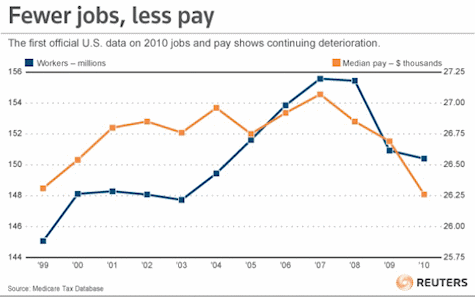
A VERY Scary Chart
 I had gotten away from posting Scary Charts. There were just too many to pick from. But when I came across this graphic, well I just had to post it.
 lifeunderwriter.net
You must be logged in to post a comment.