Lp-PLA2 Predicts Non-Vascular Death

Medical News: Lp-PLA2 Predicts Non-Vascular Death – in Cardiovascular, Atherosclerosis from MedPage Today

High levels of lipoprotein-associated phospholipase A2 (Lp-PLA2) were an independent risk factor for non-vascular mortality as well as for cardiovascular death, stroke, and coronary heart disease in a large meta-analysis.

For each standard deviation above the mean for Lp-PLA2 among nearly 80,000 participants in 32 prospective studies, the risk of non-vascular death increased by 10% after adjusting for conventional risk factors, reported Alexander Thompson, of the University of Cambridge in England, and 14 other members of the Lp-PLA2 Studies Collaboration in the May 1 Lancet.

Anticonvulsant Meds and Suicide Risk

JAMA — Abstract: Anticonvulsant Medications and the Risk of Suicide, Attempted Suicide, or Violent Death, April 14, 2010, Patorno et al. 303 (14): 1401

Results: The study identified 26 completed suicides, 801 attempted suicides, and 41 violent deaths in 297 620 new episodes of treatment with an anticonvulsant (overall median follow-up, 60 days). The incidence of the composite outcomes of completed suicides, attempted suicides, and violent deaths for anticonvulsants used in at least 100 treatment episodes ranged from 6.2 per 1000 person-years for primidone to 34.3 per 1000 person-years for oxcarbazepine. The risk of suicidal acts was increased for gabapentin (hazard ratio [HR], 1.42; 95% confidence interval [CI], 1.11-1.80), lamotrigine (HR, 1.84; 95% CI, 1.43-2.37), oxcarbazepine (HR, 2.07; 95% CI, 1.52-2.80), tiagabine (HR, 2.41; 95% CI, 1.65-3.52), and valproate (HR, 1.65; 95% CI, 1.25-2.19), compared with topiramate. The analyses including violent death produced similar results. Gabapentin users had increased risk in subgroups of younger and older patients, patients with mood disorders, and patients with epilepsy or seizure when compared with carbamazepine.

Conclusion: This exploratory analysis suggests that the use of gabapentin, lamotrigine, oxcarbazepine, and tiagabine, compared with the use of topiramate, may be associated with an increased risk of suicidal acts or violent deaths.

Lifestyle Underwriting – Update 4/27/10

Arch Intern Med — Abstract: Influence of Individual and Combined Health Behaviors on Total and Cause-Specific Mortality in Men and Women: The United Kingdom Health and Lifestyle Survey, April 26, 2010, Kvaavik et al. 170 (8): 711

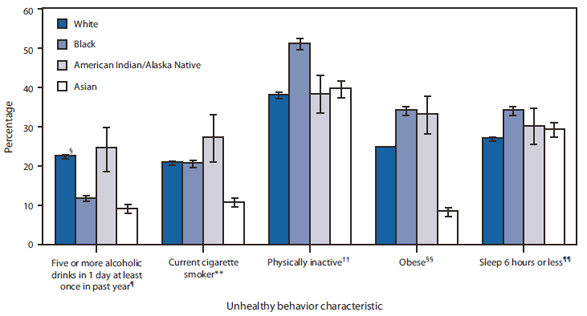
The effect of combined health behaviors was strongest for other deaths and weakest for cancer mortality. Those with 4 compared with those with no poor health behaviors had an all-cause mortality risk equivalent to being 12 years older.

Combination Therapy for Crohn’s

Better Treatment Found for Crohn’s Disease – BusinessWeek

The international trial included 508 people with Crohn’s disease who had never been treated with immunosuppressive drugs. One-third were given infliximab alone, one-third received only azathioprine and one-third were treated with both. The trial was funded by Centocor Ortho Biotech, which markets infliximab, and Schering-Plough.

After 26 weeks, 56.8 percent of those getting combination therapy had complete remission of symptoms, compared to 44.4 percent of those getting only infliximab and 30 percent of those getting only azathioprine.

Energy Drinks + ETOH = Bad Combo

There is a link to the original study in PDF format within the AAFP article.

Alcohol/Energy Drink Combo Leads to Higher Intoxication, Driving Risk — AAFP News Now — American Academy of Family Physicians

“Caffeine appears to reduce subjective perceptions of alcohol intoxication, but it does not ameliorate the performance deficits produced by alcohol,” said Thombs. “(Individuals) are more alert but just as behaviorally impaired as if they did not consume caffeine.”

FMAT – Family Medicine Accelerated Track

Texas Tech School of Medicine to Start Three-year M.D. Program for Family Medicine — AAFP News Now — American Academy of Family Physicians

The AAFP’s 2006 Workforce Report projected a shortage of 39,000 family physicians by 2020. In its new Workforce Reform policy, the Academy recommends that medical schools develop admissions policies that serve to recruit students most likely to pursue careers in primary care.

7.6% of the US Population Estimated to be Diabetic

QuickStats: Percentage of Adults Aged ≥18 Years Ever Told They Had Diabetes* by a Doctor or Health Professional, by Race/Ethnicity† — National Health Interview Survey, United States, 2004–2008§

During 2004–2008, 7.6% of adults overall in the United States reported ever having been told they had diabetes. American Indian/Alaska Natives (17.5%), blacks (11.8%), and Hispanics (10.6%) were more likely than Asians (8.0%) and whites (6.6%) to report ever having been told by a doctor or health professional that they had diabetes.