
Attempted Suicide in High School America – 2019
Since the start of the COVID-19 pandemic, there has been a dramatic increase in depression, anxiety, psychosis, and suicidality, new research shows.
The most profound health problems were found among adults younger than 25 years. Roughly 90% screened positive for moderate to severe depression, and 80% screened positive for moderate to severe anxiety.
One of the most alarming findings was that in June, 25,498 participants who screened positive for depression reported thinking of suicide or self-harm on “more than half of days to nearly every day.” A total of 14,607 participants said they had these thoughts every day.
Sadly, not surprising.
I live with “the world’s most dangerous” eating disorder
I have been struggling with diabulimia on and off since my diagnosis of type 1 diabetes in 2011, at age 30. I had just started a PhD and spent the first semester walking around campus with all the classic symptoms of type 1 diabetes: famished, dehydrated, constantly needing to urinate, and experiencing rapid weight loss. After my diabetes diagnosis, when I started injecting insulin, I gained the weight back—and then some. It didn’t take long to figure out that omitting insulin was not only an effective weight loss tool, compared with vomiting, it was a much less violent way to purge. Having a history of bulimia nervosa, I thought I had found the holy grail. I could eat what I wanted, not use insulin, and not gain weight.
And I thought Orthorexia Nervosa was bad.
This article is written by an Emergency Medicine doctor for other Emergency Medicine doctors as a quick primer on recognizing and diagnosing anorexia. While those of us in the life insurance business are not diagnosticians you will definitely benefit from this short ten minute article on the next case you encounter where Momma Bear is applying for $2,000,000 on her skinny 15 year old daughter who can’t seem to gain weight no matter how much the kid eats.
AN is a common, severe psychiatric illness. It is often present with co-morbid psychiatric illnesses. There is a high mortality rate, 5.6% per decade. It is notoriously difficult to treat with psychotherapy and pharmacotherapy.
How to maintain your mental health while working from home
Pretty good article online at Fast Company.
I’ve been working from home since 2006. As a result social distancing and hoarding come naturally now. The article has several good suggestions and well worth reading.
Personally I would add one more suggestion to the list: your favorite music. Today is a Willie Day.
I roll in my bed, unable to sleep. I listen to BBC talk about the craziness that took over the world, preoccupied with this one question. What question? It’s not: “Why, Corona?” For that, I already have more answers than I want. Scientists say that COVID19 is an animal virus. It spread to humans from…
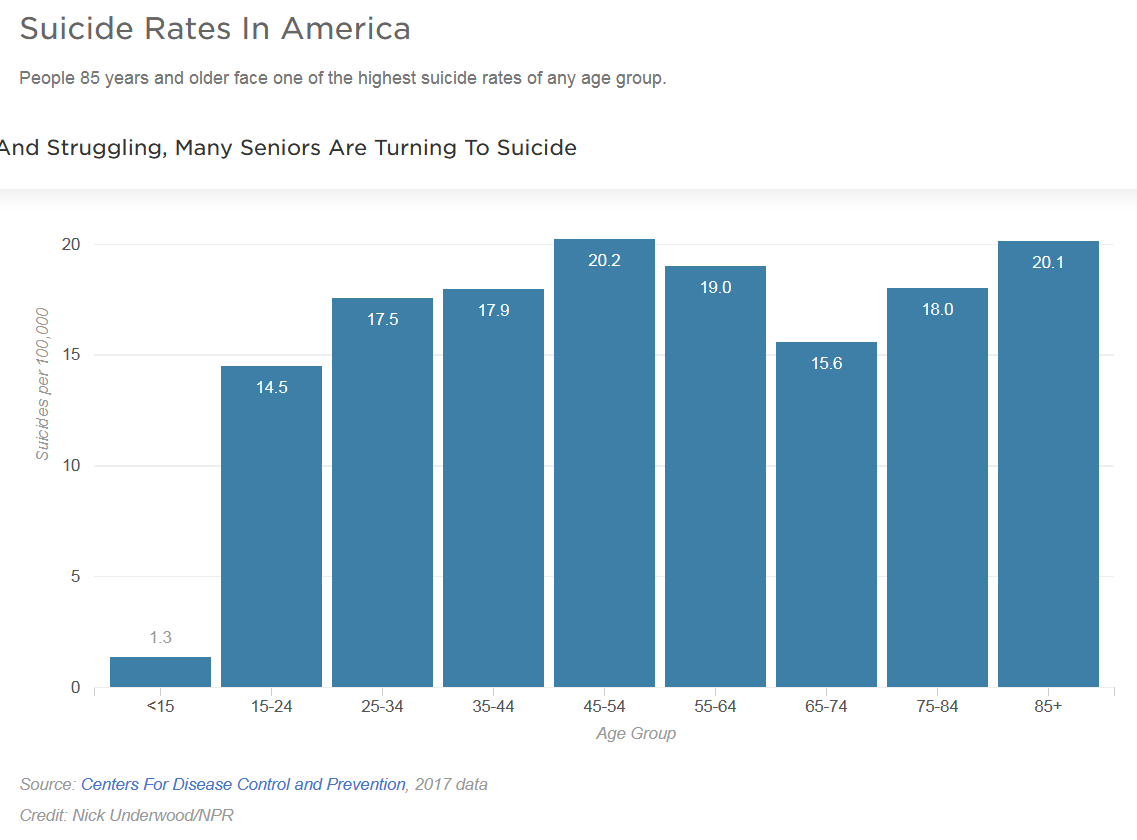
Across the country, suicide rates have been on the rise, and that rise has struck the nation’s seniors particularly hard. Of the more than 47,000 suicides that took place in 2017, those 65 and up accounted for more than 8,500 of them, according to the Centers for Disease Control and Prevention. Men who are 65 and older face the highest risk of suicide, while adults 85 and older, regardless of gender, are the second most likely age group to die from suicide.
Isolated And Struggling, Many Seniors Are Turning To Suicide

At the end of your life, what will have more meaning to you? Will it be the thousands of filtered images you spent “liking” on social media or the real-life moments you spent with loved ones? Realize that every single moment you spend looking at your phone instead of the face of your loved one is a missed opportunity of having a real connection. Your support group in life should consist of the interconnected arms of the real people you know encircling you with love, not the sporadic connectivity of the world wide web.
via Break Free From The Stimulation Nation — Dr. Eric Perry, PhD
BMJ 2019; 365 doi: https://doi.org/10.1136/bmj.l1255 (Published 10 April 2019) Cite this as: BMJ 2019;365:l1255
Conclusion Stress related disorders are robustly associated with multiple types of cardiovascular disease, independently of familial background, history of somatic/psychiatric diseases, and psychiatric comorbidity.
This study is Open Access and a PDF can be downloaded at the link above.

Cross-Sectional Weighted Prevalence of Despair by Race/Ethnicity and Education: United States, 2016–2017
Note. HS = high school. The figure shows results for wave V of the study. The average age was 37 years. Non-Hispanic White with high school or less education was the reference category. We conducted a χ2 test of independence to compare proportions in each group to the reference category. *P < .05; **P < .01; ***P < .001.
The Depths of Despair Among US Adults Entering Midlife
Conclusions. Results suggest that generally rising despair among the young adult cohort now reaching midlife that cuts across racial/ethnic, educational, and geographic groups may presage rising midlife mortality for these subgroups in the next decade.
Our study had potential limitations. We measured despair using several indicators of mental and emotional health and substance use. These indicators do not completely capture all domains of despair; for example, we were unable to account for economic anxiety, reports of physical pain, or hopelessness. We did not examine mortality.


You must be logged in to post a comment.