GLP-1s and the Risk for Malnutrition

“We see cases where people take a GLP-1 medication and become so severely malnourished that they need to be hospitalized,” said Rebecca Boswell, PhD, director of Penn Medicine Princeton Center for Eating Disorders, in Philadelphia. “It’s not uncommon.” The Scary Health Risk That Can Sneak Up on GLP-1 Users – Medscape – January 19, 2026. https://www.medscape.com/viewarticle/scary-health-risk-can-sneak-glp-1-users-2026a10001pi

Yikes.

People return to their baseline weight and lose all cardiometabolic benefits in less than 2 years after stopping semaglutide or tirzepatide, a new meta-analysis found. Weight Regain, Health Benefit Loss Rapid When GLP-1s Stopped – Medscape – January 08, 2026. https://www.medscape.com/viewarticle/weight-regain-health-benefit-loss-rapid-when-glp-1s-stopped-2026a10000kr?

YIKES.

You see, cures are passée. Cures kill markets. Getting the population properly hooked on a pharmaceutical treatment for a ‘chronic’ condition is where the serious money is. “Our core insight was simple and grim: it’s far easier—and infinitely more profitable—to convince healthy people that they’re sick than to develop genuine cures for the truly ill.

Twenty years later, the hustle is bigger, slicker, and more dangerous than ever. Watching that hustle unfold with weight loss drugs feels weirdly ominous, like watching a slow-moving train wreck you can’t peel your eyes off of. You know there’ll be carnage and bodies, vast fortunes won and lost, and humanity left just a little bit poorer. We have often documented the pharmaceutical industry’s proven ability to create enormously lucrative markets overnight, by inventing and selling diseases. Now watch as all that ingenuity and energy gets pointed at one of the biggest problems bewitching humanity: human fatness. The Seven Deadly Sins of Weight Loss Drugshttps://brownstone.org/articles/the-seven-deadly-sins-of-weight-loss-drugs/

YIKES!

This will not end well.

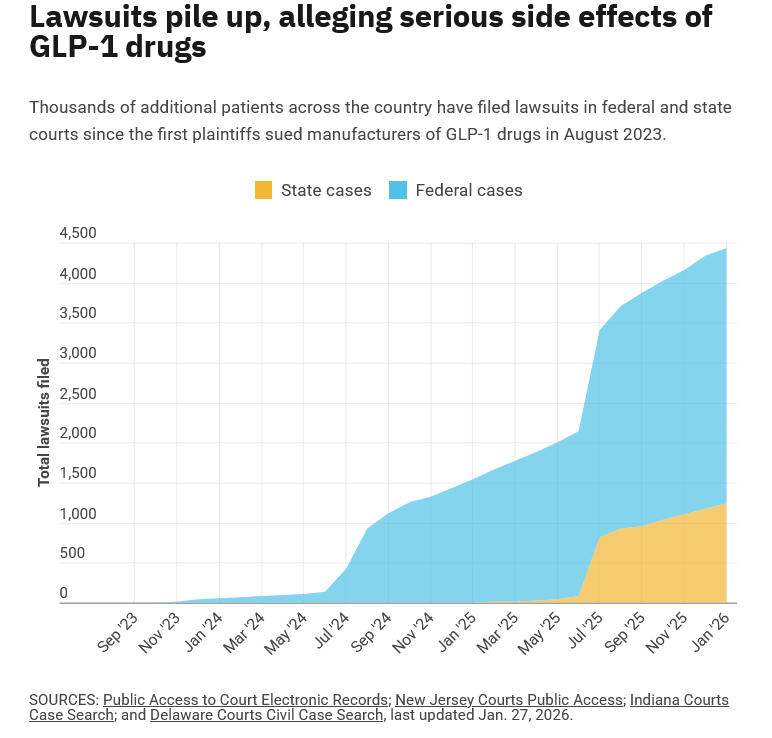
Complications? What Complications? (just another GLP-1 receptor agonist post)

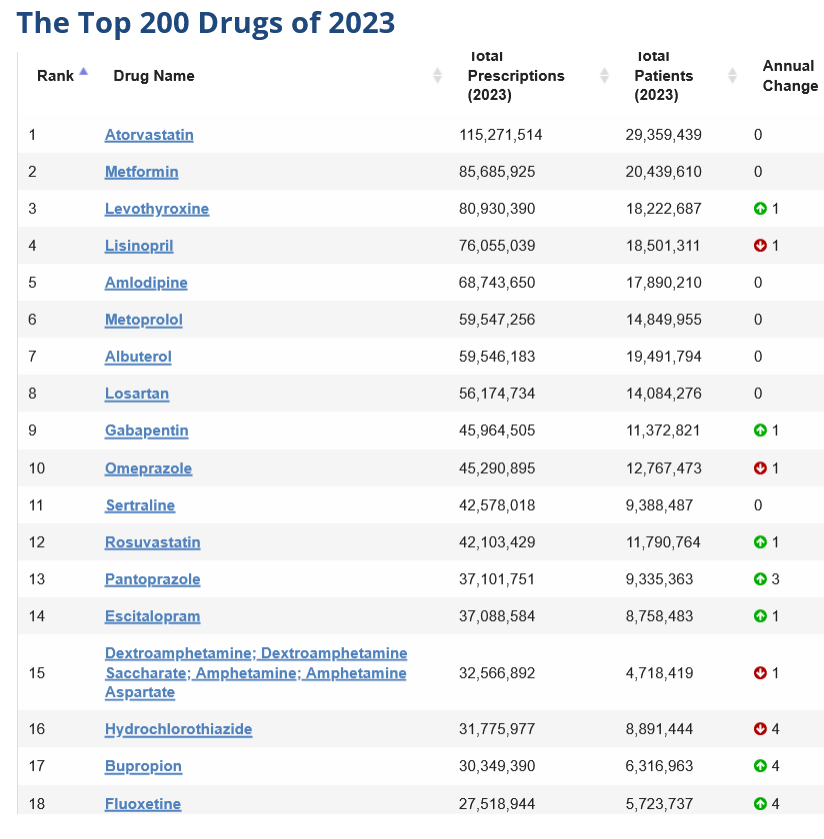
My Statin Comes From India

According to the USP, the bulk of the APIs come from India. That country is responsible for 50% of the active pharmaceutic ingredients. China is not far behind at 32%. The European Union supplies 10%. That’s a big change since 2000. Back then, European countries like France, Germany, Switzerland and Denmark supplied 42% of the APIs. Drug Recalls From India – Can You Trust Foreign-Made Generics?https://www.peoplespharmacy.com/articles/more-drug-recalls-from-india-do-you-trust-foreign-made-generics

Dozens of companies received approval from the FDA over the years to sell metoprolol and bupropion in the U.S. Yet from 2018 to 2024, the agency reported running only 2 tests on metoprolol and 7 on bupropion through its quality surveillance program — in each case, by pulling a sample from a single drug maker. In many of those years, the drugs weren’t tested at all, FDA records show. Those that were assessed received passing results. The FDA Often Doesn’t Test Generic Drugs for Quality Concerns, So ProPublica Didhttps://www.propublica.org/article/fda-generic-drug-testing

ClinCalc DrugStats Databasehttps://clincalc.com/DrugStats/

Both articles are long reads but worth your time.

Yikes.

Antidepressant Prescriptions Increase 130% for Teenage Girls

The increasing rate of mental health disorders among children and adolescents is a concerning trend that has been observed for several decades, with survey studies revealing dramatic increases in anxiety, depression, and suicidal ideation.1 In the United States, suicide ranks as the second leading cause of death for those aged 10 to 19 years and the third leading cause of death for those aged 15 to 24 years.2 Antidepressant Prescriptions and Mental Healthhttps://publications.aap.org/pediatrics/article/153/3/e2023064677/196661/Antidepressant-Prescriptions-and-Mental-Health

Between January 2016 and December 2022, the monthly antidepressant dispensing rate increased 66.3%, from 2575.9 to 4284.8. Before March 2020, this rate increased by 17.0 per month (95% confidence interval: 15.2 to 18.8). The COVID-19 outbreak was not associated with a level change but was associated with a slope increase of 10.8 per month (95% confidence interval: 4.9 to 16.7). The monthly antidepressant dispensing rate increased 63.5% faster from March 2020 onwards compared with beforehand. In subgroup analyses, this rate increased 129.6% and 56.5% faster from March 2020 onwards compared with beforehand among females aged 12 to 17 years and 18 to 25 years, respectively. In contrast, the outbreak was associated with a level decrease among males aged 12 to 17 years and was not associated with a level or slope change among males aged 18 to 25 years. Antidepressant Dispensing to US Adolescents and Young Adults: 2016–2022https://publications.aap.org/pediatrics/article/153/3/e2023064245/196655/Antidepressant-Dispensing-to-US-Adolescents-and?autologincheck=redirected

Between 2020 and 2022, antidepressant prescriptions for girls aged 12-17 skyrocketed by 130%. Antidepressants Increase 130% for Teen Girls, Drop 7% For Boyshttps://brownstone.org/articles/antidepressants-increase-130-for-teen-girls-drop-7-for-boys/

Yikes.

Ketamine in the UK

Acute harms of ketamine use relate to vulnerability and injuries. Long term use can seriously harm both physical and mental health, diminishing quality of life, affecting personal relationships, and impairing academic or professional performance.9 Ketamine induced uropathy from ulceration and thickening of the bladder is a common and serious complication. In the UK, 27% of regular ketamine users report at least one urological symptom—dysuria, frequency, incontinence, haematuria, or retention—with severity correlated with dose and frequency of use.10 Treatment requires abstinence.11 If abstinence is not achieved, irreversible bladder and kidney damage can occur, requiring urinary tract reconstruction. Long term ketamine use is also associated with “K cramps”—severe abdominal pain. This may be related to liver disease that is similar to primary sclerosing cholangitis but less inflammatory and progressive.12 Acute harms of ketamine use relate to vulnerability and injuries. Long term use can seriously harm both physical and mental health, diminishing quality of life, affecting personal relationships, and impairing academic or professional performance.9 Ketamine induced uropathy from ulceration and thickening of the bladder is a common and serious complication. In the UK, 27% of regular ketamine users report at least one urological symptom—dysuria, frequency, incontinence, haematuria, or retention—with severity correlated with dose and frequency of use.10 Treatment requires abstinence.11 If abstinence is not achieved, irreversible bladder and kidney damage can occur, requiring urinary tract reconstruction. Long term ketamine use is also associated with “K cramps”—severe abdominal pain. This may be related to liver disease that is similar to primary sclerosing cholangitis but less inflammatory and progressive.12Non-prescribed ketamine use is rising in the UKhttps://doi.org/10.1136/bmj.r1167

Yikes.

Update 07.05.25https://www.bbc.com/news/articles/c70r1xdyy59o

One Toke Over the Line

A wave of recent research points to reasons for concern for older users, with cannabis-related emergency room visits and hospitalizations rising, and a Canadian study finding an association between such acute care and subsequent dementia. Older people are more apt than younger ones to try cannabis for therapeutic reasons: to relieve chronic pain, insomnia, or mental health issues, though evidence of its effectiveness in addressing those conditions remains thin, experts said. As Cannabis Users Age, Health Risks Appear To Grow https://kffhealthnews.org/news/article/cannabis-medical-use-older-adults-health-risks/

Then…

And now…

“Our brains are more sensitive to psychoactive substances as we age.” Dr. Benjamin Han

Don’t you know I’m just waiting for the train that goes home, sweet Mary.

Cannabis Dependence and Erectile Dysfunction

The short-term analysis included 29,442 patients with cannabis dependence matched to 29,442 patients without dependence. Cannabis dependence was significantly associated with an approximately 4-fold higher risk for ED and PDE5i prescription at 3 months to 1 year from diagnosis among all men and those aged 40 years and older and an approximately 3-fold higher risk for men aged 18-39 years, Dr Asanad’s team reported in The Journal of Sexual Medicine. The longer-term analysis included 17,211 men with cannabis dependence matched to 17,211 men without dependence. Cannabis dependence was significantly associated with an approximately 1.2-fold increased risk for ED among all adult men and those aged 40 years and older, the investigators reported. Cannabis Dependence Linked With Erectile Dysfunction, Testosterone Deficiencyhttps://www.renalandurologynews.com/news/erectile-dysfunction-testosterone-cannabis-dependence

Yikes.

DUI/DWI for a New Generation

I am impressed with the ability of some people to injure themselves in creative ways.

Analyzing data from the 2016-2021 National Inpatient Sample, UCLA researchers found that 25% of 7350 patients hospitalized for scooter-related injuries were using substances such as alcohol, opioids, marijuana and cocaine when injured. Published in The American Surgeon, the study also notes that overall scooter-related hospitalizations during the 5-year period jumped more than eight-fold, from 330 to 2705. In addition, the risk of traumatic brain injuries among the substance use group was almost double that of the non-impaired patients. University of California – Los Angeles Health Sciences. “Nearly one-quarter of e-Scooter injuries involved substance impaired riders.” https://www.sciencedaily.com/releases/2025/04/250429195329.htm (accessed May 3, 2025).

AND don’t forget about these things can randomly explode.

“In all of these fires, these lithium-ion fires, it is not a slow burn there’s not a small amount of fire, it literally explodes,” FDNY Commissioner Laura Kavanagh – https://www.statista.com/chart/29472/fires-caused-by-lithium-ion-batteries/

Glenmark Pharmaceuticals Recall (check your prescription bottles)

In February, the FDA found problems with cleaning and testing at the plant in Madhya Pradesh, India, which was the subject of a ProPublica investigation last year. The current recalls, listed in an FDA enforcement report last week, cover a wide range of commonly prescribed medicines, including ones that treat epilepsy, diabetes, multiple sclerosis, heart disease and high blood pressure, among other ailments. ​​A full list of the recalled medications is available here. An Indian Drugmaker, Investigated by ProPublica Last Year, Has Recalled Two Dozen Medications Sold to U.S. Patients https://www.propublica.org/article/glenmark-recalls-two-dozen-drugs

Time to bring the pharma supply chain back onshore.

Controlled Substance Prescribing Patterns – Pennsylvania

Rates of psychostimulant (stimulant)-related overdose deaths in the United States have increased substantially since 2010; in 2022, 32% of all overdose deaths involved stimulants. Citation: Hayden S, Murzynski SM, Bolton A, Goetz CT. Controlled Substance Prescribing Patterns Among Fatal Overdose Decedents with an Opioid, Stimulant, or Both Contributing to Death — Pennsylvania, 2017–2022. MMWR Morb Mortal Wkly Rep 2025;74:205–209. DOI: http://dx.doi.org/10.15585/mmwr.mm7412a2

Prescribed stimulants. Read more here – https://www.dea.gov/factsheets/stimulants

Happy Friday!