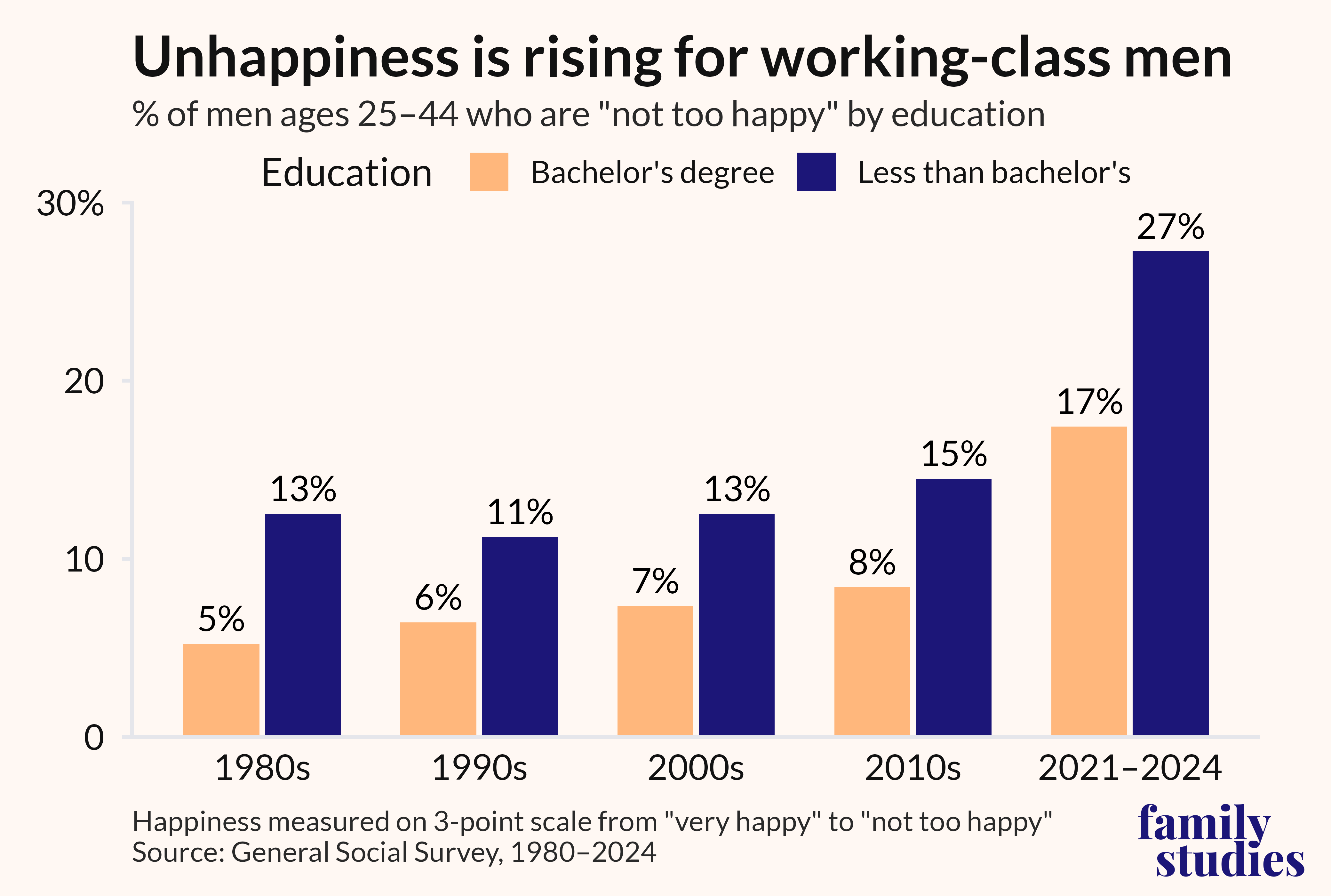
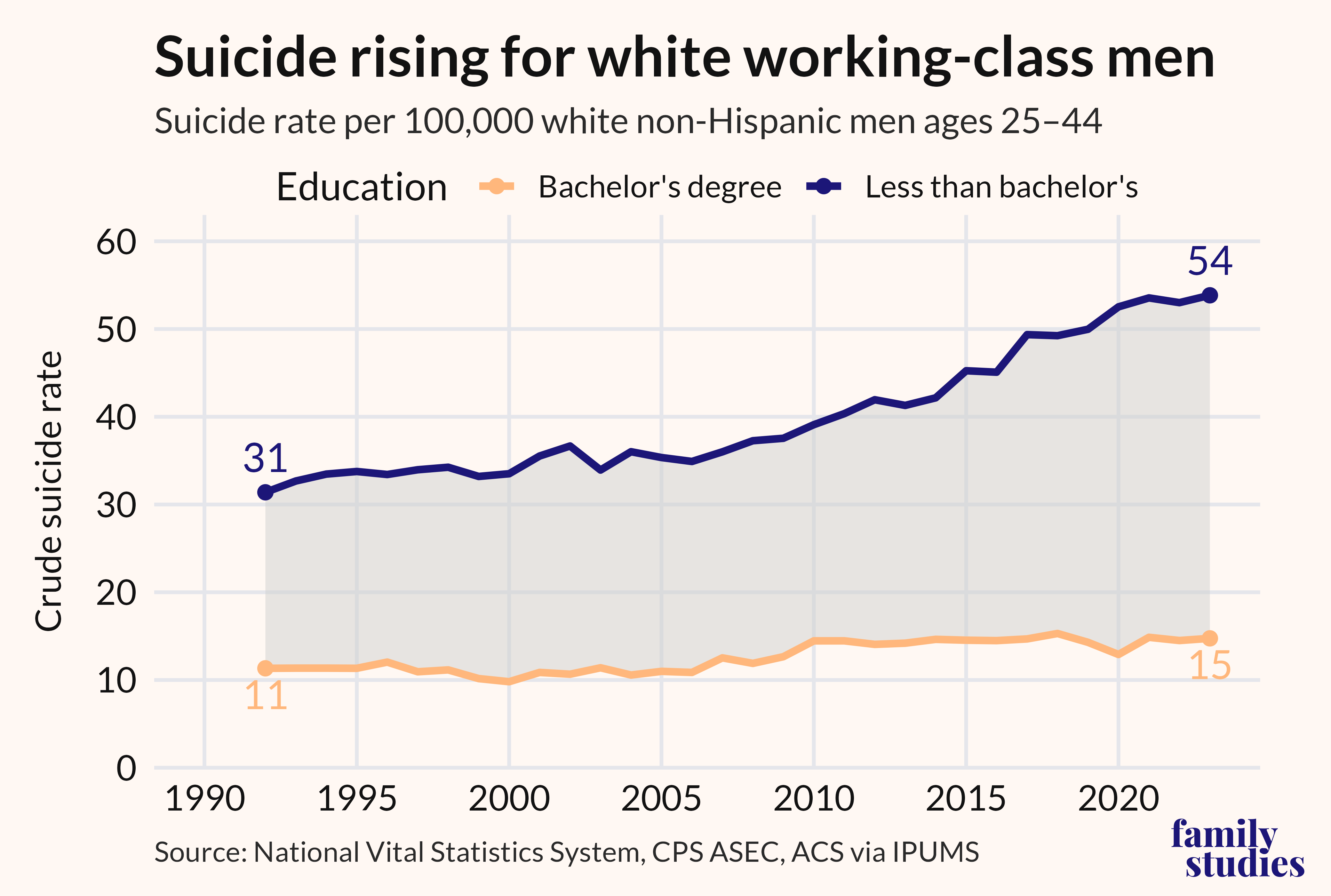
The class disparity in happiness is nothing new. The GSS data reveal that college-educated men were happier than their less-educated peers going back to the 1980s. And while the GSS shows somewhat steady levels of happiness from the 1980s through the 2000s, other well-being metrics suggest rising discontent in earlier decades. Mortality data, for instance, shows a steady and concerning rise in what researchers call “deaths of despair”—fatalities attributable to drug overdoses, suicide, and alcoholism. The rise in “deaths of despair” has been especially dramatic among white working-class men. Our analysis of death records and population estimates finds that the suicide rate per 100,000 white non-Hispanic men ages 25 to 44 has risen from 31 in 1992 to 54 in 2023, a shocking 71% increase over just three decades.
The entire study and more scary charts can be downloaded here:
Curiosity is not a curse. I’ve been expanding my knowledge base this morning.
As I have written before, the key to treating chronic pain often lies in therapies designed to dampen the brain’s response to pain signals. In treating my own chronic pain, I benefited greatly from a mindfulness therapist who helped me develop techniques to redirect thoughts and feelings of pain, push them out of my body. In my case, I met virtually with the therapist, who expertly sussed out my situation and tailored her advice to my needs. She worked at Duke University, in one of their pain clinics, and was an expert at helping people like me. This Online Program Could Be The Solution To Your Chronic Pain – https://www.forbes.com/sites/peterubel/2026/02/07/this-online-program-could-be-the-solution-to-your-chronic-pain/
Here’s the link to Telehealth and Online Cognitive Behavioral Therapy–Based Treatments for High-Impact Chronic Pain A Randomized Clinical Trial – https://jamanetwork.com/journals/jama/fullarticle/2836795Conclusions and Relevance Remote, scalable CBT-CP treatments (delivered either via telehealth or self-completed modules online) resulted in modest improvements in pain and related functional/quality-of-life outcomes compared with usual care among individuals with high-impact chronic pain. These lower-resource CBT-CP treatments could improve availability of evidence-based nonpharmacologic pain treatments within health care systems.
I’ve had chronic pain since 1976 (or was it 1977?) when I had a near fatal encounter with a fast moving car while walking home. I don’t take any pain medications other than the occasional ibuprofen. I have been using an online pain management resource courtesy of my employer (not the resource linked above). A DPT (Doctor of Physical Therapy) and health coach are part of the resources at my disposal. I haven’t used any ibuprofen in quite some time, if that tells you anything.
“Folks might be familiar with this group at Northeastern, the Public Health Advocacy Institute. It is treating gambling as a public health issue and has deemed it a crisis…
“First of all, lots of people, predominantly young men, are losing more money than they can afford gambling on sports, or are developing either full-blown or sort of borderline gambling addictions. To me, that makes it a public health issue.”
The next major health epidemic in the U.S. will not come from a pathogen. This plague has a potential patient population in the tens of millions, limited effective treatments, and is not widely studied in the medical community. I’m referring to sports gambling, an activity that deeply alarms me as a physician who specializes in addiction. Problem gambling can increase the incidence of depression and anxiety and can lead to bankruptcy, homelessness, or suicide. Why gambling addiction is America’s next health crisis – https://kevinmd.com/2025/06/why-gambling-addiction-is-americas-next-health-crisis.html
In certain cases, concerned friends and family provided us with screenshots of these conversations. The exchanges were disturbing, showing the AI responding to users clearly in the throes of acute mental health crises — not by connecting them with outside help or pushing back against the disordered thinking, but by coaxing them deeper into a frightening break with reality…Online, it’s clear that the phenomenon is extremely widespread. As Rolling Stone reported last month, parts of social media are being overrun with what’s being referred to as “ChatGPT-induced psychosis,” or by the impolitic term “AI schizoposting“: delusional, meandering screeds about godlike entities unlocked from ChatGPT, fantastical hidden spiritual realms, or nonsensical new theories about math, physics and reality. An entire AI subreddit recently banned the practice, calling chatbots “ego-reinforcing glazing machines that reinforce unstable and narcissistic personalities.” People Are Becoming Obsessed with ChatGPT and Spiraling Into Severe Delusions – https://futurism.com/chatgpt-mental-health-crises
Alcohol use is ubiquitous in the United States, with 84% of adults reporting use at some point. Alcohol use disorder (AUD) is a serious and persistent disease at the extreme end of alcohol use that contributes heavily to the burden on the healthcare system, with more than 200,000 hospitalizations each year due to the condition. About 6% of people in the United States have AUD. However, only 7.6% of patients with AUD seek treatment, although several pharmacologic and nonpharmacologic treatment options are available. Stephen Soreff. Rapid Rx Quiz: Alcohol Use Disorder Treatments – Medscape – Dec 30, 2024. https://reference.medscape.com/viewarticle/1002119
Overall mortality rates increased from 10.7 (95% CI, 10.6-10.8) per 100,000 in 1999 to 21.6 (95% CI, 21.4-21.8) per 100,000 in 2020, representing a significant twofold increase.
Adults aged 55-64 years demonstrated both the steepest increase and highest absolute rates in both 1999 and 2020.
American Indian and Alaska Native individuals experienced the steepest increase and highest absolute rates among all racial groups.
Nearly 500 years ago, Swiss physician and chemist Paracelsus expressed the basic principle of toxicology: “All things are poison and nothing is without poison; only the dose makes a thing not a poison.” This is often condensed to: “The dose makes the poison.” It means that a substance that contains toxic properties can cause harm only if it occurs in a high enough concentration. https://www.chemicalsafetyfacts.org/health-and-safety/the-dose-makes-the-poison/
Dry January? If you’re doing this trendy behavior you know you drank too much this past holiday season.
Cancer warnings on alcohol? No one will read them.
Trust your intuition. If you’ve ever felt like you drink too much alcohol then you do.
1-800-662-HELP or text 988 for SAMHSA’s National Helpline.
Mealtime can provide opportunities to connect with someone experiencing memory loss and tap into deeply rooted memories. “If you’re going to make your father’s favorite meal, think about how you can delve into it as an experience,” Aguirre says. Dr. Kramer notes that several senses associated with cooking and eating dishes, including smell and taste, are closely related to memory. Both the olfactory bulb, the main receiving center for smell, and the insular cortex and frontal operculum (also called the gustatory cortex), responsible for perception of taste, are closely connected to the amygdala, an area involved in emotional learning. The olfactory nerve, which conveys the sense of smell to the brain, is also close to the hippocampus, one of the most important brain structures for memory. And the combined effect of smell and taste—what neuroscientists who study this field call “flavor”—can be especially powerful at conjuring long-held memories charged with emotion, says Joel Salinas, MD, MBA, FAAN, assistant professor of neurology at NYU Langone Health and chief medical officer at Isaac Health, a clinic in New York City for brain health and memory problems.Favorite Meals May Trigger Memories in People with Dementia – https://www.brainandlife.org/articles/food-may-trigger-memories-in-people-with-dementia
At the minimum I have a plan. Sell the house, buy a van and do an upscale conversion so I can sleep in it. Travel. Spend time in Oklahoma and Colorado.
Again, you can’t connect the dots looking forward; you can only connect them looking backward. So you have to trust that the dots will somehow connect in your future. You have to trust in something — your gut, destiny, life, karma, whatever. This approach has never let me down, and it has made all the difference in my life.
Steve Jobs
Let’s be honest: If you keeled over at 68, it would be a family tragedy—but it wouldn’t be a financial one. At that juncture, all your financial problems would be over, and your family would likely be better off financially because they’d inherit your retirement nest egg, which would probably still be largely intact. Instead, the real financial risk is living to a ripe old age. That raises the question: As you make your retirement plans, shouldn’t you care more about the live version of your future self, rather than the dead one?
Today’s life expectancies hover just below eighty, and if you reach the milestone of seventy they jump to the mid eighties. Due to advances in medicine and healthier lifestyles, reaching your nineties or even 100 is more realistic than ever. How do you ensure that you don’t run out of money? The answer is to start saving more now and plan to work longer. You’re Going to Live Past 90. Congrats! Here’s How to Pay For It. — https://www.esquire.com/news-politics/a60647995/how-to-afford-living-to-100/
A Big Dot
A little over four and a half years ago at the tender age of 65 my boss asked me if I was planning on retiring or if I wanted to continue working. I said I wanted to continue working. My FRA (full retirement age) for social security retirement benefits was still nearly a year away and I really didn’t want to collect a reduced benefit. As I connect the dots this decision turned out to be a Big Dot. Covid happened. Then inflation soared and continues to soar making everything cost more. I’m glad I didn’t retire back then and lock in a lower monthly lifetime benefit before the cost of everything went up.
Sometimes things in life work out as planned. Sometimes they don’t. When I decided to stay in the workforce the strategy was to wait until age 70 to collect social security benefits. The math was compelling.
My focus was simple. All I had to do was stay healthy and stay connected with an employer willing to keep an Old Guy with a particular set of skills on the payroll.
My particular set of skills is understanding what kills people.
The Road to 70 is now just a short trip. Just 10% of people in one survey planned to wait until age 70 to claim Social Security – https://www.cnbc.com/2023/08/08/survey-just-10percent-plan-to-wait-until-age-70-to-claim-social-security.html. Time for another Big Dot related to this Big Dot. I think I’ll keep working for another 3-5 years, contingent upon the same variables of sustained good health and a willing employer. I have about another 30 years to go, so why not do a few more years of work?
You must be logged in to post a comment.