Stroke Rounds: Long Work Hours, Stroke and CHD Risk Associated | Medpage Today

via Stroke Rounds: Long Work Hours, Stroke and CHD Risk Associated | Medpage Today.

“Working 55 hours or more a week was associated with significant 33% increase in stroke risk and a more modest 13% increase in risk of developing coronary heart disease, compared to working 35 to 40 hours weekly, in the analysis of published and previously unpublished prospective cohort studies from the U.S., Europe, and Australia.”

One could argue for causation given the strength of association identified by this study.  Common sense tells us that anyone working more than 60 hours a week is going to have considerably less time for other activities like exercise and time with family and friends.  Long hours working also can lead to neglect of one’s health.

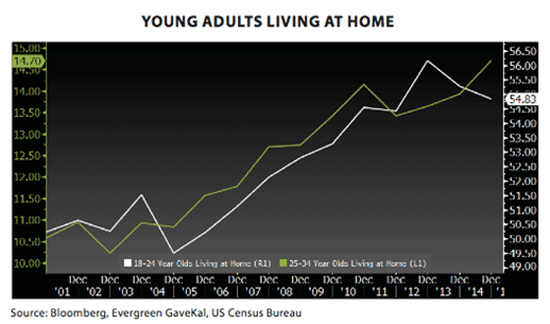
Why Millennials Will Never Grow Up – MarketWatch

“Fully 56% of millennials (compared with 43% of adults overall) with current or past student loans have delayed at least one major life event because of student loan debt, according to a survey of 1,000 adults released Wednesday by Bankrate.com. And a survey of 1,000 current and former students released last year by Citizens Bank came to similar conclusions: Roughly 90% of people ages 18 to 40 (most of this age group is made up of millennials) with student loans say that paying these loans has impacted their day-to-day life, including the achievement of some major life milestones.”

via This is why millennials will never grow up – MarketWatch.

Hint:  student loan debt.

Poisoning Deaths Involving Opioid Analgesics — New York State, 2003–2012

Comparison of opioid analgesic-related mortality between those enrolled or not enrolled in Medicaid shows considerably higher death rates and a more rapid increase in mortality among Medicaid enrollees. The consistently higher age-adjusted death rates for poisonings involving opioid analgesics among Medicaid enrollees (after stratifying data by sex) suggest that differences in age and sex distributions do not underlie these Medicaid/non-Medicaid differences. Other factors, such as the greater prevalence of mental illness and substance abuse in the Medicaid population (6), might contribute to the observed differences.

via Poisoning Deaths Involving Opioid Analgesics — New York State, 2003–2012.

Maybe the title should be Socioeconomic Status and Death.

Austerity Kills: Economic Distress Seen as Culprit in Sharp Rise in Suicide Rate Among Middle Aged – naked capitalism

Austerity Kills: Economic Distress Seen as Culprit in Sharp Rise in Suicide Rate Among Middle Aged | naked capitalism.

Suicide rates for adults between 40 and 64 years of age in the U.S. have risen about 40% since 1999, with a sharp rise since 2007. One possible explanation could be the detrimental effects of the economic downturn of 2007-2009, leading to disproportionate effects on house values, household finances, and retirement savings for that age group. In a study published in the American Journal of Preventive Medicine, researchers found that external economic factors were present in 37.5% of all completed suicides in 2010, rising from 32.9% in 2005.

US Income and Wealth Inequality Facts – FT Alphaville and naked capitalism

Public opinion surveys consistently show pessimistic views of the economy for the broad mass of people. Growing numbers believe the Great Recession led to a permanent change in the economy, which is probably something less than true – with few exceptions, these wage and income trends have been consistent since the late 1970s. But the other questions in this Rutgers poll appear right on the mark. Almost eight in ten Americans knew somebody laid off between 2008-2012. For leading indicators like low unemployment, affordable higher education, and job and retirement security, the majority of Americans think they will never see positive progress for many years. Just 16 percent of respondents thought job and career opportunities would be better for the next generation, a figure nearly four times lower than from 1999.And we can chalk this up to the wisdom of crowds, because the public happens to be right. It is harder to get a job out of college. It is harder to avoid the trap of underemployment. It is harder to prosper in the career you want. It is harder to save amid stagnant wages. It is harder to grow as an economy when the gains flow to the top. It is harder to secure enough reserves for a dignified retirement.

via Fed Survey of Consumer Finances Shows Americans Understand Their Lousy Economic Condition | naked capitalism.

Facts are facts and these are the facts.

The charts are ugly.  But they tell us what we already know.

US income and wealth inequality facts of the day | FT Alphaville.

The Federal Reserve has just released its Survey of Consumer Finances for the year 2013.

These surveys occur every three years, so this is the first comprehensive update we have gotten about the distribution of income and wealth in the US since the economy hit bottom four years ago.

The most striking finding is that the median American family earned 5 per cent less in 2013 than in 2010 after inflation even though the average American family took home 4 per cent more.
Mish’s Global Economic Trend Analysis: Employment Perspective in Pictures: Only 25% of Decline in Fulltime Employment Attributable to Aging Workforce

Mish’s Global Economic Trend Analysis: Employment Perspective in Pictures: Only 25% of Decline in Fulltime Employment Attributable to Aging Workforce.

“The job of the leader isn’t just to make decisions, it’s to make sense.”

John Seely Brown

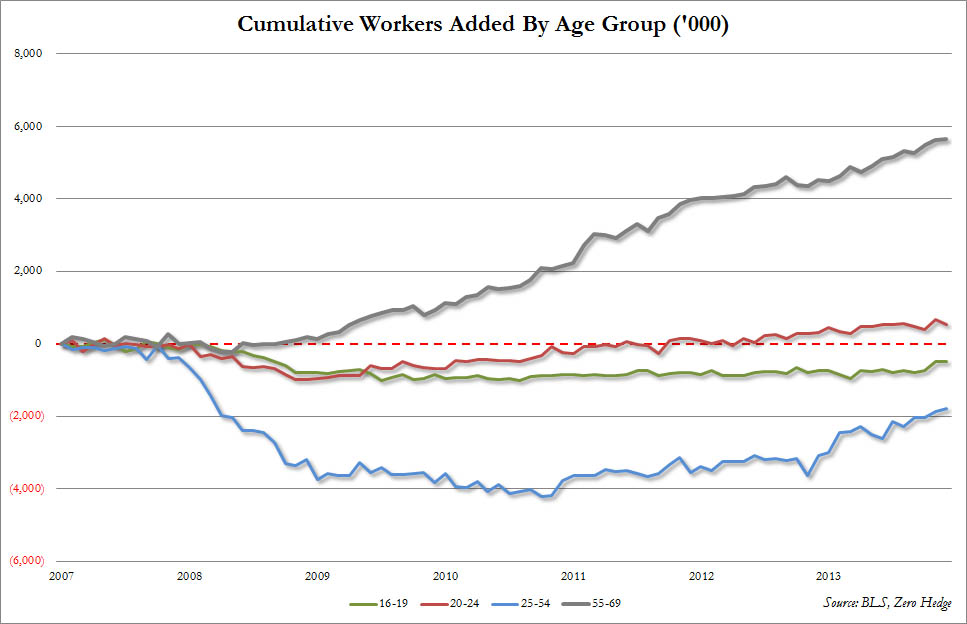
The Scary Charts in Mish’s article paint a vivid picture of where this country and economy are headed.  It’s not a pretty picture.