Think Again About Outsourcing Your Thinking 2.0 (if you can)

Michael Gerlich, head of the Centre for Strategic Corporate Foresight and Sustainability at SBS Swiss Business School, began studying the impact of generative AI on critical thinking because he noticed the quality of classroom discussions decline. Sometimes he’d set his students a group exercise, and rather than talk to one another they continued to sit in silence, consulting their laptops. He spoke to other lecturers, who had noticed something similar. Gerlich recently conducted a study, involving 666 people of various ages, and found those who used AI more frequently scored lower on critical thinking. (As he notes, to date his work only provides evidence for a correlation between the two: it’s possible that people with lower critical thinking abilities are more likely to trust AI, for example.) Like many researchers, Gerlich believes that, used in the right way, AI can make us cleverer and more creative – but the way most people use it produces bland, unimaginative, factually questionable work. Are we living in a golden age of stupidity?https://www.theguardian.com/technology/2025/oct/18/are-we-living-in-a-golden-age-of-stupidity-technology

Yikes.

Scary Charts 10.11.25

Here in the US not bad when compared to South Korea – https://www.statista.com/chart/4101/where-is-pensioner-poverty-the-most-prevalent/

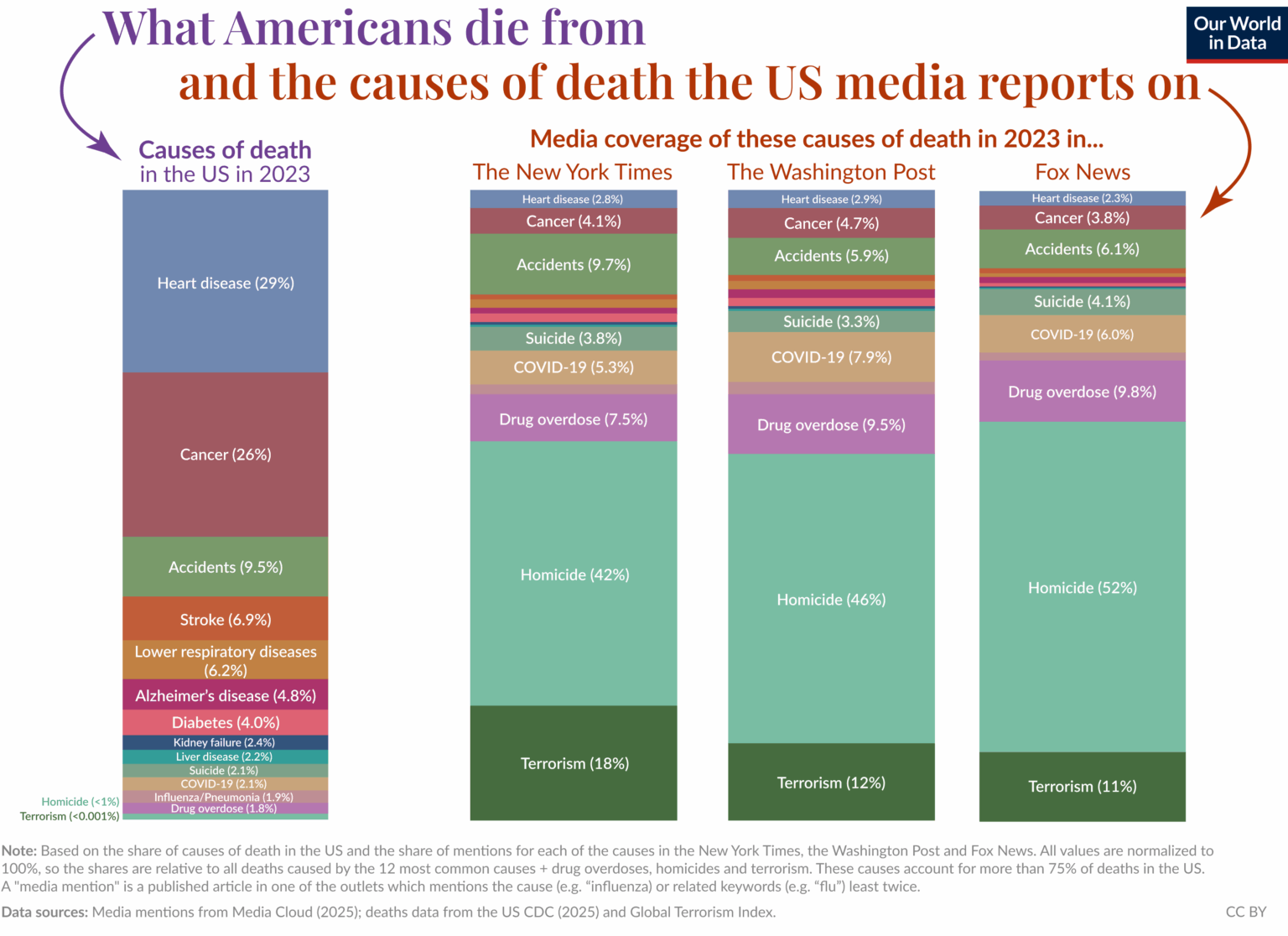
Our World in Data compared causes of death in the United States against how much those causes are covered by the New York Times, Washington Post, and Fox News. The results are about what you would expect, based on coverage data from Media Cloud.

Rarer events, like homicide and drug overdose, are reported more heavily, whereas everyday causes, like cancer and heart disease, are reported less.

Another lesson in not believing everything you read – https://flowingdata.com/2025/10/08/mortality-in-the-news-vs-what-we-usually-die-from/

Think Some More About Outsourcing Your Thinking (if you can)

Artificial Intelligence Breeds Mindless Inhumanity

By Bruce Abramson

July 15, 2025

I began studying AI in the mid-1980s. Unusually for a computer scientist of that era, my interest was entirely in information, not in machines. I became obsessed with understanding what it meant to live during the transition from the late Industrial Age to the early Information Age.  

What I learned is that computers fundamentally alter the economics of information. We now have inexpensive access to more information, and to higher quality information, than ever before. In theory, that should help individuals reach better decisions, organizations devise improved strategies, and governments craft superior policies. But that’s just a theory. Does it? 

The answer is “sometimes.” Unfortunately, the “sometimes not” part of the equation is now poised to unleash devastating consequences. 

Consider the altered economics of information: Scarcity creates value. That’s been true in all times, in all cultures, and for all resources. If there’s not enough of a resource to meet demand, its value increases. If demand is met and a surplus remains, value plummets.  

Historically, information was scarce. Spies, lawyers, doctors, priests, scientists, scholars, accountants, teachers, and others spent years acquiring knowledge, then commanded a premium for their services.  

Today, information is overabundant. No one need know anything because the trusty phones that never leave our sides can answer any question that might come our way. Why waste your time learning, studying, or internalizing information when you can just look it up on demand? 

Having spent the past couple of years working in higher education reform and in conversation with college students, I’ve come to appreciate the power—and the danger—of this question. Today’s students have weaker general backgrounds than we’ve seen for many generations because when information ceased being scarce, it lost all value.  

It’s important to recall how recently this phenomenon began. In 2011, an estimated one-third of Americans, and one-quarter of American teenagers, had smartphones. From there, adoption among the young grew faster than among the general population. Current estimates are that over 90% of Americans, and over 95% of teenagers, have smartphone access. 

Even rules limiting classroom use cannot overcome the cultural shift. Few of today’s college students or recent grads have ever operated without the ability to scout ahead or query a device for information on an as-needed basis. There’s thus no reason for them to have ever developed the discipline or the practices that form the basis for learning.

The deeper problem, however, is that while instant lookup may work well for facts, it’s deadly for comprehension and worse for moral thinking.

A quick lookup can list every battle of WWII, along with casualty statistics and outcome. It cannot reveal the strategic or ethical deliberations driving the belligerents as they entered that battle. Nor can it explain why Churchill fought for the side of good while Hitler fought for the side of evil—a question that our most popular interviewers and podcasters have recently brought to prominence. 

At least, lookup couldn’t provide such answers until recently. New AI systems—still less than three years old—are rushing to fill that gap. They already offer explanations and projections, at times including the motives underlying given decisions. They are beginning to push into moral judgments. 

Of course, like all search and pattern-matching tools, these systems can only extrapolate from what they find. They thus tend to magnify whatever is popular. They’re also easy prey for some of the most basic cognitive biases. They tend to overweight the recent, the easily available, the widely repeated, and anything that confirms pre-conceived models. 

The recent reports of Grok regurgitating crude antisemitic stereotypes and slogans illustrate the technological half of the problem. The shocking wave of terror-supporting actions wracking college campuses and drawing recent grads in many of our cities illustrate the human half. 

The abundance of information has destroyed its value. Because information—facts and data—are the building blocks upon which all understanding must rest, we’ve raised a generation incapable of deep understanding. Because complex moral judgments build upon comprehension, young Americans are also shorn of basic morality 

We are rapidly entering a world in which widespread access to voluminous information is producing worse—not better—decisions and actions at all levels. We have outsourced knowledge, comprehension, and judgment to sterile devices easily biased to magnify popular opinion. We have bred a generation of exquisitely credentialed, deeply immoral, anti-intellectuals on the brink of entering leadership. 

When the ubiquity of instant lookup evolves beyond basic facts and into moral judgments, banal slogans and mindless cruelty will come to rule our lives.  

Is there a way out of this morass?  Perhaps the only one that the ancients discovered back when information, understanding, and morality all retained immense value: faith in a higher power. Because the path we’ve set on our own is heading into some very dark places. 

This article was originally published by RealClearScience and made available via RealClearWire.

Clearing Up Myths About Older Workers

In 2001, only about 1 out of every 7 U.S. workers was 55 or older. By 2021, the number jumped to almost 1 out of every 4 workers (a 93% increase). That’s almost twice the proportion of older workers as before.3 Older workers are staying on the job longer for various reasons, ranging from financial needs to the joy of work.  More people are working past the age when they might have retired. They might be responding to the increase in the Social Security full retirement age, needing money or health insurance, or simply enjoying their jobs and being around their friends at work.⁴ Clearing Up Myths About Older Workers While Understanding and Supporting an Aging Workforcehttps://blogs.cdc.gov/niosh-science-blog/2023/09/25/older-workers/

I just learned I have a high level of Crystallized intelligence. https://en.wikipedia.org/wiki/Fluid_and_crystallized_intelligence

I’ve Been in Physical Therapy For Over Three Months

Less is more.

We’ve turned the idea of “exercise” into something so loaded these days, only to be validated by a specific kind of intensity. Just uttering the word exercise now can ignite an all-or-nothing mindset, filled with protein obsessions, endless wearable fitness trackers, or even a costly membership to an elite wellness club. I Won’t Be Shamed — Physical Therapy Is Still Exercisehttps://www.popsugar.com/fitness/physical-therapy-still-a-workout-49448831

I used to be a runner. Quite a few years ago my knees told me not to run anymore.

I joined the Y and did the elliptical and treadmills until my knees complained some more. I moved my exercise routine to the resistance machines. Then Covid hit, I cancelled my membership and the months turned into years away from the gym.

I found some resistance bands in the house and started some simple exercises at home. I rejoined the Y and started back with the resistance machines.

Earlier this year my employer offered access to online virtual physical therapy. I took advantage of this benefit from https://www.hingehealth.com/ and have been in physical therapy now for over three months. Less pain (especially my cervical spine, the result of a near fatal encounter with a car), less stiffness, better flexibility, and gradually improving strength. The beauty of the program is availability on demand and it is 100% HEP (home exercise program). Sessions are 10-12 minutes long and you don’t have to leave the house.

Less is more.

Tsundoku (guess the disease)

“All those books you haven’t read are indeed a sign of your ignorance. But if you know how ignorant you are, you’re way ahead of the vast majority of other people.” Jessica Stillman

Tsundoku is the Japanese word for the stack(s) of books you’ve purchased but haven’t read. Its morphology combines tsunde-oku (letting things pile up) and dokusho (reading books). The Japanese call this practice tsundoku, and it may provide lasting benefits — https://bigthink.com/neuropsych/do-i-own-too-many-books/

Thinking Styles – What’s Your Style?

Read this thinking style pyramid and refer back to it as often as needed.

This image has an empty alt attribute; its file name is screenshot-2025-04-26-074800.png

We are all suckers for click bait. I started with this:

Older Adults Face Higher Cancer Risk From Alcohol, Even at Low or Moderate Levelshttps://www.medscape.com/viewarticle/older-adults-face-higher-cancer-risk-alcohol-even-low-or-2025a

Scary stuff if you’re an older adult! I should STOP DRINKING ALCOHOL.

But what if this study is wrong? See pyramid above. Sensing bias in the article I took a look at the comments. Dr. Bradley Fawkes’ comment was noteworthy. In the results section of the study you’ll find this:

“While no associations were found for low- or moderate-risk drinking patterns vs occasional drinking among individuals without socioeconomic or health-related risk factors…” Alcohol Consumption Patterns and Mortality Among Older Adults With Health-Related or Socioeconomic Risk Factors – https://jamanetwork.com/journals/jamanetworkopen/fullarticle/2822215

So in the absence of socioeconomic or health-related risk factors no associations were found.

Cheers!