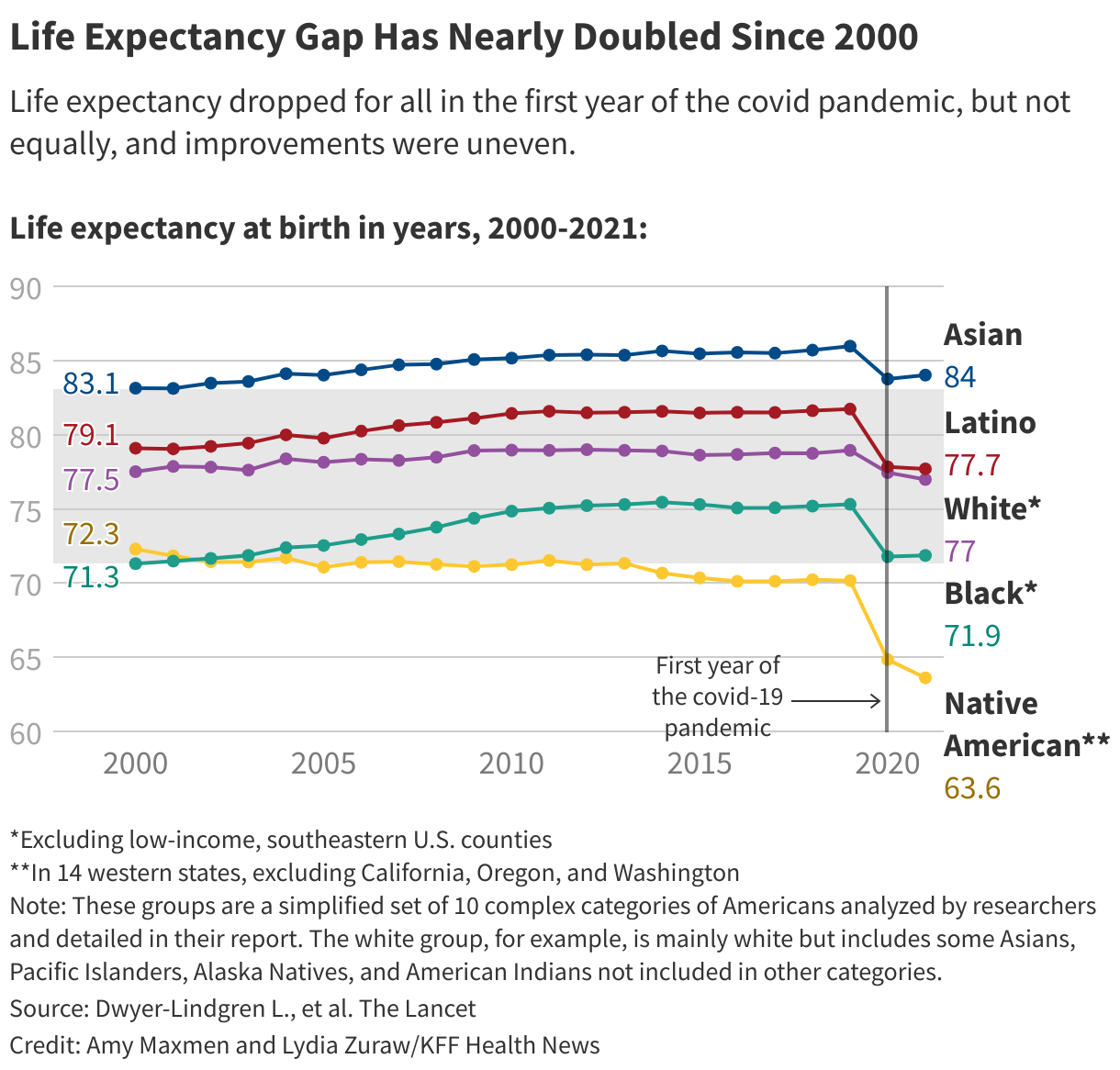
Asians and Native Hawaiian or Pacific Islanders definitively outlive other Americans. Is there anything we can learn from them? A confluence of factors may be at play. They tend to have relatively higher socioeconomic status, lower rates of obesity, and the lowest smoking rates of any racial group in the U.S. Healthier traditional cooking may also contribute to their longevity. When it comes to life expectancy, there are 10 Americas – https://bigthink.com/health/ten-americas-for-life-expectancy/
Attention Mortality Risk Experts
Sharpen your pencils and don’t ask me what a pencil is.
Caroline Apovian, MD, co-director of the Center for Weight Management and Wellness at Brigham and Women’s Hospital and professor of medicine at Harvard Medical School, Boston.
“Doctors who are obesity medicine specialists like myself in academic centers do not prescribe compounded semaglutide or tirzepatide,” she said.
Many of the compounded prescriptions, she said, come from telehealth virtual–only companies interested in profits.
To be clear, all of my GLP-1 posts are not anti-pharma. If you can afford these medications and they work for you on your weight loss journey that’s great. Just be aware of the possible side effects and the fact these medications are for life. You will regain all that you’ve lost if you stop taking the drug.
New cultivation methods are making psychedelic mushrooms stronger, and fiendishly potent varieties are kicking in faster and lasting longer—even if you eat only a fraction of what you would with another variety. Psychedelic Mushrooms Are Getting Much, Much Stronger – https://www.wired.com/story/breeding-stronger-magic-mushrooms/
Have a nice trip. When you see God tell her I said hello.
We identified an association between alcohol consumption and nocturnal leg cramps among patients aged 60 years and older attending general practices. These findings have implications for the prevention of cramps. Association Between Alcohol Consumption and Nocturnal Leg Cramps in Patients Over 60 Years Old: A Case-Control Study – https://www.ncbi.nlm.nih.gov/pmc/articles/PMC6037509
Add this to the list of things that happen when you get older.
I briefly considered medical school when I was in my 20’s. I never considered medical school when I was in my 60’s. Wonderful story. A very impressive human being.
Retirement doesn’t just raise financial concerns – it can also mean feeling unmoored and irrelevant
Published: August 29, 2024 8:49am EDT
Author
Marianne Janack John Stewart Kennedy Professor of Philosophy, Hamilton College
Disclosure statement
Marianne Janack does not work for, consult, own shares in or receive funding from any company or organization that would benefit from this article, and has disclosed no relevant affiliations beyond their academic appointment.
But this might not be the biggest problem that potential retirees face. The deeper issues of meaning, relevance and identity that retirement can bring to the fore are more significant to some workers.
Work has become central to the modern American identity, as journalist Derek Thompson bemoans in The Atlantic. And some theorists have argued that work shapes what we are. For most people, as business ethicist Al Gini argues, one’s work – which is usually also one’s job – means more than a paycheck. Work can structure our friendships, our understandings of ourselves and others, our ideas about free time, our forms of entertainment – indeed our lives.
I teach a philosophy course about the self, and I find that most of my students think of the problems of identity without thinking about how a job will make them into a particular kind of person. They think mostly about the prestige and pay that come with certain jobs, or about where jobs are located. But when we get to existentialist philosophers such as Jean-Paul Sartre and Simone de Beauvoir, I often urge them to think about what it means to say, as the existentialists do, that “you are what you do.”
Don’t let yourself be misled. Understand issues with help from experts
How you spend 40 years of your life, I tell them, for at least 40 hours each week – the time many people spend at their jobs – is not just a financial decision. And I have come to see that retirement isn’t just a financial decision, either, as I consider that next phase of my life.
Usefulness, tools and freedom
For Greek and Roman philosophers, leisure was more noble than work. The life of the craftsperson, artisan – or even that of the university professor or the lawyer – was to be avoided if wealth made that possible.
The good life was a life not driven by the necessity of producing goods or making money. Work, Aristotle thought, was an obstacle to the achievement of the particular forms of excellence characteristic of human life, like thought, contemplation and study – activities that express the particular character of human beings and are done for their own sake.
And so, one might surmise, retirement would be something that would allow people the kind of leisure that is essential to human excellence. But contemporary retirement does not seem to encourage leisure devoted to developing human excellence, partly because it follows a long period of making oneself into an object – something that is not free.
German philosopher Immanuel Kant distinguished between the value of objects and of subjects by the idea of “use.” Objects are not free: They are meant to be used, like tools – their value is tied to their usefulness. But rational beings like humans, who are subjects, are more than their use value – they are valuable in their own right, unlike tools.
And yet, much of contemporary work culture encourages workers to think of themselves and their value in terms of their use value, a change that would have made both Kant and the ancient Greek and Roman philosophers wonder why people didn’t retire as soon as they could.
But as one of my colleagues said when I asked him about retirement: “If I’m not a college professor, then what am I?” Another friend, who retired at 59, told me that she does not like to describe herself as retired, even though she is. “Retired implies useless,” she said.
So retiring is not just giving up a way of making money; it is a deeply existential issue, one that challenges one’s idea of oneself, one’s place in the world, and one’s usefulness.
One might want to say, with Kant and the ancients, that those of us who have tangled up our identities with our jobs have made ourselves into tools, and we should throw off our shackles by retiring as soon as possible. And perhaps from the outside perspective, that’s true.
But from the participant perspective, it’s harder to resist the ways in which what we have done has made us what we are. Rather than worry about our finances, we should worry, as we think about retirement, more about what the good life for creatures like us – those who are now free from our jobs – should be.
At the age of fifty I began the process of becoming what I wanted to be. I had known for a long time that I was a teacher and that the vehicle for my teaching would be in my writing. I also came to the conclusion I would never be compensated well enough through writing to support myself and my family. So I got good at something else.
That something else has and continues to provide a good living.
What I do is who I am and who I am is what I do. No existential crisis here.
For some, it can be dangerous. In the past few years, reports have swelled of people, especially teens, experiencing short- and long-term “marijuana-induced psychosis,” with consequences including hospitalizations for chronic vomiting and auditory hallucinations of talking birds. Multiple studies have drawn a link between heavy use of high-potency marijuana, in particular, and the development of psychological disorders, including schizophrenia, although a causal connection hasn’t been proved. “It’s entirely possible that this new kind of cannabis—very strong, used in these very intensive patterns—could do permanent brain damage to teenagers because that’s when the brain is developing a lot,” Keith Humphreys, a Stanford psychiatry professor and a former drug-policy adviser to the Obama administration, told me. Humphreys stressed that the share of people who have isolated psychotic episodes on weed will be “much larger” than the number of people who end up permanently altered. But even a temporary bout of psychosis is pretty bad. Marijuana Is Too Strong Now – https://www.theatlantic.com/ideas/archive/2024/08/high-potency-marijuana-regulation/679639/
You must be logged in to post a comment.