Remote Work – Not The Norm

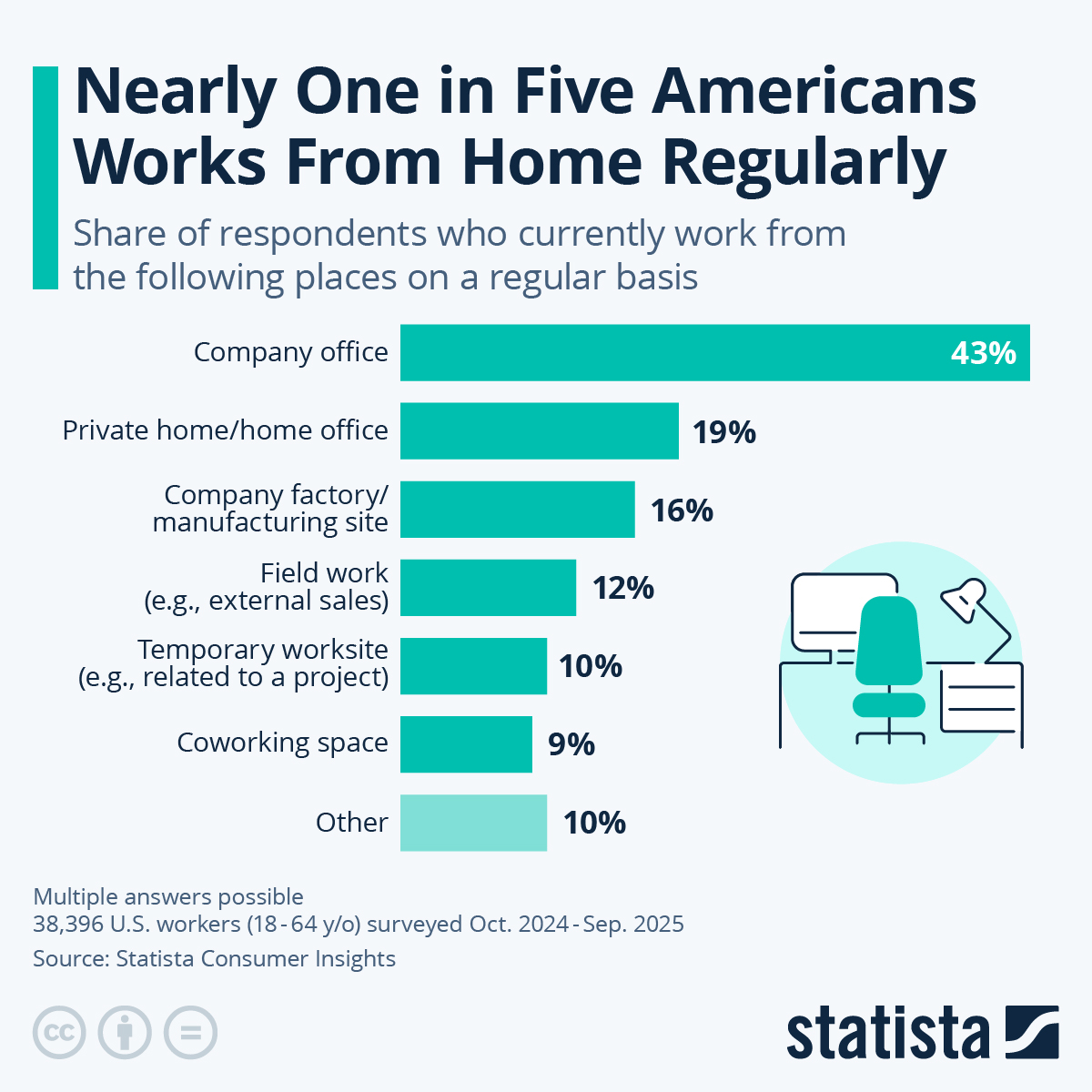
Nearly One in Five Americans Works From Home Regularlyhttps://www.statista.com/chart/35389/regular-remote-and-home-office-work/

I started writing my journal in 2005. One of the best things about keeping a journal is the ability to verify if memories from the past are accurate or the made up, mashups your brain creates as memories. Here’s my entry on Monday July 24 2006:

A 4:00 PM meeting with the Division head with an HR rep present is never a good thing. I immediately thought to myself:

“This is gonna suck.”

And it did, big time. I got whacked today.

And that’s how my WFH life began. When my work from home situation arises in conversation most are surprised to learn I’ve been WFH this long. I’m surprised how long I’ve been working from home!

I am convinced due to having a low stress working environment, better diet (NO office snacks/free food/lunches out), no commute, along with a host of other variables I just might be increasing my lifespan. I do know I get plenty of sleep on a regular routine basis.

Short sleep duration (< 7 h per night) was associated with a 14% increase in mortality risk compared to the reference of 7–8 h, with a pooled hazard ratio of 1.14 (95% CI 1.10 to 1.18). Conversely, long sleep duration (≥ 9 h per night) was associated with a 34% higher risk of mortality, with a hazard ratio of 1.34 (95% CI 1.26 to 1.42). Sex-specific analyses indicated that both short and long sleep durations significantly elevated mortality risk in men and women, although the effect was more pronounced for long sleep duration in women. Both short and long sleep durations are associated with increased all-cause mortality, though the degree of risk varies by sex. Imbalanced sleep increases mortality risk by 14–34%: a meta-analysis – Ungvari, Z., Fekete, M., Varga, P. et al. Imbalanced sleep increases mortality risk by 14–34%: a meta-analysis. GeroScience 47, 4545–4566 (2025). https://doi.org/10.1007/s11357-025-01592-y
Would You Pay $700.00 a Month to Live in One of These?

Brownstone, by virtue of renting cheaply in a city with sky-high prices and a dearth of new housing, has received thousands of applications for its $700-a-month pods over the past few years, Stallworth said. He thinks there’s at least “10,000 people probably interested in being in San Francisco at any time” and pointed to the tens of thousands of applications that Y Combinator, a local startup incubator, has received in recent years.(Startup founders make up a sizable share of the Mint Plaza building’s residents, Stallworth said.) Startup behind $700-a-month bed ‘pods’ wants to put 10,000 more in San Franciscohttps://www.sfgate.com/tech/article/startup-bed-pods-san-francisco-21029460.php

I keep telling The Boss all I’m trying to do is to make our retirement income last as long as we last.

Rejected. Again.

How To Reduce Your Risk of Developing Diabetes

The researchers, from 23 universities in Spain and Harvard Chan School, split 4,746 PREDIMED-Plus participants into an intervention group and a control group and followed their health outcomes for six years. The intervention group adhered to a Mediterranean diet; reduced their caloric intake by about 600 calories per day; engaged in moderate physical activity, such as brisk walking and strength and balance exercises; and received professional support for weight loss control. The control group adhered to a Mediterranean diet without calorie restriction, exercise guidance, or professional support. Participants ranged from age 55 to 75, were overweight or obese, and had metabolic syndrome, but were free of T2D at baseline.

The study found that those in the intervention group had a 31% lower risk of developing T2D compared to those in the control group. Additionally, the intervention group lost an average of 3.3 kilograms and reduced their waist circumference by 3.6 centimeters, compared to 0.6 kilograms and 0.3 centimeters in the control group. Scientists found 3 simple tweaks that cut diabetes risk by 31%https://www.sciencedaily.com/releases/2025/08/250829022835.htm Harvard T.H. Chan School of Public Health. ScienceDaily. http://www.sciencedaily.com/releases/2025/08/250829022835.htm (accessed August 29, 2025).

Guess I’ll cut out beer.

One Toke Over the Line

A wave of recent research points to reasons for concern for older users, with cannabis-related emergency room visits and hospitalizations rising, and a Canadian study finding an association between such acute care and subsequent dementia. Older people are more apt than younger ones to try cannabis for therapeutic reasons: to relieve chronic pain, insomnia, or mental health issues, though evidence of its effectiveness in addressing those conditions remains thin, experts said. As Cannabis Users Age, Health Risks Appear To Grow https://kffhealthnews.org/news/article/cannabis-medical-use-older-adults-health-risks/

Then…

And now…

“Our brains are more sensitive to psychoactive substances as we age.” Dr. Benjamin Han

Don’t you know I’m just waiting for the train that goes home, sweet Mary.

Thinking Styles – What’s Your Style?

Read this thinking style pyramid and refer back to it as often as needed.

This image has an empty alt attribute; its file name is screenshot-2025-04-26-074800.png

We are all suckers for click bait. I started with this:

Older Adults Face Higher Cancer Risk From Alcohol, Even at Low or Moderate Levelshttps://www.medscape.com/viewarticle/older-adults-face-higher-cancer-risk-alcohol-even-low-or-2025a

Scary stuff if you’re an older adult! I should STOP DRINKING ALCOHOL.

But what if this study is wrong? See pyramid above. Sensing bias in the article I took a look at the comments. Dr. Bradley Fawkes’ comment was noteworthy. In the results section of the study you’ll find this:

“While no associations were found for low- or moderate-risk drinking patterns vs occasional drinking among individuals without socioeconomic or health-related risk factors…” Alcohol Consumption Patterns and Mortality Among Older Adults With Health-Related or Socioeconomic Risk Factors – https://jamanetwork.com/journals/jamanetworkopen/fullarticle/2822215

So in the absence of socioeconomic or health-related risk factors no associations were found.

Cheers!

Obesity is Not a Disease

David L. Katz, MD, MPH, FACPM, FACP, FACLM is a specialist in Internal Medicine, Preventive Medicine/Public Health, and Lifestyle Medicine – globally recognized for expertise in chronic disease prevention, health promotion, and nutrition. The founding director of Yale University’s Prevention Research Center, and past president of the American College of Lifestyle Medicine, Katz is the founder of the non-profit True Health Initiative, founder of Diet ID, and Chief Medical Officer for leading food-as-medicine company, Tangelo. He is a senior science advisor to Blue Zones. He holds multiple US patents, including for advances in dietary assessment. He has roughly 250 peer-reviewed publications, has authored 19 books- including multiple editions of a leading textbooks in nutrition and preventive medicine, and has earned numerous awards for his contributions to public health, including three honorary doctoral degrees.

https://www.vumedi.com/video/obesity-is-not-a-disease-so-what-is-it

Diet until proven otherwise.

Heart Attacks Happen in the Young

Dr Ravi Prakash, senior consultant in cardiology at PSRI Hospital, Delhi, said that data from hospitals across India between 2020 and 2023 show that 50% of heart attack patients are below the age of 40. Doctors and researchers are alarmed by the growing number of cardiac arrests among individuals under 40 years of age. Experts attribute this rise to sedentary lifestyle, stress, poor diet, smoking, alcohol consumption, and even genetic factors. 50% of heart attack cases since 2020 among adults below 40https://www.newindianexpress.com/amp/story/xplore/2025/Feb/24/50-of-heart-attack-cases-since-2020-among-adults-below-40

Prevention of MI in young individuals is an important public health problem. Despite being categorized as “low risk” prior to their events, most young individuals who experience an MI have pre-existing risk factors, such as obesity, diabetes, hypertension, and hyperlipidemia. Tobacco use, which occurs in approximately 50% of young adults who experience an MI, remains one of the most important modifiable risk factors. Additionally, substance abuse, tobacco use, diabetes, left ventricular systolic dysfunction, and systemic inflammatory disease are all associated with a worse long-term prognosis in those who experience an MI at a young age. Not All Heart Attacks are Created Equal: Thinking Differently About Acute Myocardial Infarction in the Younghttps://journal.houstonmethodist.org/articles/10.14797/mdcvj.345

Yikes.

Lisdexamfetamine Dimesylate (not just for ADHD anymore)

Llisdexamfetamine dimesylate is currently the only drug to be approved in the USA for the treatment of moderate to severe binge eating disorder (BED) in adult patients. – https://pubmed.ncbi.nlm.nih.gov/29134566/

Just a few side effects BTW.

The prescribing information also includes warnings and precautions regarding serious cardiovascular reactions, blood pressure and heart rate increases, psychiatric adverse reactions, suppression of growth, peripheral vasculopathy (reduced circulation of blood flow to body parts), and serotonin syndrome (a potentially life-threatening overage of serotonin). Please see Vyvanse’s full prescribing information for additional details.

The most common side effects in children, adolescents and/or adults with ADHD taking lisdexamfetamine dimesylate capsules and chewable tablets were anorexia, anxiety, decreased appetite, decreased weight, diarrhea, dizziness, dry mouth, irritability, insomnia, nausea, upper abdominal pain, and vomiting. The most common side effects in adults with BED were dry mouth, insomnia, decreased appetite, increased heart rate, constipation, feeling jittery, and anxiety. https://www.fda.gov/drugs/news-events-human-drugs/fda-approves-multiple-generics-adhd-and-bed-treatment

Take Home Lesson for Life Underwriters

Know your drugs and read the prescription DB reports. You’re welcome.

Low Serum Levels of 3 Carotenoids Linked to Increased Risk for Migraine

The cross-sectional study, which was performed on a nationally representative United States cohort, indicated an inverse association between serum carotenoid levels and migraine risk in adults. https://www.clinicalpainadvisor.com/news/low-serum-levels-of-3-carotenoids-linked-to-increased-risk-for-migraine/

α-Carotene, β-Carotene, β-Cryptoxanthin, Lycopene, Lutein, and Zeaxanthin – https://lpi.oregonstate.edu/mic/dietary-factors/phytochemicals/carotenoids

Yum.