
Negative Transfer of Training
I recently upgraded my computer to a Gateway with an Intel Quad core CPU running the Windows Vista Home Premium 64-bit OS. Here is what I’ve learned:
- Parallel ports aren’t supported anymore. I can’t use Old Faithful, my ancient laser printer.
- A number of my older software programs won’t run on a 64-bit OS.
- The meaning of the phrase “negative transfer of training”
My primary machine got nailed with a nasty virus a few months ago and I’d been working with my hot spare backup. Just as I was getting used to working with Windows XP I am now having to learn how to use Vista. I began having a negative transfer of training experience.
It’s been a few days and I’m better now. I like my new computer. One major plus is the computer came with a set of recovery disks. I used these to configure my old machine which now becomes my hot spare. Same setup as my primary machine. When I need to use it, I’ll load up my programs and data and I’m good to go.
Note I said “when” not “if”.
Outsourcing is Not a Four Letter Word
I read this online Business Week article and I thought I was reading about myself. If I were to add my thoughts, I’d add:
- Live where you want to live (provided you have a decent Internet connection)
- Enjoy flexibility of schedule
- No corporate politics or non-productive meetings
- Meet and work with interesting intelligent humans
- Enjoy a different kind of stress.
Outsourcing Benefits U.S. Workers, Too – BusinessWeek
For the project workers who log in to oDesk every day to create their own job with decent pay, outsourcing is a wonderful thing—be it in Wyoming or New Delhi. Some have been forced from full-time jobs but many simply prefer to go it alone or to work with small groups. Scarred by a barrage of layoffs in recent years, these workers like the control over their lives and diversity in the source of paychecks.
Employer Provided Training – What Training?
Copied shamelessly from Workforce Training Management e-newsletter.
| METRICS Formal Training Hours Consumed per Learner, by Industry, 2007 and 2008 Bersin & Associates reports that the drops in formal training hours from 2007 to 2008 is not necessarily a bad thing. “For smart companies, this means that they are cutting programs that are generic, low value and under-utilized,” analyst Karen O’Leonard writes. “We have talked with several organizations that are now carefully scrutinizing the value of their learning programs, some by employing cost-benefit analyses to their initiatives. Their analyses have led them to cancel some programs that were costly to run and offered relatively low value.” |
| Industry |
2007 |
2008 |
| Pharmaceuticals | 35.3 | 25.2 |
| Banking/finance * | n/a | 20.2 |
| Manufacturing | 29.4 | 19.5 |
| Business services/consulting | n/a | 19.1 |
| Telecommunications | 31.7 | 18.9 |
| Banking/financial services & insurance * | 28.0 | 18.8 |
| Insurance* | n/a | 16.8 |
| Retail | 14.0 | 15.3 |
| Technology | 21.9 | 14.3 |
| Health care/medical | 24.0 | 14.1 |
| * In 2007, small sample size required that insurance industry results be combined with those of banking and financial services. For 2008, there was a large enough sample of banking /financial services and insurance companies to break them out. The individual industries’ data are shown, as well as the combined category. |
| Source: “Corporate Learning Factbook,” 2009, Bersin & Associates |
Financial Underwriting – Yes, It Matters
Unable To Sell Homes, Brokers Turn To Arson
This a sad article about the real estate bust, arson, and insurance fraud.
Pay attention to financial underwriting. I suspect there will be more sad stories like this in the future.
Risk Factors for Aortic Stenosis
Valturna – Think HTN
Once again, where do they get these names?
1.1 Million Suicide Attempts
Click on the link to read the article. Within the article you will find a link to download the full study report.
Scary Chart of the Day – September 16, 2009
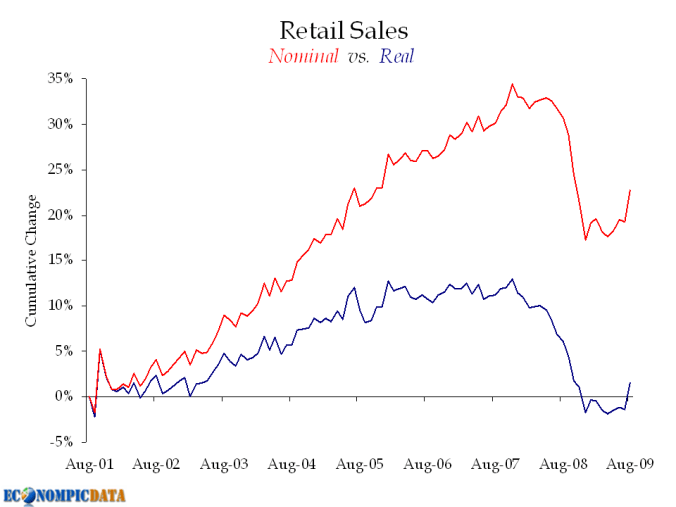
Kind of puts a different perspective on retail sales figures, no?
EconomPic: Retail Sales in Perspective
MEOS 3Q US
Follow the link to download the full Manpower Employment Outlook Survey.
I did.
For the third consecutive quarter, two thirds of survey respondents anticipate no change in hiring.
What recovery?


You must be logged in to post a comment.