Epidemiologic research suggests that cannabis use may be a significant risk factor for psychotic disorders. A meta-analysis of longitudinal studies estimated that lifetime cannabis users had an odds ratio of 2.58 (95% CI 1.08–6.13) for psychotic disorders compared to non-users (Moore et al., Reference Moore, Zammit, Lingford-Hughes, Barnes, Jones, Burke and Lewis2007). Another meta-analysis found an odds ratio of 3.90 (95% CI 2.84–5.34) for psychotic disorders among the most frequent cannabis users compared to non-users, suggesting dose–response (Marconi, Di Forti, Lewis, Murray, & Vassos, Reference Marconi, Di Forti, Lewis, Murray and Vassos2016). Whether cannabis use is causally related to psychotic disorders continues to be debated, with recent genetic studies raising uncertainty about the directionality of the relationship and the magnitude of association (Ganesh & D’Souza, Reference Ganesh and D’Souza2022; Gillespie & Kendler, Reference Gillespie and Kendler2021).
This study provides new evidence of a strong but age-dependent association between cannabis use and risk of psychotic disorder, consistent with the neurodevelopmental theory that adolescence is a vulnerable time to use cannabis. The strength of association during adolescence was notably greater than in previous studies, possibly reflecting the recent rise in cannabis potency. Age-dependent association of cannabis use with risk of psychotic disorder Psychological Medicine , First View , pp. 1 – 11 https://doi.org/10.1017/S0033291724000990
Adolescence
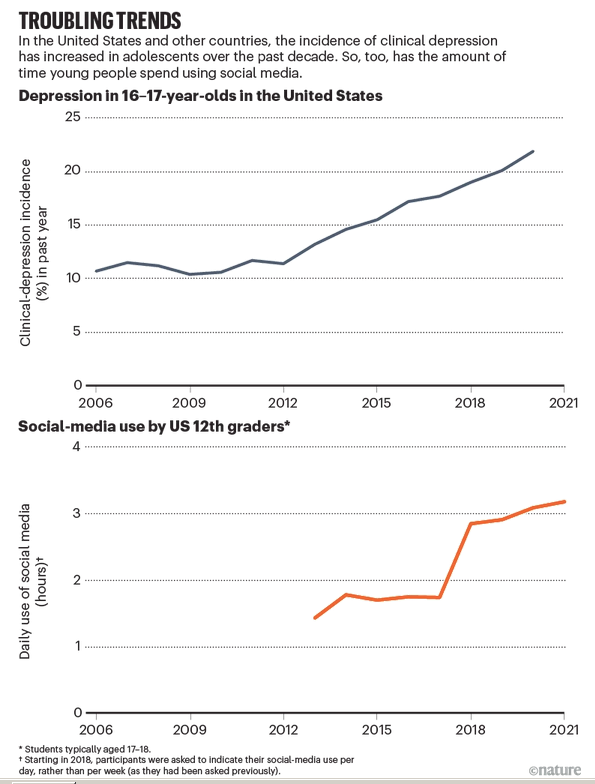
Troubling Trends
Early adolescence is characterized by wide-reaching hormonal changes, as well as physiological changes throughout the body. At the same time, all sorts of neural, cognitive and social shifts are happening. These changes could make social-media environments, such as those provided by Snapchat or TikTok, particularly alluring, but also especially impactful on mental health9–11. Several developmental-psychology studies have shown, for instance, that adolescents — particularly those in early to mid-adolescence — place increased importance on being able to interact with their peers, and on what their peers think of them12. Other studies suggest that although young children tend to view themselves positively, as they become adolescents, their ideas about themselves come to more closely align with what they perceive others to think of them13,14. Still more work has shown that being rejected or not being included has a greater impact on mood for those in early to mid-adolescence than for people older than 2515.
How social media affects teen mental health: a missing link — Nature 614, 410-412 (2023) — https://www.nature.com/articles/d41586-023-00402-9
I Thought I Told You To Put That Phone Down!
If I have to tell you one more time to Put The Phone Away…
Yikes!
 lifeunderwriter.net
You must be logged in to post a comment.