Scary Charts 10.11.25

Here in the US not bad when compared to South Korea – https://www.statista.com/chart/4101/where-is-pensioner-poverty-the-most-prevalent/

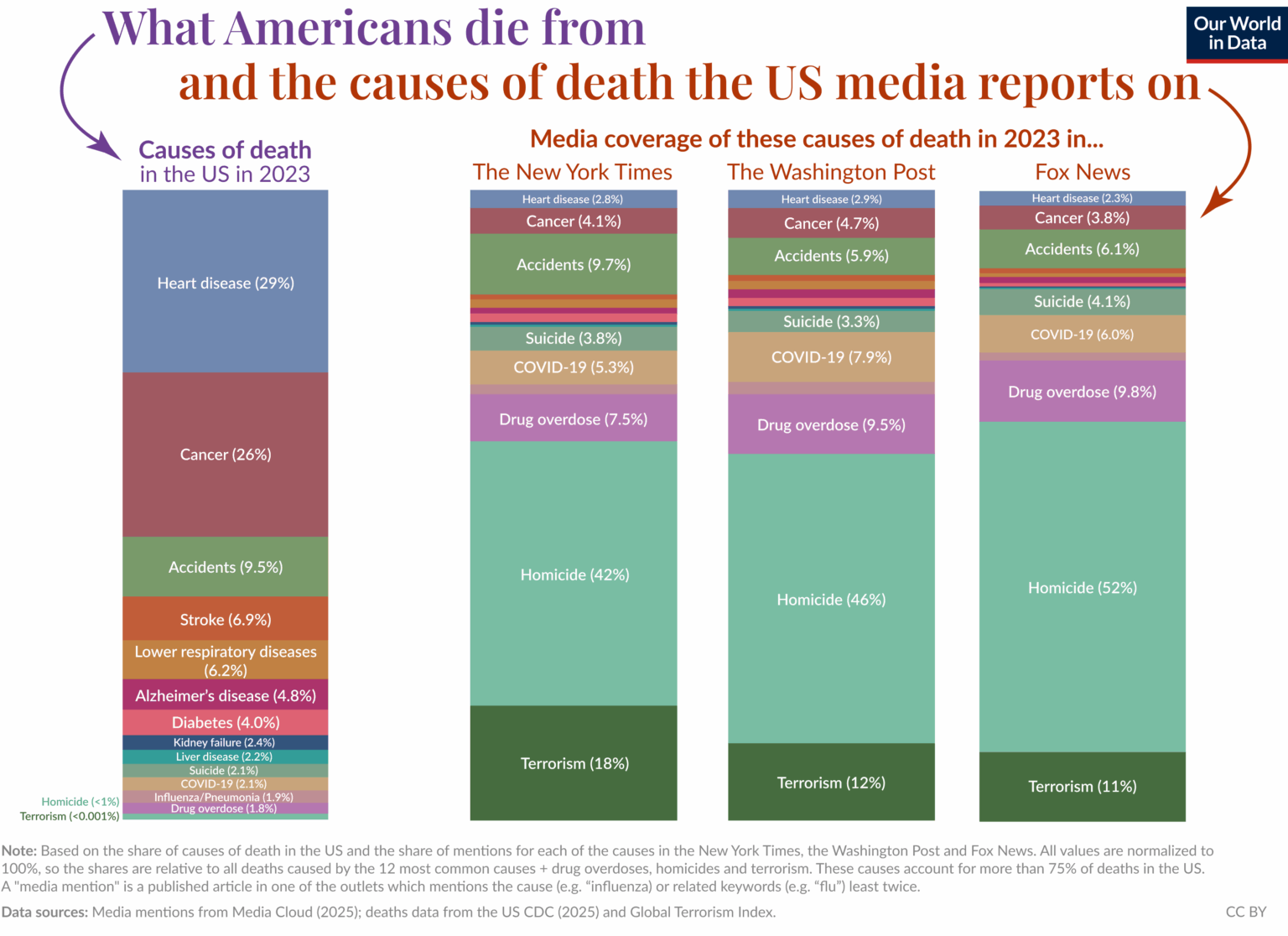
Our World in Data compared causes of death in the United States against how much those causes are covered by the New York Times, Washington Post, and Fox News. The results are about what you would expect, based on coverage data from Media Cloud.

Rarer events, like homicide and drug overdose, are reported more heavily, whereas everyday causes, like cancer and heart disease, are reported less.

Another lesson in not believing everything you read – https://flowingdata.com/2025/10/08/mortality-in-the-news-vs-what-we-usually-die-from/

Random Thoughts on Retirement and Longevity – Can Remote Work Delay Retirement?

The mortality impact is interesting

The Journal of Epidemiology and Community Health found that those who worked just a year beyond retirement age had a 9% to 11% lower risk of dying during the 18 years the research covered, regardless of health. Could Remote Work Delay Your Retirement? https://www.kiplinger.com/retirement/retirement-planning/could-remote-work-delay-your-retirement

If you only eat “superfoods” will you have a long life?

“There is no single secret to living a long, healthy life.” Salvatore Di Somma, MD. Sanford Burnham Prebys. “A long and ongoing look at the secrets of human longevity and healthy aging.” ScienceDaily – https://www.sciencedaily.com/releases/2025/05/250505171023.htm

Coffee

All coffee types decrease the risk of adverse clinical outcomes in chronic liver disease: a UK Biobank study

Kennedy, O.J., Fallowfield, J.A., Poole, R. et al. BMC Public Health 21, 970 (2021) – https://bmcpublichealth.biomedcentral.com/articles/10.1186/s12889-021-10991

Movement is medicine

Being consistently physically active in adulthood is linked to a 30–40% lower risk of death from any cause in later life, while upping levels from below those recommended for health is still associated with a 20–25% lower risk, finds a pooled data analysis of the available evidence, published online in the British Journal of Sports Medicine. It’s never too late: Just moving more could add years to your lifehttps://www.sciencedaily.com/releases/2025/07/250711224321.htm

Whiskey

University of California neurologist Claudia Kawas and her team have been studying the lifestyle habits of people who live until their 90s. The group has been researching people of this age group for some 15 years – and they have found that those who drank two units of alcohol every day were less likely to die prematurely.“I have no explanation for it, but I do firmly believe that modest drinking improves longevity,” Kawas said. – Whiskey makes you live a longer, healthier lifehttps://www.irishcentral.com/culture/food-drink/whiskey-live-longer-healthier

Loneliness

Now, however, new research is calling into question this long-held belief and, surprisingly, found that loneliness may not be quite the threat that we all once thought it was. In fact, the problem may be one of confusing cause and effect. The Surprising Truth About Loneliness and Longevityhttps://www.kiplinger.com/retirement/the-surprising-truth-about-loneliness-and-longevity

Loneliness is pervasive in home care settings across the 3 countries; however, its association with mortality differs from reports for the general population. Loneliness was not associated with an increased risk of death after adjusting for health-related covariates. The causal order between changes in health, loneliness, and mortality is unclear. For example, loneliness may be a consequence of those health changes rather than their cause. Cross-National Evidence on Risk of Death Associated with Loneliness: A Survival Analysis of 1-Year All-Cause Mortality among Older Adult Home Care Recipients in Canada, Finland, and Aotearoa | New Zealandhttps://www.sciencedirect.com/science/article/pii/S152586102500204X

The Mortality Effects of Retirement

WSJ: What do the numbers show?

DR. FITZPATRICK: There’s a sizable, 2% increase in male mortality at age 62 in the U.S. Over the 34 years we studied, there were an additional 400 to 800 deaths per year beyond what we expected, or an additional 13,000 to 27,000 excess male deaths within 12 months of turning 62. That 2% is 2 of every 100 men in the whole male population who turn 62. We really think these deaths are concentrated among the 10% of men who retire at 62, so instead of 2 in 100, it’d be 2 in 10. So, the increase in the probability of death for men who retire could be as high as 20%. I actually think that’s a pretty big deal.

You can find the original WSJ article at this link. 

If you can’t get past the firewall or if you want to read the original study go here.

    Social Security eligibility begins at age 62.
    1/3 of Americans immediately claim benefits upon reaching this age.
    There is a discontinuous increase in male mortality at age 62 of 2%.
    This increase in mortality is closely connected to changes in labor force participation.
    Our results suggest mortality rises because men retire once Social Security is available.