In the Argentine capital of Buenos Aires, the pandemic H1N1 flu was associated with a pediatric death rate that was 10 times as high as the usual winter flu season toll, researchers said.

In the Argentine capital of Buenos Aires, the pandemic H1N1 flu was associated with a pediatric death rate that was 10 times as high as the usual winter flu season toll, researchers said.
Reining in College Costs – BusinessWeek
In the “learning” paradigm, the teacher is not the expert provider of knowledge, but rather a guide who first specifies what students are expected to learn and then lays out pathways they can follow to meet the learning goals. The teacher becomes a supporter, a collaborator, and a coach for students as they learn to evaluate and gather information, test ideas, and explore their application to different issues and problems. Students begin to learn how to develop and pose their own questions and to explore alternative ways of finding and framing answers. So instead of working only to master the subject matter of a course, students are developing the skills to learn on their own. They no longer wait to be taught—they come to realize that, if they are to succeed, they must take a good deal of responsibility for their own learning.
Read this article written by Michael Bassis, President of Westminster College in Salt Lake City, Utah. We need to rethink corporate training methods if you agree with Mr. Bassis’ paradigm shift assessment.
I’m of the opinion the global economic recession will be long and nasty. Read this article if you think the job market in the US is bad. A few years back I posed the following question to an unemployed friend,
“What are you going to do if what you’re looking for doesn’t exist anymore?”
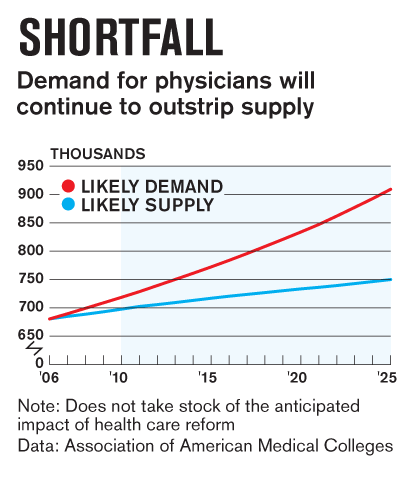
The Coming U.S. Doctor Shortage – BusinessWeek
If lack of health care is a public issue, then why is medical school privately funded?
Drinking lots of coffee and tea every day — even decaf — might keep diabetes away, new research shows.
In a meta-analysis of 18 studies, drinking three to four cups of coffee per day was associated with a 25% lower risk of diabetes than drinking two cups or less per day (RR 0.76, 95% CI 0.69 to 0.82), according to Rachel Huxley, PhD, of the George Institute for International Health in Sydney, Australia, and colleagues.
There were similar results for decaf coffee and tea.
Lafrance and Miller looked at VA data involving 864,933 U.S. veterans (4.9% female) who survived at least 90 days after a hospital discharge. Of those, 82,711 had acute kidney injury that did not require dialysis.
Through a mean follow-up of 2.34 years, the rate of death was higher in patients with acute kidney injury — 29.8% versus 16.1%.
After adjustment for demographics, comorbidities, medication use, primary diagnosis of admission, length of stay, mechanical ventilation, and postdischarge kidney function (estimated glomerular filtration rate), patients with acute kidney injury were 41% more likely to die during follow-up (HR 1.41, 95% CI 1.39 to 1.43).
The mortality risk increased significantly with greater severity of acute kidney injury (P<0.001 for trend), reaching a hazard ratio of 1.59 (95% CI 1.54 to 1.65) for those with stage III injury.
The risk of dying during follow-up was reduced, but still elevated, in patients with lower baseline kidney function, older patients, and those with diabetes.
Even among patients whose kidney function declined by 10% or less from the baseline assessment — who were considered to have recovered or to have maintained function — acute kidney injury was still associated with significantly higher mortality (HR 1.47, 95% CI 1.43 to 1.51).
The CDC has confirmed reports from other government agencies that cocaine users are at risk for agranulocytosis because of contamination with the veterinary drug levamisole.
Hartford’s Business Model ‘Does Not Make Sense,’ Bernstein Says – Bloomberg.com
And having a Wall Street analyst dictate corporate strategy doesn’t make sense either.


You must be logged in to post a comment.