Beyond their versatility, tiny homes typically have multifunctional furniture, including fold-down tables, convertible sofas, and Murphy beds. Because of the small space, tiny homes are commonly built vertically, with sleeping areas accessible by built-in ladders or stairs.
The verticality is definitely not senior friendly. Where’s the bathroom? But despite the obvious disadvantages for a person of my vintage, serious downsizing remains highly attractive. All I’m trying to do is make our retirement income last as long as we last. Hon, what do you think?
Meta is testing an app that uses AI to automate bedtime stories for children. The future is here, folks — and boy, is it depressing.
The app, first caught by 9to5Mac, is called “StoryKit.” (It’s not yet available in the US; Meta confirmed to TechCrunch that it’s currently testing StoryKit in pilot countries.) Per a webpage for the app, parents pick a character either by creating one or taking a “photo of their favorite toy or person to bring them to life,” then describe a setting or world for the story to take place in. They can also ask the story to include a specific lesson or moral, which the app says will allow it to “weave in values like kindness, courage, or empathy without it feeling like a lecture.”
Some U.S. employers use local third-party agencies to hire Filipinos with nursing experience, while others insist on American nursing licenses.But for many virtual healthcare assistants, including telesitters, a degree in any medical field will do. The remote nurses, who usually work the graveyard shift at night from their homes or offices in the Philippines, earn between $5 and $10 per hour, compared to the average pay of more than $45 an hour for registered nurses in the U.S.
The country has grown into a “clinical process outsourcing powerhouse … [and] a premier global hub for supporting over-stressed international healthcare systems,” JL Botor, president of HIMAP, told Rest of World.
U.S. hospitals and clinics can save up to 70% in labor costs by hiring Filipino workers, said Botor, who expects the industry to expand due to the chronic labor shortage, as well as the growing use of AI. Companies will automate easier tasks such as note-taking, and lean more heavily on human oversight for other tasks, he said. He declined to name the U.S. hospitals and clinics that outsource work to the Philippines, citing confidentiality agreements.
Your next nurse may monitor you from the Philippines
You must be 18 or older and meet one of these requirements when you start GLP-1 therapy:
You have a body mass index (BMI) of 35 or more.
You have a BMI between 30-34.99 and have at least one of these conditions: Diastolic heart failure (also called heart failure with preserved ejection fraction) Uncontrolled high blood pressure (also called hypertension) Chronic kidney disease at stage 3a or higher Prediabetes A previous heart attack (also called myocardial infarction) or stroke Blocked arteries in your legs or arms (also called peripheral artery disease) with symptoms
You have a BMI between 27-29.99 and have at least one of these conditions: Prediabetes A previous heart attack (also called myocardial infarction) or stroke Blocked arteries in your legs or arms (also called peripheral artery disease) with symptoms
Yes, I loved writing the click bait title to this post.
In this prospective cohort study, resistance training among US adult health care professionals was associated with substantially lower T2D risk, particularly when performed consistently over midlife and combined with adequate aerobic activity and limited sedentary television viewing. These findings support the inclusion of resistance training as a key component of lifestyle recommendations for diabetes prevention. Long-Term Resistance Training and Risk of Type 2 Diabetes – https://jamanetwork.com/journals/jamanetworkopen/fullarticle/2850563
This is another post in the never ending series of random thoughts on retirement. For the curious, here’s a link to my previous posts full of random thoughts (brain droppings): https://lifeunderwriter.net/tag/retirement/.
I am writing this on Father’s Day, the fourth day of a four day weekend and I’m ready to go back to work. It’s tough being an Old Guy who is old enough to be retired but isn’t retired and still working. Some days I wonder why I’m not retired. I guess this is all part of my living a longer healthier life strategy.
Social connection, prosociality, spirituality, optimism, and work—growing evidence suggests these five factors can play an important role in improving the well-being of people and communities…Work is one of the most important—and neglected—social determinants of health, according to Lisa Berkman, Thomas D. Cabot Professor of Public Policy and of Epidemiology at Harvard Chan School and director of the Harvard Center for Population and Development Studies. “Work drives income, social ties, and the opportunity for meaningful participation in society,” she said. “As such, it also shapes both our cognitive and physical health in many different ways.” The importance of connections: Ways to live a longer, healthier life – https://hsph.harvard.edu/news/the-importance-of-connections-ways-to-live-a-longer-healthier-life/
The optimism factor is interesting.
“The findings are remarkably consistent,” she said. “Across different racial and ethnic populations, we have seen that people who are more optimistic are more likely to age in good health and less likely to suffer from chronic diseases, physical illness, or cognitive impairments in old age. Optimists are also more likely to live exceptionally longer lives, beyond age 85 or more.”
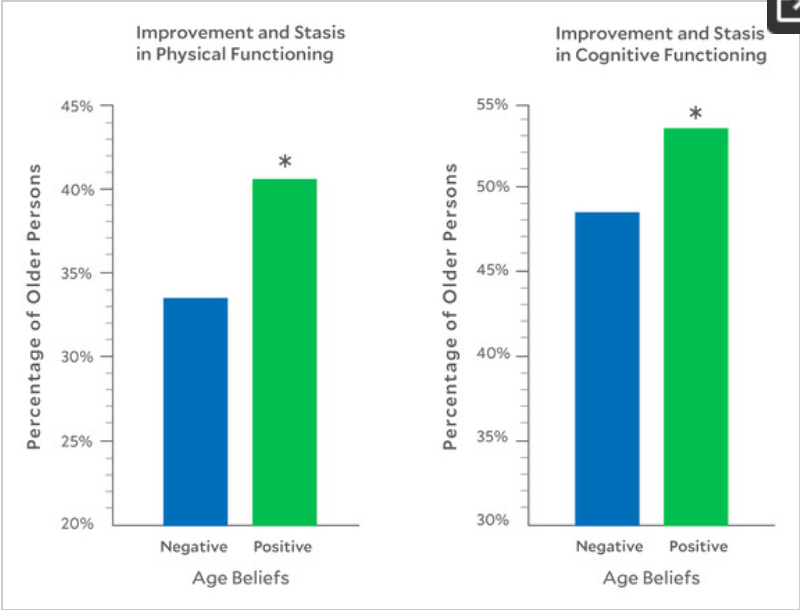
Aging Redefined: Cognitive and Physical Improvement with Positive Age Beliefs
Background/Objectives: A widespread assumption exists among scientists, health care providers, and the public that later life is a time of inevitable and universal cognitive and physical decline. This assumption is likely due to considering older persons who improve to be exceptions, and the reliance on aging-health measures that do not allow for improvement. In contrast, we utilized a measure that allowed for an upward trajectory to occur. Our objective was to examine whether a meaningful number of older persons improve with this measure and, if so, to examine whether a promising modifiable culture-based variable, positive age beliefs, contributes to this improvement. Methods: Individuals 65 years and older, who participated in a nationally representative longitudinal study, had their physical health assessed by walking speed and their cognitive health assessed by a global performance measure. We calculated the percentage of the sample that showed improvement in each domain from baseline to the last measurement up to 12 years later. We also examined whether a positive-age-belief measure predicted this improvement in regression models. Results: It was found that 45.15% of persons improved in cognitive and/or physical function over this period, and positive age beliefs predicted these two types of improvement, both with and without adjusting for relevant covariates. Conclusions: Our findings underscore the need to instill or magnify the positivity of age beliefs and to redefine aging so that it includes the possibility of improvement.
In sociology this phenomenon is known as a self-fulfilling prophecy.




You must be logged in to post a comment.