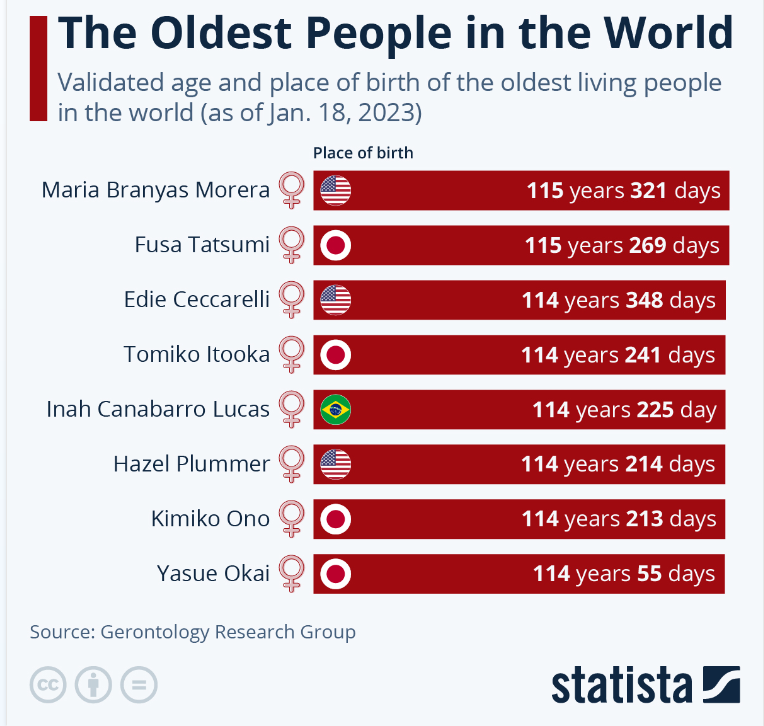
The Oldest People in the World — https://www.statista.com/chart/8978/the-oldest-people-on-earth/
The Oldest People in the World — https://www.statista.com/chart/8978/the-oldest-people-on-earth/
Strong, consistent evidence shows that managing obesity can delay progression of prediabetes to type 2 diabetes. Obesity management is also highly beneficial in treating type 2 diabetes, based on the degree of weight loss achieved. Losing excess weight improves glycemic control, reduces the need for glucose-lowering medications, can substantially reduce A1C, and can even promote sustained diabetes remission.
Diabesity Clin Diabetes 2022;40(4):392–393 — https://doi.org/10.2337/cd22-0088
A study by Huang and colleagues is the first nationally representative cohort study examining the association between social isolation and incident dementia for older adults in community dwelling settings. A cohort of 5,022 older adults participating in the National Health and Aging Trends Study was followed from 2011 to 2020. When adjusting for demographic and health factors, including race, level of education, and number of chronic health conditions, socially isolated adults had a greater risk of developing dementia, compared with adults who were not socially isolated (hazard ratio, 1.27; 95% CI, 1.08 – 1.49). Potential mechanisms to explain this association include the increased risk of cardiovascular disease and depression in older adults who are socially isolated, thereby increasing dementia risk.
Mengru Wang. Geriatrician Advises on Use of Vitamin D Supplementation, Lecanemab, and Social Media for Her Patients – Medscape – Jan 20, 2023 — https://www.medscape.com/viewarticle/987285?src=rss#vp_2
One week ago we had our older adult friends over for dinner. Midweek my wife went out with her friends while I gathered with my friends. Last night was date night and we got out of the house. This evening we’re having dinner at a friend’s house.
Dementia risk reduction activities!
Full Disclosure – I hate cooking on an electric stove. So there might be some bias in this post.
Here’s a link to the study behind the headlines – Population Attributable Fraction of Gas Stoves and Childhood Asthma in the United States https://www.mdpi.com/1660-4601/20/1/75#B6-ijerph-20-00075.
Here’s a nice review of the study that most people will never read – No, new study does not link gas stoves with asthma in children https://junkscience.com/2023/01/no-new-study-does-not-link–stoves-with-asthma-in-children/
I read the study behind the headlines:
Indoor gas stove use for cooking is associated with an increased risk of current asthma among children…
Population Attributable Fraction of Gas Stoves and Childhood Asthma in the United States – link above
The proportion of children (<18 years old) exposed to gas stoves was obtained from the American Housing Survey for the US, and states with available data (n = 9). We found that 12.7% (95% CI = 6.3–19.3%) of current childhood asthma in the US is attributable to gas stove use. The proportion of childhood asthma that could be theoretically prevented if gas stove use was not present (e.g., state-specific PAFs) varied by state… Nonetheless, our results align with a cross-sectional study which found that the use of a gas stove or oven for heat was a main risk factor for doctor-diagnosed asthma in US children under age six [6].
Note the authors went from “associated with” to “attributed to gas stove use”. When I got to the “main risk factor” statement I immediately went into WTF mode. So I decided to read some of the authors’ source documents including this one – Contribution of Residential Exposures to Asthma in US Children and Adolescents https://publications.aap.org/pediatrics/article-abstract/107/6/e98/66289/Contribution-of-Residential-Exposures-to-Asthma-in?redirectedFrom=fulltext.
The list of predictors of doctor diagnosed asthma included history of pet allergy, presence of pet in the household, dust mites, fungus, diagnosis of allergic rhinitis and cockroaches. The main risk factor of gas stove use is not listed.
Talor Gruenwald is listed as the lead author of the study causing an uproar from professional chefs in the US. Gruenwald used to work here https://rmi.org/ and now works here https://www.rewiringamerica.org
Power is in tearing human minds to pieces and putting them together again in new shapes of your own choosing.
George Orwell – 1984
This was an interesting deep dive behind the headlines.
Did I mention I hate cooking on an electric stove?

Anxiety Disorders – A Review JAMA. 2022;328(24):2431-2445. doi:10.1001/jama.2022.22744 – https://jamanetwork.com/journals/jama/article-abstract/2799904
“In the end, obviously, laughter is serious business, and the inability to laugh, at the world and at ourselves, is often, I believe, a sign of mental illness.”
Richard Russo author of The Destiny Thief
Did you hear about the headline which claimed that every year 250,000 people in the U.S. die after misdiagnosis…
Junk Science Rules — Authentic Medicine
Anyone who reads this source article will no longer fear going to the local hospital emergency room to avoid a “misdiagnosis”.
Or just go online, Google your symptoms, self-diagnose, stay home and take care of your own sorry ass.


You must be logged in to post a comment.