Scary stuff if you’re an older adult! I should STOP DRINKING ALCOHOL.
But what if this study is wrong? See pyramid above. Sensing bias in the article I took a look at the comments. Dr. Bradley Fawkes’ comment was noteworthy. In the results section of the study you’ll find this:
“While no associations were found for low- or moderate-risk drinking patterns vs occasional drinking among individuals without socioeconomic or health-related risk factors…” Alcohol Consumption Patterns and Mortality Among Older Adults With Health-Related or Socioeconomic Risk Factors – https://jamanetwork.com/journals/jamanetworkopen/fullarticle/2822215
So in the absence of socioeconomic or health-related risk factors no associations were found.
Alcohol use is ubiquitous in the United States, with 84% of adults reporting use at some point. Alcohol use disorder (AUD) is a serious and persistent disease at the extreme end of alcohol use that contributes heavily to the burden on the healthcare system, with more than 200,000 hospitalizations each year due to the condition. About 6% of people in the United States have AUD. However, only 7.6% of patients with AUD seek treatment, although several pharmacologic and nonpharmacologic treatment options are available. Stephen Soreff. Rapid Rx Quiz: Alcohol Use Disorder Treatments – Medscape – Dec 30, 2024. https://reference.medscape.com/viewarticle/1002119
Overall mortality rates increased from 10.7 (95% CI, 10.6-10.8) per 100,000 in 1999 to 21.6 (95% CI, 21.4-21.8) per 100,000 in 2020, representing a significant twofold increase.
Adults aged 55-64 years demonstrated both the steepest increase and highest absolute rates in both 1999 and 2020.
American Indian and Alaska Native individuals experienced the steepest increase and highest absolute rates among all racial groups.
Nearly 500 years ago, Swiss physician and chemist Paracelsus expressed the basic principle of toxicology: “All things are poison and nothing is without poison; only the dose makes a thing not a poison.” This is often condensed to: “The dose makes the poison.” It means that a substance that contains toxic properties can cause harm only if it occurs in a high enough concentration. https://www.chemicalsafetyfacts.org/health-and-safety/the-dose-makes-the-poison/
Dry January? If you’re doing this trendy behavior you know you drank too much this past holiday season.
Cancer warnings on alcohol? No one will read them.
Trust your intuition. If you’ve ever felt like you drink too much alcohol then you do.
1-800-662-HELP or text 988 for SAMHSA’s National Helpline.
When Karla Adkins looked in the rear view mirror of her car one morning nearly 10 years ago, she noticed the whites of her eyes had turned yellow.
She was 36 at the time and working as a physician liaison for a hospital system on the South Carolina coast, where she helped build relationships among doctors. Privately, she had struggled with heavy drinking since her early 20s, long believing that alcohol helped calm her anxieties. She understood that the yellowing of her eyes was evidence of jaundice. Even so, the prospect of being diagnosed with alcohol-related liver disease wasn’t her first concern.
“Honestly, the No. 1 fear for me was someone telling me I could never drink again,” said Adkins, who lives in Pawleys Island, a coastal town about 30 miles south of Myrtle Beach.
But the drinking had caught up with her: Within 48 hours of that moment in front of the rearview mirror, she was hospitalized, facing liver failure. “It was super fast,” Adkins said.
After years of heavy drinking to ease her anxiety, Karla Adkins nearly died from liver failure 10 years ago. “You can’t get much worse from where I got,” says Adkins. She now works as a coach to help people change their relationship with alcohol and published a book about her health ordeal.(Allison Duff)
Historically, alcohol use disorder has disproportionately affected men. But recent data from the Centers for Disease Control and Prevention on deaths from excessive drinking shows that rates among women are climbing faster than they are among men. The Biden administration considers this trend alarming, with one new estimate predicting women will account for close to half of alcohol-associated liver disease costs in the U.S. by 2040, a $66 billion total price tag.
It’s a high-priority topic for the Department of Health and Human Services and the Department of Agriculture, which together will release updated national dietary guidelines next year. But with marketing for alcoholic beverages increasingly geared toward women, and social drinking already a huge part of American culture, change isn’t something everyone may be ready to raise a glass to.
“This is a touchy topic,” said Rachel Sayko Adams, a research associate professor at the Boston University School of Public Health. “There is no safe level of alcohol use,” she said. “That’s, like, new information that people didn’t want to know.”
Over the past 50 years, women have increasingly entered the workforce and delayed motherhood, which likely has contributed to the problem as women historically drank less when they became mothers.
“Parenthood tended to be this protective factor,” but that’s not always the case anymore, said Adams, who studies addiction.
More recently, the covid-19 pandemic “significantly exacerbated” binge-drinking, said George Koob, director of the National Institute on Alcohol Abuse and Alcoholism at the National Institutes of Health, as people used alcohol to cope with stress. That is particularly true of women, who are more likely to drink alcohol because of stress than men, he said.
But women are also frequently the focus of gender-targeted advertising for alcoholic beverages. The growth of rosé sales and low-calorie wines, for example, has exploded in recent years. New research published by the International Journal of Drug Policy in February found that the “pinking of products is a tactic commonly used by the alcohol industry to target the female market.”
Also at play is the emergence of a phenomenon largely perpetuated by women on social media that makes light of drinking to deal with the difficulties of motherhood. The misperception of “mommy wine culture,” said Adams, is that “if you can drink in a normal way, a moderate way, if you can handle your alcohol, you’re fine.”
And while it’s unclear to what extent memes and online videos influence women’s drinking habits, the topic merits further study, said Adams, who with colleagues last year found that women without children at age 35 are still at the highest risk for binge-drinking and alcohol use disorder symptoms among all age groups of women. But over the past two decades, the research concluded, the risk is escalating for both childless women and mothers.
Research indicates stress is one of the main reasons that people misuse alcohol. Experts also say unique burdens lead many mothers to rely on alcohol. “It’s a vulnerable group,” says Rachel Sayko Adams, a research associate professor at the Boston University School of Public Health.(Chrissie Bonner)
These factors at play, coupled with the pressure to fit in, can make excessive drinking a difficult conversation to broach.“It’s a very taboo topic,” Adams said.
And when it does come up, said Stephanie Garbarino, a transplant hepatologist at Duke Health, it’s often surprising how many patients are unaware how their drinking affects their health.
“Often, they didn’t know there was anything wrong with what they’re doing,” she said. She is more frequently seeing younger patients with liver disease, including men and women in their 20s and 30s.
And public health and addiction experts fear that alcohol-related liver disease among women will become a costly issue for the nation to address. Women accounted for 29% of all costs associated with the disease in the U.S. in 2022 and are expected to account for 43% by 2040, estimated a new analysis published in the American Journal of Gastroenterology in February.
National dietary guidelines advise women to drink no more than one alcoholic drink a day. Those guidelines are up for a five-year review next year by the USDA and HHS, which has called a special committee to examine, among other questions, the relationship between alcohol consumption and cancer risks. The report will be made public in 2025.
When Canada published guidance in 2023 advising that drinking any more than two alcoholic beverages a week carried health risks, Koob sparked backlash when his comments to the Daily Mail suggested that U.S. guidelines might move in the same direction. The CDC report published in February suggested that an increase in alcohol taxes could help reduce excessive alcohol use and deaths. Koob’s office would not comment on such policies.
It’s a topic close to Adkins’ heart. She now works as a coach to help others — mostly women — stop drinking, and said the pandemic prompted her to publish a book about her near-death experience from liver failure. And while Adkins lives with cirrhosis, this September will mark 10 years since her last drink.
“The amazing thing is, you can’t get much worse from where I got,” said Adkins. “My hope is really to change the narrative.”
The findings of this cohort study suggest that, in a national veterans cohort of patients with dementia, 5% to 10% of the patients have laboratory values suggestive of possible undiagnosed cirrhosis that could implicate HE as a contributor to overall cognitive impairment. Patients in this study with possibly undiagnosed cirrhosis were more likely to be of races other than White, Hispanic, and urban-dwelling, and more likely to have AUD and viral hepatitis. These percentages of affected patients were corroborated with medical records review of 2 separate validation cohorts. In conclusion, FIB-4 should be considered as a screening tool to detect cirrhosis and potential HE in older veterans with dementia. Those with high scores (eg, >2.67) should be considered for further evaluation and treatment.
“We found that alcohol and THC together significantly reduced, and in some cases prevented, the ability of the prefrontal cortex in drug-exposed rats to undergo plasticity in the same way that the brains from control animals can,” said Linyuan Shi, a graduate student in the Gulley lab. “The effects were apparent in rats exposed to either drug alone, and they were most pronounced with co-exposure to both drugs. We also found the impaired plasticity was likely due to changes in signaling caused by gamma-aminobutyric acid, a chemical messenger in the brain. When we used a chemical that enhances GABA, it could rescue the deficits we saw in the animals that had been exposed to the drugs.”
Carl R. Woese Institute for Genomic Biology, University of Illinois at Urbana-Champaign. “Combined use of alcohol and THC can affect rat brains, study finds.” ScienceDaily. ScienceDaily, 30 November 2023 — https://www.sciencedaily.com/releases/2023/11/231130121946.htm
I’m glad I am not a rat.
Young adults who simultaneously use alcohol and marijuana (SAM) consume more drinks, are high for more hours in the day, and report more negative alcohol-related consequences.
On SAM use days, participants consumed an average of 37% more drinks, with 43% more negative alcohol consequences, were high for 10% more hours, and were more likely to feel clumsy or dizzy, compared with non-SAM use days.
“We found that alcohol and THC together significantly reduced, and in some cases prevented, the ability of the prefrontal cortex in drug-exposed rats to undergo plasticity in the same way that the brains from control animals can,” said Linyuan Shi, a graduate student in the Gulley lab. “The effects were apparent in rats exposed to either drug alone, and they were most pronounced with co-exposure to both drugs. We also found the impaired plasticity was likely due to changes in signaling caused by gamma-aminobutyric acid, a chemical messenger in the brain. When we used a chemical that enhances GABA, it could rescue the deficits we saw in the animals that had been exposed to the drugs.”
Carl R. Woese Institute for Genomic Biology, University of Illinois at Urbana-Champaign. “Combined use of alcohol and THC can affect rat brains, study finds.” ScienceDaily. ScienceDaily, 30 November 2023 — https://www.sciencedaily.com/releases/2023/11/231130121946.htm
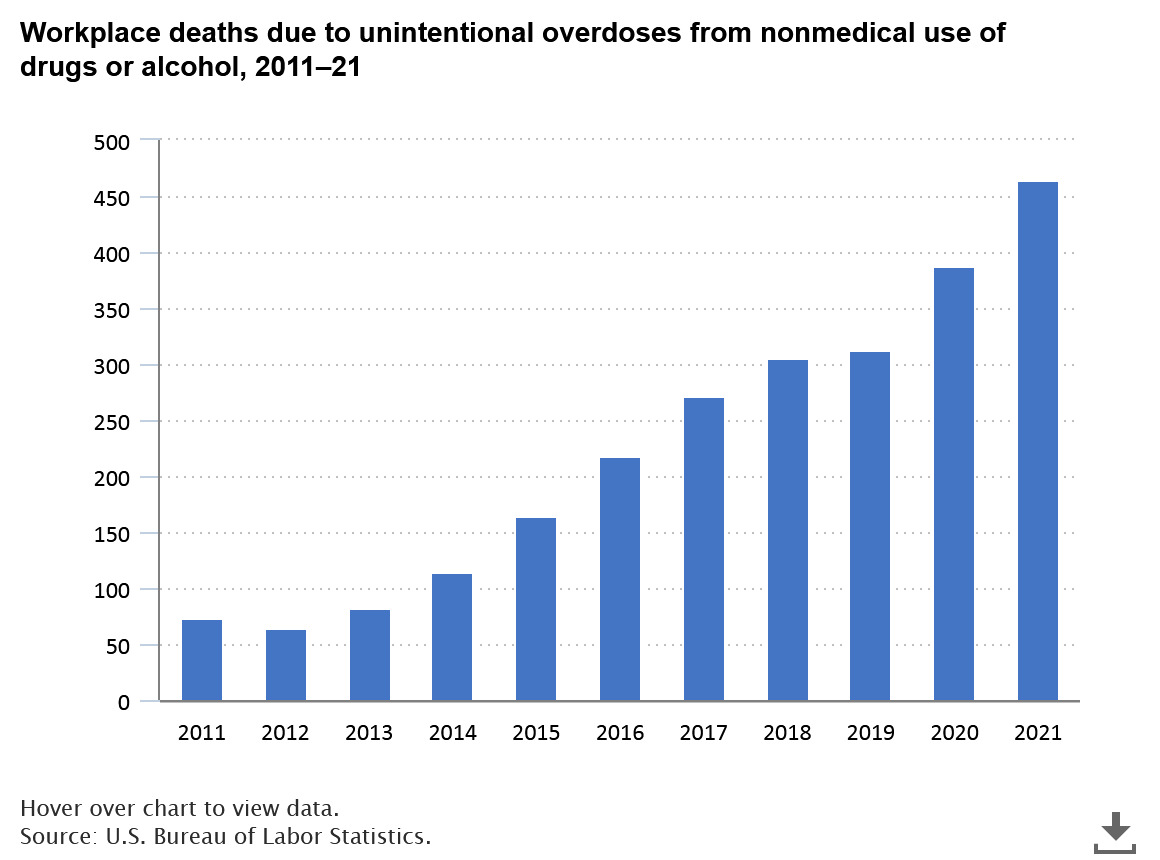
There were 464 workplace fatalities from unintentional overdoses due to non-medical use of drugs or alcohol in 2021. This is a 19.6-percent increase from 2020 when there were 388 fatalities and is the ninth consecutive annual increase. Unintentional overdoses from non-medical use of drugs include overdoses from stimulants such as methamphetamine and from narcotics such as fentanyl.




 lifeunderwriter.net
You must be logged in to post a comment.