The Dangers of Self-Diagnosis and AUD (Alcohol Use Disorder)

Using naltrexone to cut back on drinking isn’t new, says Sarah Wakeman, a senior medical director for substance use disorder at Mass General Brigham. The approach dates back to the 1980s with the Sinclair method, which pairs drinking with naltrexone to blunt alcohol’s pleasurable effects. In parts of Europe, Wakeman adds, people have long used a “pill-in-the-pocket” strategy, taking the medication only when they anticipate drinking. A decades-old drug is helping people drink less alcohol—without giving it up completelyhttps://www.nationalgeographic.com/health/article/naltrexone-drink-less-alcohol? (Paywall article)

The Provider Individual who is not a doctor will see you after you answer the questionnaire (this is the self-diagnosis part).

Oar Health is an online service offering naltrexone subscriptions to those with alcohol use disorder (AUD). Users can fill out a brief assessment which is reviewed by a medical professional, then be given a naltrexone prescription if appropriate. After a one-time $50 fee, subscriptions cost $297 for three months of medication, which comes out to $99 monthly. It’s currently available in 42 US states. Beyond the naltrexone prescription, Oar Health offers ongoing access to the support of a medication prescriber, a health coach, a Facebook group for community support, and extras like educational articles and guided reflections.Oar Health Review: Pros & Cons, Cost, & My Experiencehttps://www.choosingtherapy.com/oar-health-review/

Health coaches who are “naltrexone experts”! And The Sinclair Method might not work for everyone. https://drugfree.org/article/sinclair-method/

Depending upon the online service you choose you may get naltrexone prescribed when trying to get your doctor prescribed GLP-1 filled out even when you don’t have alcohol use disorder.

Telehealth companies such as Vida Health and its rivals offer lifestyle support so people taking drugs like Wegovy and Zepbound can have the most success on the drugs. But the companies often have another job: limiting obesity drug costs for employers.

The Vida Health nurse said he was a good candidate for Zepbound but insisted he try two generic drugs first: naltrexone, a drug used to curb alcohol and opioid use, and bupropion, an antidepressant. Neither drug is approved for obstructive sleep apnea. Primary care doctors raise alarm as telehealth companies get involved in obesity drugshttps://www.npr.org/2026/06/14/nx-s1-5805984/glp1-telehealth-weight-loss-drugs

Yikes.
College Students Are Losing the Ability to Read (and think)

More food for thought (but only if you can read and think):

In a new essay for The Chronicle Higher Education, university-level literature and writing instructor Tyler Jagt recalls how not a single one of his students could get through an assigned 20-page article, something that he had read “without complaint” as an undergraduate a decade ago…“So when a student tells me they ‘kept losing track’ of a 20-page article, I have to acknowledge that they may be describing a measurable neurological condition,” Jagt wrote. “The neural pathways that support sustained attention are built by use, and they atrophy without it. Your body is a use-it-or-lose-it system, and the brain is no exception.” College Students Are Rapidly Losing the Ability to Readhttps://futurism.com/future-society/college-students-losing-ability-read

No surprise then when graduates demonstrate Alarmingly Shallow Ideas.

Do we really want Artificial Intelligence (AI) in the Classroom?

Study Failure to Learn Success

Michael Girdley on private equity:

The lesson is pretty straightforward. You’re going to go buy a business, and you’re going to look and say, “Where can I cut costs? How can I start to optimize and streamline this?” You can cut fat, but you definitely don’t want to cut muscle, and you don’t want to cut bone. That’s exactly what these guys did. Why did they do that? They’re private equity guys. They get paid on management fees and the deals when they turn around and put them out in the public. They don’t care about the long term. They care about the next three to five years, and that’s exactly what they optimized for.

You Will Own Nothing and Be Happy

In her original post, Auken predicted a time, viz. 2030, wherein she would not ‘own anything’, not a car, a house, nor even any clothes. This was because, she explained, all things previously regarded as a ‘product’ would be supplied and available in the future as a ‘service’. As a result, everything that one might need could be rented, thereby eliminating the need, although not necessarily the right, to ‘own anything’. This was “a good life”, Auken concluded. A future with no individual ownership is not a happy one: Property theory shows why – Futures, Volume 152, 2023 https://www.sciencedirect.com/science/article/pii/S0016328723001131

Text message received, deleted.

I will never sell my house to a modern day slum landlord.

Artificial Intelligence (AI) in the Classroom?

Retraction Note to: Humanities and Social Sciences Communications https://doi.org/10.1057/s41599-025-04787-y, published online 06 May 2025. The Editor has decided to retract this paper owing to concerns regarding discrepancies in the meta-analysis. These issues ultimately undermine the confidence the Editor can place in the validity of the analysis and resulting conclusions. The authors have not responded to correspondence regarding this retraction. Retraction Note: The effect of ChatGPT on students’ learning performance, learning perception, and higher-order thinking: insights from a meta-analysishttps://www.nature.com/articles/s41599-026-07310-z

The jury’s still out on AI’s effectiveness as a learning tool, but research so far paints a grim picture. Using AI chatbots can impair critical thinking, result in lower brain activity during cognitive tasks, and has been linked to memory loss. A Major Paper Claiming AI Is Good for Students Just Got Retracted, Which Is Very Bad News for Advocates of AI in the Classroomhttps://futurism.com/artificial-intelligence/study-ai-good-for-students-retracted

AI’s effectiveness as a learning tool is probably better for people who already know how to think having “learned” stuff the old fashioned way. AI’s effectiveness as a learning tool for some of the younger generations has shown promise in one area known as cheating.

Last year, a survey of some 500 Princeton seniors found that over 27 percent admitted to cheating with an AI model like ChatGPT, while about half said they knew about a violation of the honor code. If those are the numbers at a vaunted Ivy league, just imagine what conditions are like for the rest of the country. Princeton in Shambles Over AI Cheatinghttps://futurism.com/future-society/princeton-shambles-ai-cheating

BTW, the estimated cost of attendance for 2026-27 is $94,624 at Princeton U. https://admission.princeton.edu/cost-aid/fees-payment-options

Maybe the Princeton kids had to cheat because they offloaded too much of their own thinking and by default, didn’t learn how to think.

The risks of using generative artificial intelligence to educate children and teens currently overshadow the benefits, according to a new study by the Brookings Institution’s Center for Universal Education… The report describes a kind of doom loop of AI dependence, where students increasingly off-load their own thinking onto the technology, leading to the kind of cognitive decline or atrophy more commonly associated with aging brains… Rebecca Winthrop, one of the report’s authors and a senior fellow at Brookings, warns, “When kids use generative AI that tells them what the answer is they are not thinking for themselves. They’re not learning to parse truth from fiction. They’re not learning to understand what makes a good argument. They’re not learning about different perspectives in the world because they’re actually not engaging in the material. The risks of AI in schools outweigh the benefitshttps://www.npr.org/2026/01/14/nx-s1-5674741/ai-schools-education?

Your final food for thought.

America’s Largest Hospital System Ready to Start Replacing Radiologists With AI

“We could replace a great deal of radiologists with AI at this moment, if we are ready to do the regulatory challenge,”
Mitchell Katz, president and CEO of New York’s 11-hospital public benefit corporation

Mohammed Suhail, a radiologist at North Coast Imaging in San Diego, told Radiology that Katz’s comments are “undeniable proof that confidently uninformed hospital administrators are a danger to patients (and are) ..“easily duped by AI companies that are nowhere near capable of providing patient care.”

America’s Largest Hospital System Ready to Start Replacing Radiologists With AI, Its CEO Says – https://futurism.com/artificial-intelligence/hospital-ceo-ai-radiology

Confidently. Uninformed.

Yikes.

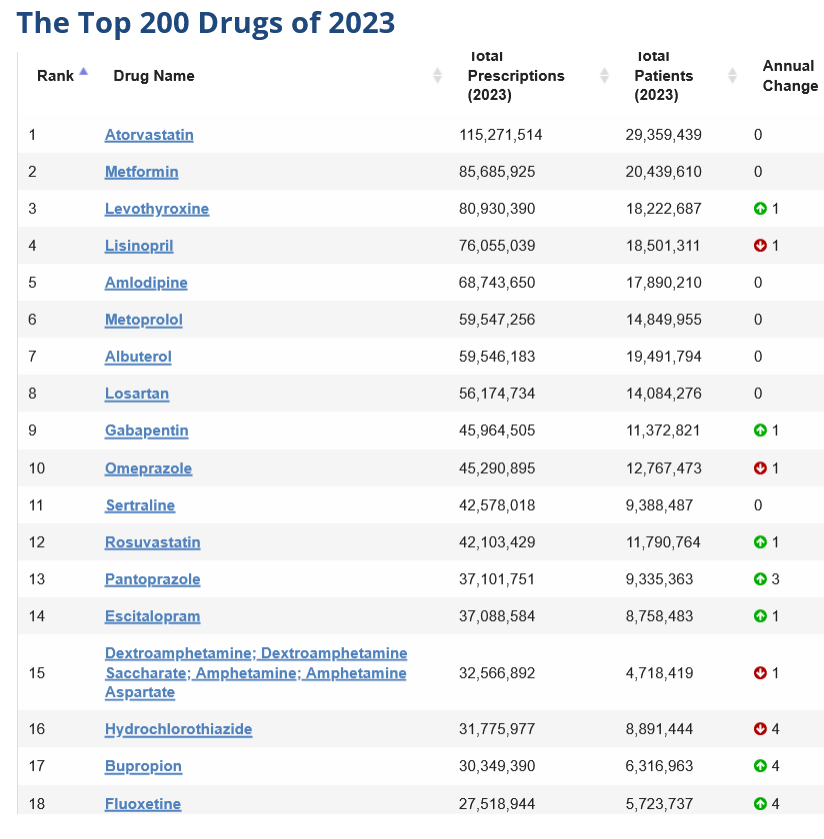
My Statin Comes From India

According to the USP, the bulk of the APIs come from India. That country is responsible for 50% of the active pharmaceutic ingredients. China is not far behind at 32%. The European Union supplies 10%. That’s a big change since 2000. Back then, European countries like France, Germany, Switzerland and Denmark supplied 42% of the APIs. Drug Recalls From India – Can You Trust Foreign-Made Generics?https://www.peoplespharmacy.com/articles/more-drug-recalls-from-india-do-you-trust-foreign-made-generics

Dozens of companies received approval from the FDA over the years to sell metoprolol and bupropion in the U.S. Yet from 2018 to 2024, the agency reported running only 2 tests on metoprolol and 7 on bupropion through its quality surveillance program — in each case, by pulling a sample from a single drug maker. In many of those years, the drugs weren’t tested at all, FDA records show. Those that were assessed received passing results. The FDA Often Doesn’t Test Generic Drugs for Quality Concerns, So ProPublica Didhttps://www.propublica.org/article/fda-generic-drug-testing

ClinCalc DrugStats Databasehttps://clincalc.com/DrugStats/

Both articles are long reads but worth your time.

Yikes.