Remote Work – Not The Norm

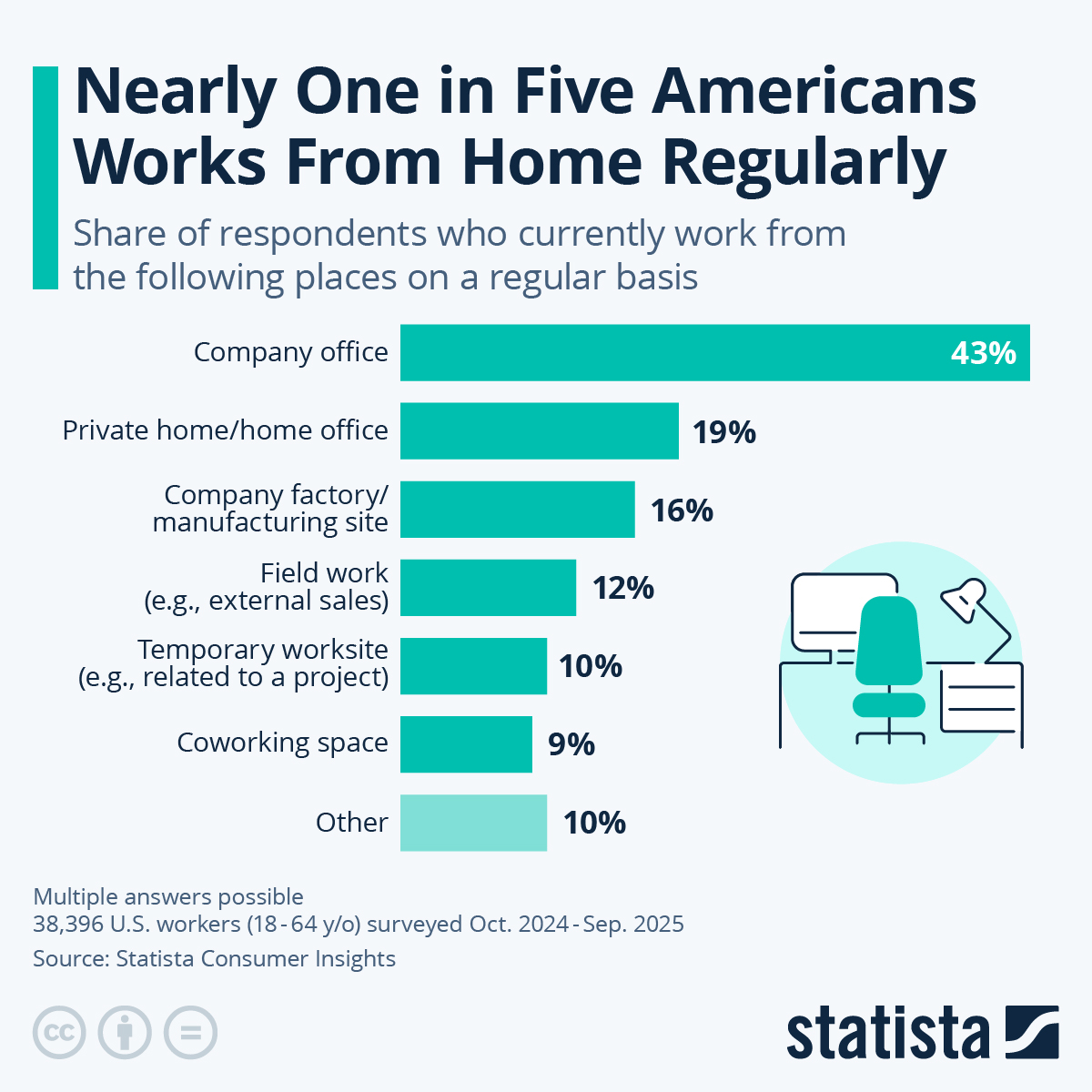
Nearly One in Five Americans Works From Home Regularlyhttps://www.statista.com/chart/35389/regular-remote-and-home-office-work/

I started writing my journal in 2005. One of the best things about keeping a journal is the ability to verify if memories from the past are accurate or the made up, mashups your brain creates as memories. Here’s my entry on Monday July 24 2006:

A 4:00 PM meeting with the Division head with an HR rep present is never a good thing. I immediately thought to myself:

“This is gonna suck.”

And it did, big time. I got whacked today.

And that’s how my WFH life began. When my work from home situation arises in conversation most are surprised to learn I’ve been WFH this long. I’m surprised how long I’ve been working from home!

I am convinced due to having a low stress working environment, better diet (NO office snacks/free food/lunches out), no commute, along with a host of other variables I just might be increasing my lifespan. I do know I get plenty of sleep on a regular routine basis.

Short sleep duration (< 7 h per night) was associated with a 14% increase in mortality risk compared to the reference of 7–8 h, with a pooled hazard ratio of 1.14 (95% CI 1.10 to 1.18). Conversely, long sleep duration (≥ 9 h per night) was associated with a 34% higher risk of mortality, with a hazard ratio of 1.34 (95% CI 1.26 to 1.42). Sex-specific analyses indicated that both short and long sleep durations significantly elevated mortality risk in men and women, although the effect was more pronounced for long sleep duration in women. Both short and long sleep durations are associated with increased all-cause mortality, though the degree of risk varies by sex. Imbalanced sleep increases mortality risk by 14–34%: a meta-analysis – Ungvari, Z., Fekete, M., Varga, P. et al. Imbalanced sleep increases mortality risk by 14–34%: a meta-analysis. GeroScience 47, 4545–4566 (2025). https://doi.org/10.1007/s11357-025-01592-y

What ChatGPT Thinks About This Blog

Here’s what I found on LifeUnderwriter.net (the blog):

  • It is a blog hosted on WordPress at [lifeunderwriter.net] titled “Curated Content From a Life Underwriting Professional”. lifeunderwriter.net+2lifeunderwriter.net+2
  • The posts cover a variety of topics — not strictly life-insurance underwriting: health topics, longevity, demographics, lifestyle commentary. For example, a post from September 2024 titled “The Placebo Effect: When the Mind Becomes the Medicine” touches on aging and life-expectancy issues. lifeunderwriter.net
  • The blog seems to be running for a long time: there are archived posts going back at least to November 2013. lifeunderwriter.net+1
  • It appears to use standard blogging content and isn’t obviously a commercial site for underwriting services or a carrier guide. It seems more personal / commentary-oriented rather than strictly professional underwriting guidance.

My assessment

  • If you were looking for professional underwriting guides (for example, detailed carrier requirements, rating classes, medical tables, etc.), this blog may not be the best or most authoritative source — it seems more reflective/opinion-style rather than official.
  • If you were interested in someone’s perspective who works in life underwriting and writes broadly about risk, life-expectancy, aging, etc., then this blog could be quite interesting.

Concerning Trends in Retirement – More Less Than Random Thoughts

  • Lack of sufficient savings
  • Inflationary pressures
  • Rising credit card debt
  • Half of respondents said they had saved less than what was needed for retirement.
  • When we asked an open-ended question about why they rated their satisfaction with retired life as they did, inflation was a major reason.

The ‘Concerning Trends’ in Retirement Now https://www.kiplinger.com/retirement/concerning-trends-in-retirement-now

I’ve decided not to retire. Wait, let me clarify my statement.

I’ve not changed my mind about my decision not to retire five years ago.

I love double negative sentences.

 Fewer than twenty percent of older people worldwide enjoy a retirement pension that is enough for them to live off. Although countries like China and India are now also developing their pension systems, the prospect of most older people receiving pensions totaling 60 to 70% of their final salaries remains a long way off.

The invention of retirementhttps://www.swisslife.com/en/home/blog/interview-matthieu-leimgruber.html

The majority of our friends are retired. I’m always asked when I’m going to retire. My quick answer was always “Don’t know”. I’ve since modified my response to “Two to four years”. This has been my answer for the past two years. Might still be my answer next year too.

https://www.kiplinger.com/retirement/retirement-planning/the-90-rule-of-retirement-live-long-and-prosper

Nearly 40% of Americans ages 55 and older were employed in 2024, according to the Bureau of Labor Statistics — a striking shift that’s even more dramatic when you look at the oldest workers. Today, 2.8 million men over 70 are working in the U.S. — part of an extraordinary long-term transformation in which employment among Americans 75 and older has quadrupled since 1964. More Americans are ‘unretiring’: 5 money factors to weigh before joining themhttps://www.aol.com/finance/retirement-planning/article/unretiring-is-trending-5-money-factors-you-should-consider-first-153926242.html

I think I’ll retire in two to four years.

Some Common Sense on Artificial Intellignce

If you’re using these systems for anything that matters, you need a verification pass that goes way beyond a lazy skim. That means detail-oriented human work — you must check every claim, every diagram, every link, every word, every line of code, every outcome and citation and fact. And who’s best positioned to verify? The very people who are already good at whatever the AI is trying to do: the workers it’s supposed to replace.

Doctors can check medical claims. Senior programmers can check AI coding outputs. Strong copywriters can check that whatever GPT writes sings — they know a good turn of phrase when they read it and can make sure each paragraph flows from the one before it.

That’s the biggest irony of AI work. If you’re not already good at the task it’s doing, you can’t tell if what it generates is good. You don’t have the knowledge or the context. If you don’t know French, then you don’t know if a French translation sounds clunky or if you just told someone to eat shit in your new commercial because of new slang that sounds like the phrase you translated. No, AI won’t take all the jobs. Here’s why.https://www.freethink.com/artificial-intelligence/ai-wont-take-all-the-jobs

The full essay is worth reading. Enjoy!

Scary Charts – 09.13.25

Interestingly, older workers (65+) earn around $3,000 more than those in the 25 to 34 bracket, reflecting a group of late-career professionals who continue to command strong wages. Charted: Median U.S. Salaries by Age Group https://www.visualcapitalist.com/charted-median-u-s-salaries-by-age-group/

Late-career professional. There seem to be a lot more of us now.

Three in four workers (75 percent) plan to work for pay in retirement, compared with just 29 percent of retirees who report they have actually worked for pay in retirement. In fact, the RCS has consistently found that workers are far more likely to plan to work for pay in retirement than retirees are to have actually done so. 2025 Retirement Confidence Surveyhttps://www.ebri.org/retirement/retirement-confidence-survey

But if you’re working for pay in retirement how can this be considered retirement?

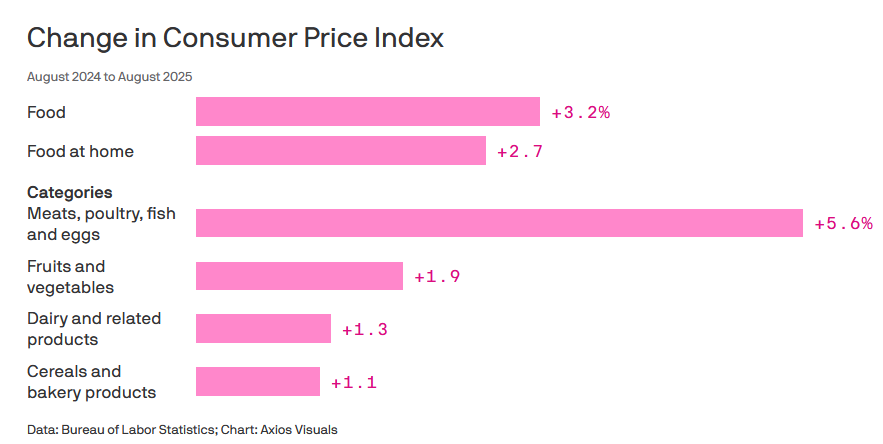
Source: https://www.axios.com/2025/09/11/trump-tariffs-grocery-prices-rise-cpi

FYI, the BLS statistics are BS. Real world eyeball prices at the market tell me so.

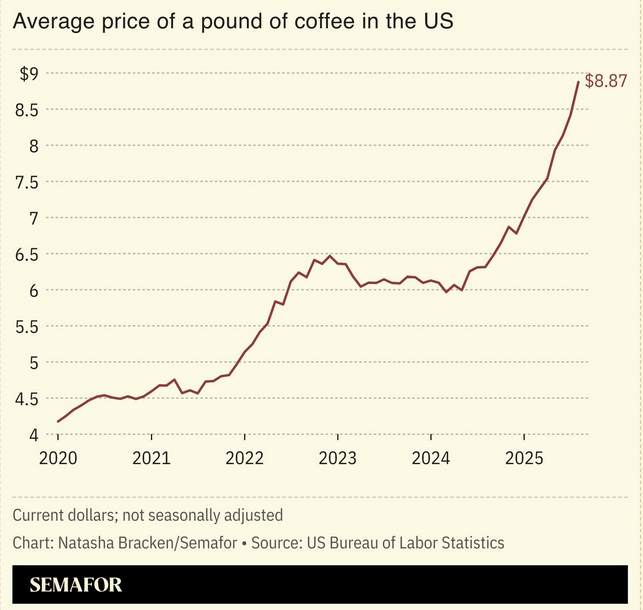
Like coffee. Coffee prices in the US has surged more than 20% in the last year.

US coffee prices surge as tariffs take effecthttps://www.semafor.com/article/09/12/2025/us-coffee-prices-surge-as-tariffs-take-effect

Ooh…not just coffee.

Here’s the inflation breakdown for August 2025 — in one charthttps://www.cnbc.com/2025/09/11/inflation-breakdown-for-august-2025.html

I guess I’ll keep working in “retirement”.

Random Thoughts on Retirement and Longevity – Can Remote Work Delay Retirement?

The mortality impact is interesting

The Journal of Epidemiology and Community Health found that those who worked just a year beyond retirement age had a 9% to 11% lower risk of dying during the 18 years the research covered, regardless of health. Could Remote Work Delay Your Retirement? https://www.kiplinger.com/retirement/retirement-planning/could-remote-work-delay-your-retirement

If you only eat “superfoods” will you have a long life?

“There is no single secret to living a long, healthy life.” Salvatore Di Somma, MD. Sanford Burnham Prebys. “A long and ongoing look at the secrets of human longevity and healthy aging.” ScienceDaily – https://www.sciencedaily.com/releases/2025/05/250505171023.htm

Coffee

All coffee types decrease the risk of adverse clinical outcomes in chronic liver disease: a UK Biobank study

Kennedy, O.J., Fallowfield, J.A., Poole, R. et al. BMC Public Health 21, 970 (2021) – https://bmcpublichealth.biomedcentral.com/articles/10.1186/s12889-021-10991

Movement is medicine

Being consistently physically active in adulthood is linked to a 30–40% lower risk of death from any cause in later life, while upping levels from below those recommended for health is still associated with a 20–25% lower risk, finds a pooled data analysis of the available evidence, published online in the British Journal of Sports Medicine. It’s never too late: Just moving more could add years to your lifehttps://www.sciencedaily.com/releases/2025/07/250711224321.htm

Whiskey

University of California neurologist Claudia Kawas and her team have been studying the lifestyle habits of people who live until their 90s. The group has been researching people of this age group for some 15 years – and they have found that those who drank two units of alcohol every day were less likely to die prematurely.“I have no explanation for it, but I do firmly believe that modest drinking improves longevity,” Kawas said. – Whiskey makes you live a longer, healthier lifehttps://www.irishcentral.com/culture/food-drink/whiskey-live-longer-healthier

Loneliness

Now, however, new research is calling into question this long-held belief and, surprisingly, found that loneliness may not be quite the threat that we all once thought it was. In fact, the problem may be one of confusing cause and effect. The Surprising Truth About Loneliness and Longevityhttps://www.kiplinger.com/retirement/the-surprising-truth-about-loneliness-and-longevity

Loneliness is pervasive in home care settings across the 3 countries; however, its association with mortality differs from reports for the general population. Loneliness was not associated with an increased risk of death after adjusting for health-related covariates. The causal order between changes in health, loneliness, and mortality is unclear. For example, loneliness may be a consequence of those health changes rather than their cause. Cross-National Evidence on Risk of Death Associated with Loneliness: A Survival Analysis of 1-Year All-Cause Mortality among Older Adult Home Care Recipients in Canada, Finland, and Aotearoa | New Zealandhttps://www.sciencedirect.com/science/article/pii/S152586102500204X

Clearing Up Myths About Older Workers

In 2001, only about 1 out of every 7 U.S. workers was 55 or older. By 2021, the number jumped to almost 1 out of every 4 workers (a 93% increase). That’s almost twice the proportion of older workers as before.3 Older workers are staying on the job longer for various reasons, ranging from financial needs to the joy of work.  More people are working past the age when they might have retired. They might be responding to the increase in the Social Security full retirement age, needing money or health insurance, or simply enjoying their jobs and being around their friends at work.⁴ Clearing Up Myths About Older Workers While Understanding and Supporting an Aging Workforcehttps://blogs.cdc.gov/niosh-science-blog/2023/09/25/older-workers/

I just learned I have a high level of Crystallized intelligence. https://en.wikipedia.org/wiki/Fluid_and_crystallized_intelligence

DUI/DWI for a New Generation

I am impressed with the ability of some people to injure themselves in creative ways.

Analyzing data from the 2016-2021 National Inpatient Sample, UCLA researchers found that 25% of 7350 patients hospitalized for scooter-related injuries were using substances such as alcohol, opioids, marijuana and cocaine when injured. Published in The American Surgeon, the study also notes that overall scooter-related hospitalizations during the 5-year period jumped more than eight-fold, from 330 to 2705. In addition, the risk of traumatic brain injuries among the substance use group was almost double that of the non-impaired patients. University of California – Los Angeles Health Sciences. “Nearly one-quarter of e-Scooter injuries involved substance impaired riders.” https://www.sciencedaily.com/releases/2025/04/250429195329.htm (accessed May 3, 2025).

AND don’t forget about these things can randomly explode.

“In all of these fires, these lithium-ion fires, it is not a slow burn there’s not a small amount of fire, it literally explodes,” FDNY Commissioner Laura Kavanagh – https://www.statista.com/chart/29472/fires-caused-by-lithium-ion-batteries/

There Are Health Related Benefits to Working Past Age 65

“Our perceptions of working after age 65 have changed over time, and these data suggest that most older adults who are still able to work after the traditional retirement age derive health-related benefits from doing so,” said poll director Jeffrey Kullgren, M.D., M.P.H., M.S., a primary care physician at the VA Ann Arbor Healthcare System and associate professor of internal medicine at U-M. “As we learn more about how loneliness, lack of social connection and isolation intertwine with physical and mental health in older adults, the role of work is important to consider.”Michigan Medicine – University of Michigan. “As more Americans work later in life, poll shows positive health impacts, especially for those over 65.” ScienceDaily. http://www.sciencedaily.com/releases/2025/02/250211141049.htm (accessed February 12, 2025)

National Poll on Healthy Aging Team. The Intersection of Work, Health, and Well-Being. University of Michigan National Poll on Healthy Aging. January/February 2025. Available at https://dx.doi.org/10.7302/25186