Health care benefit for the jobless to soon end – San Jose Mercury News

Individual Life Insurance Sales—the Good and Bad News
Declines in other products resulted in total individual life insurance sales falling 11% in the third quarter of 2009, according to the LIMRA report. Overall, because of steeper decreases in Q1and Q2, total individual annualized premium sales are down 19% YTD. Universal life (UL) sales were down 14% in the Q3, compared with drops of about 30% in Q1and Q2.In the first nine months of 2009, UL declined 24%, according to LIMRA.
Until these numbers start improving, the job market for underwriters is going to remain flat.
Or worse.
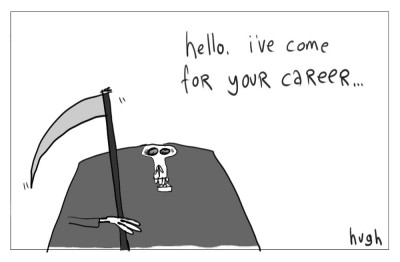 Once again technology and creativity move more quickly than corporate policy. Call me if you need help in developing a social media policy for your company. The cartoon was drawn by an artist named Hugh Macleod. I’ve added a link to his website under my Blogroll on the sidebar.
Bloggers Find The Ax is Mightier Than The Pen | workforce.com
The Coming Fight for Executive Talent – BusinessWeek
I’ve shortened the title of my occasional posts on management issues to Turkeys. Any negative connotations are purely coincidental. This series of posts started while underwriting at my brother’s house and his gaggle of wild turkeys walked by. So say bye-bye to “Remote Underwriting With Turkeys”. Now we’re just talkin’ turkey.
And management issues.
What employment contract? This is a scary article and a must-read for managers.
The Fraying Employment Contract – BusinessWeek
As a reminder I’ve titled posts on management “Remote Underwriting With Turkeys” to make these posts easier to find when using the search function.
If you want to look at older posts on management issues, use “turkeys” as the keyword in the search box.
WORKFORCE METRICS
CONTINGENT COUNTS
Valuable: 73%
Not valuable: 25%
Couldn’t find permanent/regular job: 39%
To learn new skills: 3%
Seek a job: 24%
Hire staff: 13%
Increase: 62%
Decrease: 27%
Source: Bureau of Labor Statistics via Workforce Recruiting Management e-newsletter
The link above takes you to the abstract quoted below. Highlights in bold are my emphasis and not the author’s.
In today’s global economy, employees are much less likely to stay at one organization for the length of their careers. One significant side effect of this trend is that many employees feel less secure in their jobs. According to this study, being afraid of losing your job may be bad for your health. The authors analyzed questionnaires distributed to more than 1,700 people in the U.S. during two separate periods spanning two decades, which allowed them to control for poor health, job insecurity, and actual employment losses over time. As many as 18 percent of the employees surveyed said they felt insecure about their jobs. In one of the study groups, the authors found that chronic job insecurity was a more reliable predictor of poor health than smoking or hypertension. And job insecurity was more closely associated with failing health than actual unemployment, the researchers found, because of the ongoing stress caused by an uncertain future, an inability to take action, and a lack of institutionalized support. One implication for businesses is that employees who worry about losing their jobs have trouble concentrating, experience more stress, and take more sick days. The researchers argue that programs aimed at displaced or unemployed workers won’t reach people who have jobs but are insecure, and they suggest that organizations and government policies aim to lessen the degree of stress linked to job insecurity.
Bottom Line:
Even more than actual unemployment, persistent job insecurity is closely linked to declining health and increased stress in American workers.
 lifeunderwriter.net
You must be logged in to post a comment.