The Cheapest Places To Rent An Apartment In The U.S.

Just another post in a sporadic series of posts on why I like Oklahoma.
Earlier posts are here and here.
You just have to get used to the weather.
The Cheapest Places To Rent An Apartment In The U.S.
Just another post in a sporadic series of posts on why I like Oklahoma.
Earlier posts are here and here.
You just have to get used to the weather.
Do the People Who Live in This House Have the Right to Be “Struggling”?
It is a nice house, but not an extravagant one. It sits next to a house in disrepair, and another house that is kept up. If you notice, there are two doors. The address 196 Lefferts Place, Brooklyn, New York, is divided into two homes, and the house I am talking about is Unit B, consisting of the upper floors of the structure. The cost to be the proud owner of 196 Lefferts Place, Unit B, is $1.395 million.
The greater fool theory in the US residential real estate market.
Have I mentioned lately why I live in Oklahoma?
Why I hate living in my tiny house
At the end of a long driveway, inside a former garage, it’s 240 square feet, or roughly the size of one and a half parking spaces…The small size saves energy and curbs my shopping habits, since there literally isn’t any room for, say, another pair of shoes.


What Wealth Inequality in America Looks Like: Key Facts & Figures
More scary charts can be found at the St. Louis Fed article link above.

Image Credit: “A Generation Without A Future”: Millennials Struggle To Survive In Modern Hong Kong
While reading this article the graphic reproduced above caught my eye.
OKC is mentioned! I seem to recall blogging about this affordability gap here, here, here, and here.
I guess HK is out of my retirement plans.
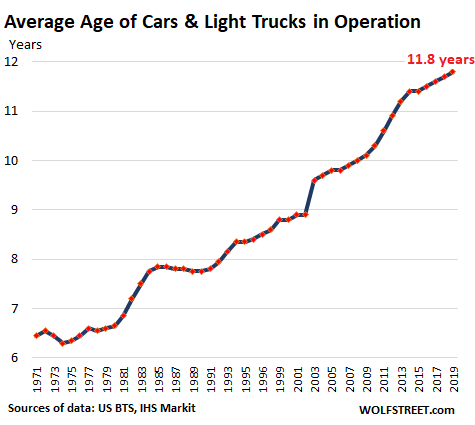
Average Age of Vehicles Sets Record, New-Vehicle Sales Drop to Where They Were 20 Years Ago.
Good article.
Said the owner and driver of a 2006 Ford Taurus.

Reprinted from the original post at https://wolfstreet.com/
Go to this link for the full article.
Note that here in the US we rank #11 worldwide. Read the article to find out who’s in the top ten.
The Authors Guild’s 2018 Author Income Survey, the largest survey of writing-related earnings by American authors ever conducted finds incomes falling to historic lows to a median of $6,080 in 2017, down 42 percent from 2009.
The Authors Guild surveyed its membership and the members of 14 other writers organizations in 2018, receiving detailed responses from 5,067 authors. This included traditionally, hybrid and self-published authors who have commercially published one or more books. When discussing median incomes, the survey looked at both full-time and part-time authors.
The respondents reported a median author income of $6,080, continuing a sharp decline over the last decade: $8,000 in 2014 and $10,500 in 2009 (per the Authors Guild’s 2015 Survey), down again from $12,850 in 2007, as reported in a joint Authors Guild/PEN survey.
Earnings from book income alone fell even more, declining 21 percent to $3,100 in 2017 from $3,900 in 2013 and just over 50 percent from 2009’s median book earnings of $6,250.
The survey showed a shift in book earnings to other writing-related activities, such as speaking engagements, book reviewing or teaching. Including those sources, respondents who identified themselves as full-time book authors still only earned a median income of $20,300, well below the federal poverty line for a family of three or more.
Add writer to the list of occupations to steer your grandchildren away from.
I am a non-professional non-paid writer. And professional writers don’t make much more than I do writing.
Read the entire article here.
Abstract
Although recent declines in life expectancy among non-Hispanic Whites, coined “deaths of despair,” grabbed the headlines of most major media outlets, this is neither a recent problem nor is it confined to Whites. The decline in America’s health has been described in the public health literature for decades and has long been hypothesized to be attributable to an array of worsening psychosocial problems that are not specific to Whites. To test some of the dominant hypotheses, we show how various measures of despair have been increasing in the United States since 1980 and how these trends relate to changes in health and longevity. We show that mortality increases among Whites caused by the opioid epidemic come on the heels of the crack and HIV syndemic among Blacks. Both occurred on top of already higher mortality rates among all Americans relative to people in other nations, and both occurred among declines in measures of well-being. We believe that the attention given to Whites is distracting researchers and policymakers from much more serious, longer-term structural problems that affect all Americans. (Am J Public Health. Published online ahead of print September 25, 2018: e1–e6. doi:10.2105/AJPH.2018.304585)
Interesting AJPH analysis which can be accessed at this link.
The article has a link to the complete analysis in PDF.

 lifeunderwriter.net
You must be logged in to post a comment.