Frontline’s Astonishing Whitewash of the Crisis « naked capitalism.
Economy
MIB Life Index January 2012 +8.3%
Life Index | MIB Solutions, Inc. | The Industry’s Timeliest Measure of Application Activity.
This is encouraging news.
Pressed and Stressed – The New (AB)Normal
Worker stress reflects not only heavier demands in recent years, but the fears and difficulties of the Great Recession that preceded the recovery as well as ongoing economic uncertainty. In effect, employees have been under sometimes-severe strain for roughly four years. Bigger workloads might be easier to shoulder if employees were getting raises, as well. But by and large they aren’t. In the Workforce Management-Workplace Options survey, just 30 percent of those employees reporting an increase in job duties said they got a pay increase as well. And government data show that inflation-adjusted average hourly earnings fell 1.6 percent from October 2010 to October 2011.Still, some observers say workers should get used to the present business as usual. Given doubts about the government’s ability to reduce unemployment rates anytime soon, employers may be able to make always-on “superjobs” the standard rather than the exception. Companies have seen a spurt in productivity, but it may not be a lasting one. Wayne Hochwarter, a management professor at Florida State University in Tallahassee, surveyed more than 700 full-time workers in 2011 and found that employees in a demanding work environment said their job performance had risen. But their anxiety levels at work and home also rose, while their job satisfaction fell. Especially when increased demands come with factors like layoff fears and poor communication by the boss and company, heightened worker productivity is likely to be short-lived, Hochwarter says. “The toll on the human system leads to deteriorating performance and effort,” he says. “The person is left with an empty tank.”
via Today’s Workforce—Pressed and Stressed – Featured Article – Workforce.
The hamsters are dying.
Scary Chart of the Day 10.21.11
Economist’s View: “First Look at US Pay Data, It’s Awful”
The median paycheck — half made more, half less — fell again in 2010, down 1.2 percent to $26,364. That works out to $507 a week, the lowest level, after adjusting for inflation, since 1999.
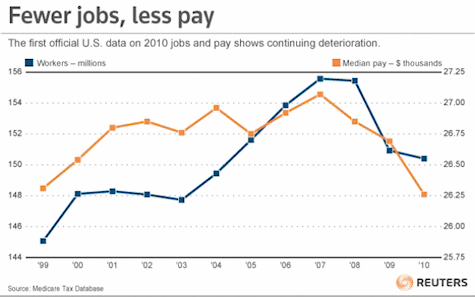
A VERY Scary Chart
 I had gotten away from posting Scary Charts. There were just too many to pick from. But when I came across this graphic, well I just had to post it.
HBR Economic Survey – 09.25.11
Spread Compression Bernanke Style
Thought for Today – 09.18.11
New Economic Perspectives: William Black: Why Nobody Went to Jail During the Credit Crisis
We have known for centuries, that if you don’t underwrite loans, or if you don’t underwrite insurance, you’ll get something called “adverse selection”.
This interview answers the question of why nobody went to jail for our recent financial crisis.
For this underwriter, it’s all about prudent underwriting and strong internal controls.
Failure to Launch
Bryce Covert: Recession Has Lit the Fuse on Explosive Student Debt « naked capitalism
Boomerang kids: 85% of college graduates must move back home – Oct. 14, 2010
If you thought they were gone, think again.
Economic Recovery…Not
Economist’s View: The US Jobless Recovery: Assertive Management Meets the Double Hangover
Will someone (not an economist) please explain to me exactly what a jobless recovery is?
Thought for Today – 7/31/11
Dani Rodrik’s weblog: The great divergence, the other way around
Dani Rodrik’s weblog: Will the divergence in growth result in eventual convergence in incomes?
Dani Rodrik, Professor of International Political Economy at Harvard University, is the author of The Globalization Paradox: Democracy and the Future of the World Economy. HT to Mark Thoma at his blog Economist’s View.
I have no further comment on this topic because there is a lot to think about here.


You must be logged in to post a comment.