Recovery From Covid-19 can Take a Long Time

mm6930e1_SymptomsRiskFactorsOutpatientsCOVID19_IMAGE_24July20_1200x675-medium

In a multi-state telephone survey of symptomatic adults who had a positive outpatient test result for SARS-CoV-2 infection, 35% had not returned to their usual state of health when interviewed 2–3 weeks after testing. Among persons aged 18–34 years with no chronic medical conditions, one in five had not returned to their usual state of health.

Citation: Tenforde MW, Kim SS, Lindsell CJ, et al. Symptom Duration and Risk Factors for Delayed Return to Usual Health Among Outpatients with COVID-19 in a Multistate Health Care Systems Network — United States, March–June 2020. MMWR Morb Mortal Wkly Rep 2020;69:993-998. DOI: http://dx.doi.org/10.15585/mmwr.mm6930e1external icon.

The assumption is that people who are suffering from lingering effects of Covid-19 infection will eventually recover completely.
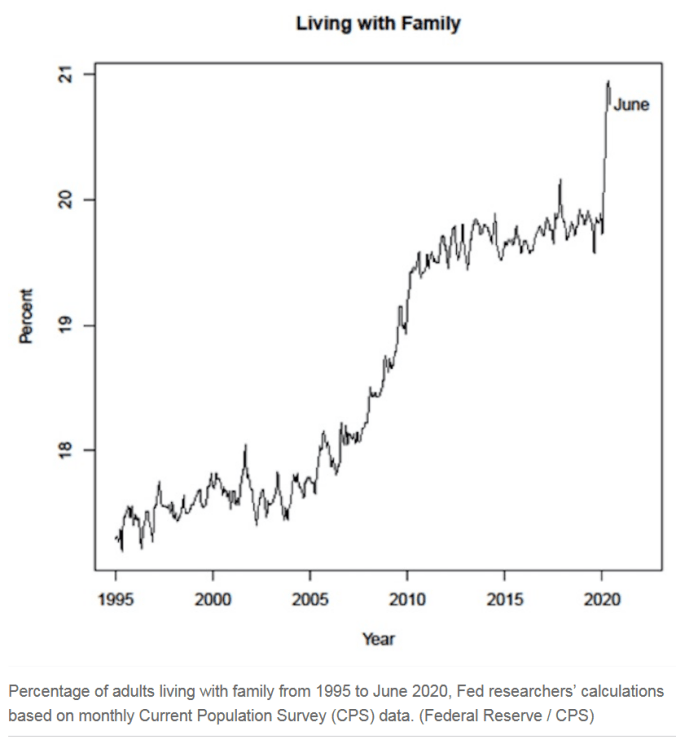
Scary Charts 08.08.20 – Surge In Number of Americans Moving In With Older Family Members

Screenshot_2020-08-08 Surge In Number of Americans Moving In With Older Family Members Amid Pandemic Fed Study

“The COVID-19 pandemic has profoundly affected the living arrangements of millions of Americans,” said Daniel Garcia and Andrew Paciorek, authors of the Aug. 7 study, which looks at the impact of the pandemic on living arrangements and household formation in the United States.

  Surge In Number of Americans Moving In With Older Family Members Amid Pandemic: Fed Study


DO NOT DRINK Hand Sanitizers

From May 1 through June 30, 2020, 15 cases of methanol poisoning were reported in Arizona and New Mexico, associated with swallowing alcohol-based hand sanitizers. Four patients died, and three were discharged with visual impairment.

Serious Adverse Health Events, Including Death, Associated with Ingesting Alcohol-Based Hand Sanitizers Containing Methanol — Arizona and New Mexico, May–June 2020

HandSanitizerCOVID19_IMAGE_05Aug20_1200x675-medium

This should be obvious but I guess it’s not.

Seniors With Covid-19 May Show Unusual Symptoms

“With a lot of conditions, older adults don’t present in a typical way, and we’re seeing that with COVID-19 as well,” said Dr. Camille Vaughan, section chief of geriatrics and gerontology at Emory University.

Instead, seniors may seem “off” — not acting like themselves ― early on after being infected by the coronavirus. They may sleep more than usual or stop eating. They may seem unusually apathetic or confused, losing orientation to their surroundings. They may become dizzy and fall. Sometimes, seniors stop speaking or simply collapse.

  Seniors With COVID-19 Show Unusual Symptoms, Doctors Say

Yikes.

What Seniors Can Expect as Their New Normal in a Post-Vaccine World

“Before COVID-19, baby boomers” — those born after 1945 but before 1965 — “felt reassured that with all the benefits of modern medicine, they could live for years and years,” said Dr. Mehrdad Ayati, who teaches geriatric medicine at Stanford University School of Medicine and advises the U.S. Senate Special Committee on Aging. “What we never calculated was that a pandemic could totally change the dialogue.”

What Seniors Can Expect as Their New Normal in a Post-Vaccine World

The skeptic in me was in complete denial until I got halfway through the list of predictions.

Hell, I’m already doing most of the things on this list now.

How Some People Pass the Time While Waiting for Covid-19 Test Results

With long testing delays in other states, some learn they tested positive after starting vacations in Maine.

The proportion of COVID-19 tests from out-of-staters that are coming back positive in Maine has increased throughout July, with nonresidents now testing positive in Maine at a rate more than four times that of residents. Though the numbers are small – about 2.8 positive tests a day – they account for over 11 percent of recent new cases in the state.

Bar Harbor hospital sounds warning on undetected COVID-infected visitors

HT – https://www.nakedcapitalism.com/

We are doomed.

Mask resistance during a pandemic isn’t new – in 1918 many Americans were ‘slackers’

“Those who cannot remember the past are condemned to repeat it.”

George Santayana


It is difficult to ascertain the effectiveness of the masks used in 1918. Today, we have a growing body of evidence that well-constructed cloth face coverings are an effective tool in slowing the spread of COVID-19. It remains to be seen, however, whether Americans will maintain the widespread use of face masks as our current pandemic continues to unfold. Deeply entrenched ideals of individual freedom, the lack of cohesive messaging and leadership on mask wearing, and pervasive misinformation have proven to be major hindrances thus far, precisely when the crisis demands consensus and widespread compliance. This was certainly the case in many communities during the fall of 1918. That pandemic ultimately killed about 675,000 people in the U.S. Hopefully, history is not in the process of repeating itself today.

  Mask resistance during a pandemic isn’t new – in 1918 many Americans were ‘slackers’

Screenshot_2020-08-02 1-OSDH-Sign-General-Safety-4key-8 5x11-ENG pdf Powered by Box

Screenshot_2020-08-02 3-OSDH-Sign-Restrooms-8 5x11-ENG pdf Powered by Box

Screenshot_2020-08-02 6-OSDH-Sign-Distance-Dots-4x4-SPA_Blue pdf Powered by Box

SARS-CoV-2 Transmission and Infection Among Attendees of an Overnight Camp — Georgia, June 2020

A total of 597 Georgia residents attended camp A. Median camper age was 12 years (range = 6–19 years), and 53% (182 of 346) were female. The median age of staff members and trainees was 17 years (range = 14–59 years), and 59% (148 of 251) were female. Test results were available for 344 (58%) attendees; among these, 260 (76%) were positive. The overall attack rate was 44% (260 of 597), 51% among those aged 6–10 years, 44% among those aged 11–17 years, and 33% among those aged 18–21 years (Table). Attack rates increased with increasing length of time spent at the camp, with staff members having the highest attack rate (56%). During June 21–27, occupancy of the 31 cabins averaged 15 persons per cabin (range = 1–26); median cabin attack rate was 50% (range = 22%–70%) among 28 cabins that had one or more cases. Among 136 cases with available symptom data, 36 (26%) patients reported no symptoms; among 100 (74%) who reported symptoms, those most commonly reported were subjective or documented fever (65%), headache (61%), and sore throat (46%).

SARS-CoV-2 Transmission and Infection Among Attendees of an Overnight Camp — Georgia, June 2020

Citation for this article: Szablewski CM, Chang KT, Brown MM, et al. SARS-CoV-2 Transmission and Infection Among Attendees of an Overnight Camp — Georgia, June 2020. MMWR Morb Mortal Wkly Rep. ePub: 31 July 2020. DOI: http://dx.doi.org/10.15585/mmwr.mm6931e1external icon.

This quoted material comes directly from the MMWR article.  The attack rate is impressive but we need to see follow up for all of the campers who tested positive.  Are we looking at merely mild symptoms as reported in the article or will we see more severe presentations of Covid-19 infection?

Statin Usage is Linked to a Lower Death Rate in Hospitalized COVID-19 Patients

A new study led by Chinese researchers in collaboration with UCLA’s Dr. Yibin Wang, PhD, has shown that people hospitalized with COVID-19 who took statin drugs were less likely to die and less likely to need mechanical ventilation than those who did not take the cholesterol-lowering drugs. Hospitalized patients taking statins had a 5.2% mortality rate, compared to a 9.4% mortality rate in patients not taking statins from two groups of COVID-19 patients with matching clinic characteristics except statin usage. Statin use also was linked to lower levels of inflammation, and a lower incidence of acute respiratory distress syndrome and admission to intensive care units.

The researchers looked back at the records of 13,981 COVID-19 patients admitted to 21 hospitals in the Hubei Province, China. Of those patients, 1,219 were given statins for an average of 25 days during hospitalization. Among patients with hypertension, 319 used statins combined with ACE inhibitors or ARBs, and 603 used statins combined with other antihypertensive drugs. Researchers analyzed mortality rates as well as secondary outcomes, including the need for mechanical ventilation, admission to intensive care units and acute respiratory distress syndrome. They also measured the levels of three inflammation biomarkers – circulating C reactive protein, interleukin 6 and neutrophil counts – selected to represent the overall status of systemic inflammation in the body.

  Statin Usage is Linked to a Lower Death Rate in Hospitalized COVID-19 Patients


‘Staggering’ Increase in COVID-Linked Depression, Anxiety

Since the start of the COVID-19 pandemic, there has been a dramatic increase in depression, anxiety, psychosis, and suicidality, new research shows.

The most profound health problems were found among adults younger than 25 years. Roughly 90% screened positive for moderate to severe depression, and 80% screened positive for moderate to severe anxiety.

One of the most alarming findings was that in June, 25,498 participants who screened positive for depression reported thinking of suicide or self-harm on “more than half of days to nearly every day.” A total of 14,607 participants said they had these thoughts every day.

‘Staggering’ Increase in COVID-Linked Depression, Anxiety

Sadly, not surprising.