Concerning Trends in Retirement – More Less Than Random Thoughts

  • Lack of sufficient savings
  • Inflationary pressures
  • Rising credit card debt
  • Half of respondents said they had saved less than what was needed for retirement.
  • When we asked an open-ended question about why they rated their satisfaction with retired life as they did, inflation was a major reason.

The ‘Concerning Trends’ in Retirement Now https://www.kiplinger.com/retirement/concerning-trends-in-retirement-now

I’ve decided not to retire. Wait, let me clarify my statement.

I’ve not changed my mind about my decision not to retire five years ago.

I love double negative sentences.

 Fewer than twenty percent of older people worldwide enjoy a retirement pension that is enough for them to live off. Although countries like China and India are now also developing their pension systems, the prospect of most older people receiving pensions totaling 60 to 70% of their final salaries remains a long way off.

The invention of retirementhttps://www.swisslife.com/en/home/blog/interview-matthieu-leimgruber.html

The majority of our friends are retired. I’m always asked when I’m going to retire. My quick answer was always “Don’t know”. I’ve since modified my response to “Two to four years”. This has been my answer for the past two years. Might still be my answer next year too.

https://www.kiplinger.com/retirement/retirement-planning/the-90-rule-of-retirement-live-long-and-prosper

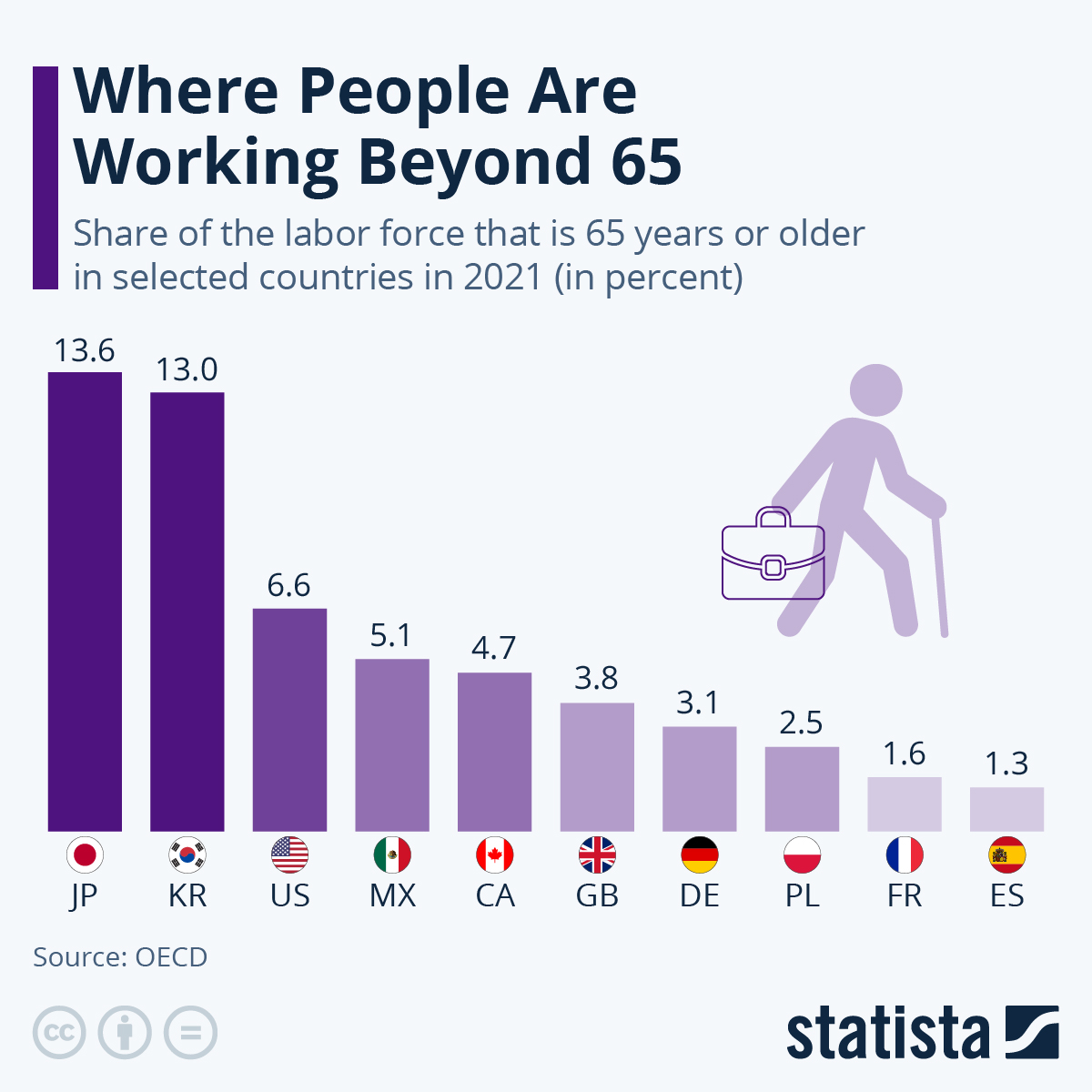
Nearly 40% of Americans ages 55 and older were employed in 2024, according to the Bureau of Labor Statistics — a striking shift that’s even more dramatic when you look at the oldest workers. Today, 2.8 million men over 70 are working in the U.S. — part of an extraordinary long-term transformation in which employment among Americans 75 and older has quadrupled since 1964. More Americans are ‘unretiring’: 5 money factors to weigh before joining themhttps://www.aol.com/finance/retirement-planning/article/unretiring-is-trending-5-money-factors-you-should-consider-first-153926242.html

I think I’ll retire in two to four years.
Scary Charts – 06.12.23

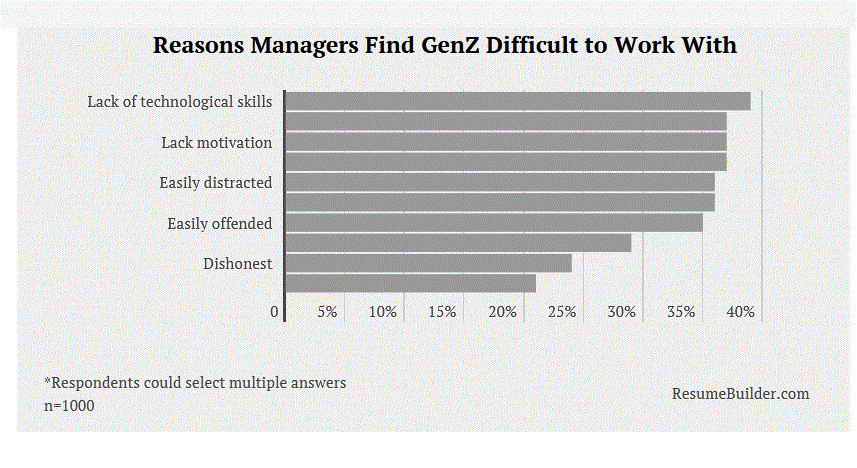
Source: 3 in 4 managers find it difficult to work with GenZ — https://www.resumebuilder.com/3-in-4-managers-find-it-difficult-to-work-with-genz/

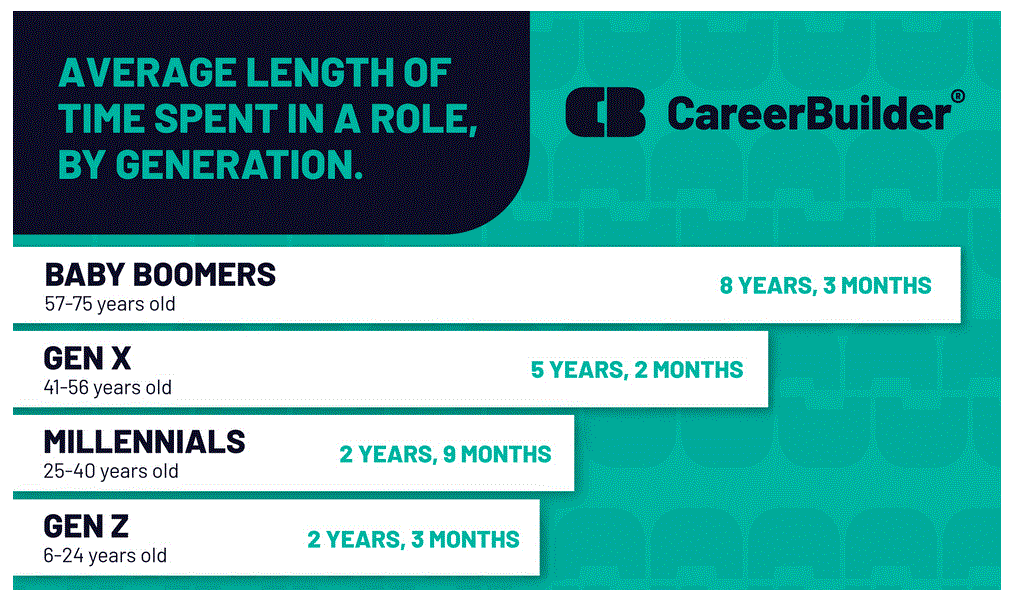
Source: Millennials or Gen Z: who’s doing the most job-hopping — https://www.careerbuilder.com/advice/blog/how-long-should-you-stay-in-a-job

There’s no malicious intent here. I’m not playing generational war games. Any relationship you see between these two survey results could simply be spurious.

Or not.

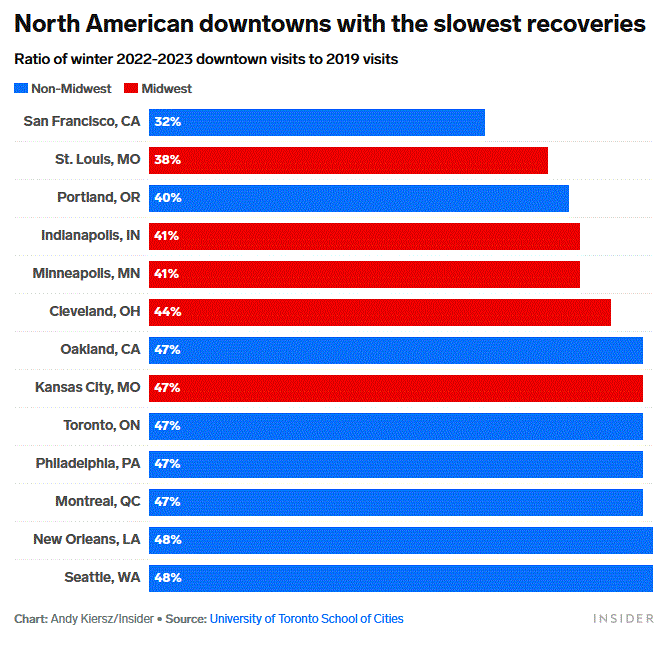
Going Back to the Office? (You Can’t. Not now. Not Ever)

People with talent and high-value skills, like most technology workers, aren’t returning to traditional offices.

How to lure employees back to the office? You can’t. Not now. Not ever. — https://www.zdnet.com/article/they-really-arent-going-back-work-from-home-is-here-to-stay/

I started working from home in 2006. I love reading articles on topics I already know a lot about.

The future of knowledge work will be a hybrid. A small percentage (like myself) will WFH 100% of the time and an even smaller percentage will work in an office 100% of the time. Most will travel to their offices a few times a month and WFH the rest of the time.

I drove a 2006 Ford Taurus for nearly 15 years and didn’t pass 80,000 miles. (short commute)

My business casual attire consists of jeans and a tee shirt.

Coffee is cheaper and tastes a lot better than office coffee too.

Italy at the Grim Edge of a Global Problem | Wolf Street

Eurostat statistics in October 2016 showed that less than a third of under-35s in Italy had left their parental home, a figure 20 percentage points higher than the European average.

Source: Italy at the Grim Edge of a Global Problem | Wolf Street

The grown up child living in her childhood bedroom or the basement is actually a global problem.  I don’t pretend to have the answers.  All I know is my millennials are gone.  Neither of the two are financially dependent upon the Bank of Mom & Dad.  Hopefully we did some things right.  Maybe we got a little lucky.

Probably both.

Stroke Rounds: Long Work Hours, Stroke and CHD Risk Associated | Medpage Today

via Stroke Rounds: Long Work Hours, Stroke and CHD Risk Associated | Medpage Today.

“Working 55 hours or more a week was associated with significant 33% increase in stroke risk and a more modest 13% increase in risk of developing coronary heart disease, compared to working 35 to 40 hours weekly, in the analysis of published and previously unpublished prospective cohort studies from the U.S., Europe, and Australia.”

One could argue for causation given the strength of association identified by this study.  Common sense tells us that anyone working more than 60 hours a week is going to have considerably less time for other activities like exercise and time with family and friends.  Long hours working also can lead to neglect of one’s health.