I briefly considered medical school when I was in my 20’s. I never considered medical school when I was in my 60’s. Wonderful story. A very impressive human being.
Retirement doesn’t just raise financial concerns – it can also mean feeling unmoored and irrelevant
Published: August 29, 2024 8:49am EDT
Author
Marianne Janack John Stewart Kennedy Professor of Philosophy, Hamilton College
Disclosure statement
Marianne Janack does not work for, consult, own shares in or receive funding from any company or organization that would benefit from this article, and has disclosed no relevant affiliations beyond their academic appointment.
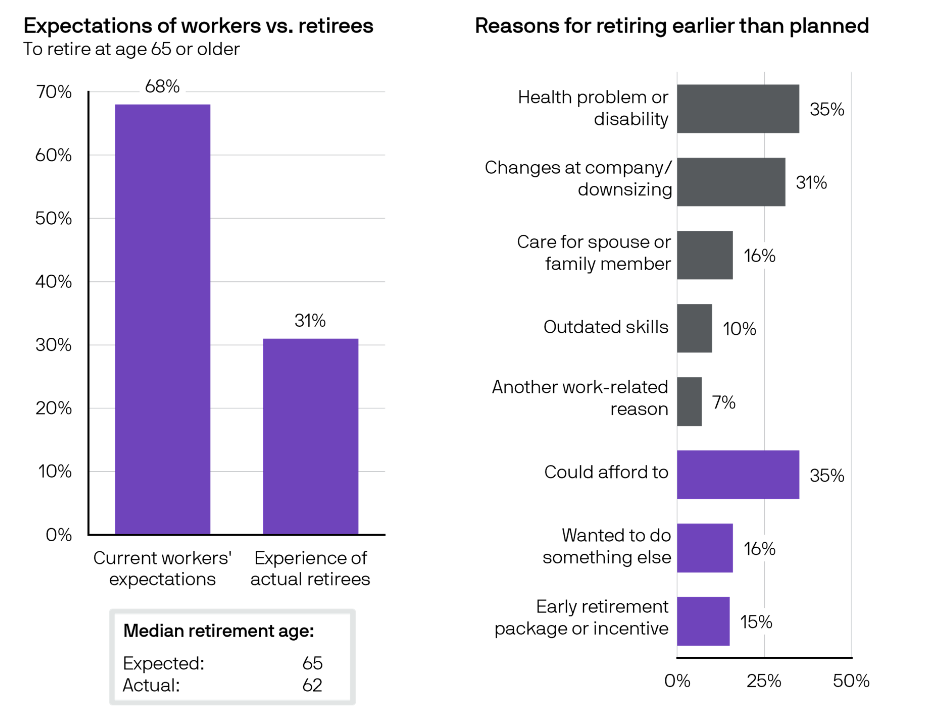
But this might not be the biggest problem that potential retirees face. The deeper issues of meaning, relevance and identity that retirement can bring to the fore are more significant to some workers.
Work has become central to the modern American identity, as journalist Derek Thompson bemoans in The Atlantic. And some theorists have argued that work shapes what we are. For most people, as business ethicist Al Gini argues, one’s work – which is usually also one’s job – means more than a paycheck. Work can structure our friendships, our understandings of ourselves and others, our ideas about free time, our forms of entertainment – indeed our lives.
I teach a philosophy course about the self, and I find that most of my students think of the problems of identity without thinking about how a job will make them into a particular kind of person. They think mostly about the prestige and pay that come with certain jobs, or about where jobs are located. But when we get to existentialist philosophers such as Jean-Paul Sartre and Simone de Beauvoir, I often urge them to think about what it means to say, as the existentialists do, that “you are what you do.”
Don’t let yourself be misled. Understand issues with help from experts
How you spend 40 years of your life, I tell them, for at least 40 hours each week – the time many people spend at their jobs – is not just a financial decision. And I have come to see that retirement isn’t just a financial decision, either, as I consider that next phase of my life.
Usefulness, tools and freedom
For Greek and Roman philosophers, leisure was more noble than work. The life of the craftsperson, artisan – or even that of the university professor or the lawyer – was to be avoided if wealth made that possible.
The good life was a life not driven by the necessity of producing goods or making money. Work, Aristotle thought, was an obstacle to the achievement of the particular forms of excellence characteristic of human life, like thought, contemplation and study – activities that express the particular character of human beings and are done for their own sake.
And so, one might surmise, retirement would be something that would allow people the kind of leisure that is essential to human excellence. But contemporary retirement does not seem to encourage leisure devoted to developing human excellence, partly because it follows a long period of making oneself into an object – something that is not free.
German philosopher Immanuel Kant distinguished between the value of objects and of subjects by the idea of “use.” Objects are not free: They are meant to be used, like tools – their value is tied to their usefulness. But rational beings like humans, who are subjects, are more than their use value – they are valuable in their own right, unlike tools.
And yet, much of contemporary work culture encourages workers to think of themselves and their value in terms of their use value, a change that would have made both Kant and the ancient Greek and Roman philosophers wonder why people didn’t retire as soon as they could.
But as one of my colleagues said when I asked him about retirement: “If I’m not a college professor, then what am I?” Another friend, who retired at 59, told me that she does not like to describe herself as retired, even though she is. “Retired implies useless,” she said.
So retiring is not just giving up a way of making money; it is a deeply existential issue, one that challenges one’s idea of oneself, one’s place in the world, and one’s usefulness.
One might want to say, with Kant and the ancients, that those of us who have tangled up our identities with our jobs have made ourselves into tools, and we should throw off our shackles by retiring as soon as possible. And perhaps from the outside perspective, that’s true.
But from the participant perspective, it’s harder to resist the ways in which what we have done has made us what we are. Rather than worry about our finances, we should worry, as we think about retirement, more about what the good life for creatures like us – those who are now free from our jobs – should be.
At the age of fifty I began the process of becoming what I wanted to be. I had known for a long time that I was a teacher and that the vehicle for my teaching would be in my writing. I also came to the conclusion I would never be compensated well enough through writing to support myself and my family. So I got good at something else.
That something else has and continues to provide a good living.
What I do is who I am and who I am is what I do. No existential crisis here.
For some, it can be dangerous. In the past few years, reports have swelled of people, especially teens, experiencing short- and long-term “marijuana-induced psychosis,” with consequences including hospitalizations for chronic vomiting and auditory hallucinations of talking birds. Multiple studies have drawn a link between heavy use of high-potency marijuana, in particular, and the development of psychological disorders, including schizophrenia, although a causal connection hasn’t been proved. “It’s entirely possible that this new kind of cannabis—very strong, used in these very intensive patterns—could do permanent brain damage to teenagers because that’s when the brain is developing a lot,” Keith Humphreys, a Stanford psychiatry professor and a former drug-policy adviser to the Obama administration, told me. Humphreys stressed that the share of people who have isolated psychotic episodes on weed will be “much larger” than the number of people who end up permanently altered. But even a temporary bout of psychosis is pretty bad. Marijuana Is Too Strong Now – https://www.theatlantic.com/ideas/archive/2024/08/high-potency-marijuana-regulation/679639/
A quick rundown: First, in the middle of the month, news broke that Superpedestrian was shutting down just 18 months after raising $125 million in fresh funding. A few days later, Micromobility.com, formerly known as Helbiz, was delisted from Nasdaq for failing to maintain a share price above $1. Then came the biggest shockwave of all: Bird, the largest e-scooter company in the U.S. with a one-time valuation of $2.5 billion, filed for bankruptcy.
TBH I never understood this e-scooter thing from the very beginning.
Maybe I’m too risk adverse.
UCLA-led research finds that scooter injuries nearly tripled across the U.S. from 2016 to 2020, with a concurrent increase in severe injuries requiring orthopedic and plastic surgery over the same period.
The study, which compared national trends in scooter and bicycle injuries during the period, also found that costs to treat those injuries rose five-fold, highlighting the financial strain these injuries pose to the healthcare system — a finding that “underscores a critical juncture for discerning the underlying causes of injuries and informing policies for injury prevention,” the researchers note.
University of California – Los Angeles Health Sciences. “Hospitalizations for scooter injuries nearly tripled in the US between 2016 and 2020, UCLA-led research finds.” ScienceDaily. ScienceDaily, 9 January 2024 — https://www.sciencedaily.com/releases/2024/01/240109121215.htm
Turkey’s Koc Holding said it revoked an agreement with Ford Motor and South Korean battery maker LG Energy Solution for a joint venture to produce battery cells for commercial electric vehicles…LGES said the three companies had mutually agreed to scrap the plan due to the current pace of consumer electrification adoption.
At the end of Q3 2023, Hertz told investors that significant price cutting during the year had “resulted in lower EV residual values, increasing vehicle depreciation expense and negatively impacting salvage cost.” Additionally, its rental EVs were damaged or crashed more often, and the much higher cost of repairs for Tesla vehicles—on average about 20 percent higher than other EVs—has meant that Hertz’s Teslas earn it less money per vehicle than its other rentals.
Consequently, it’s selling off 20,000 EVs over the course of this year. Currently, the company has over 700 EVs for sale, including 35 Chevrolet Bolts, four Kia EV6s, a single BMW i3 and Nissan Leaf, and then 673 Teslas—552 Model 3s and another 121 Model Ys.
There is a reason for such unusually rapid depreciation. It is precisely because the device is in need of a new battery – and the cost of that battery is (in this case) in the range of $13,000-plus. Not counting the cost of the installation.
Over the past few years, as Tesla built out its gigafactory near Berlin, it cut down around half a million trees.Kayrros, a company that analyzes satellite images using AI, made the calculation. Tesla cleared around 813 acres of forest between March 2020 and May 2023, according to the analysis. Tesla cut down 500,000 trees to build its German gigafactory
Scientists from the University of South Australia measured blood samples from 172 middle aged adults, finding a strong link between low magnesium levels and high amounts of a genotoxic amino acid called homocysteine. University of South Australia. “Low magnesium levels increase disease risk.” ScienceDaily. http://www.sciencedaily.com/releases/2024/08/240812123307.htm (accessed August 13, 2024).
Journal Reference:
Varinderpal S. Dhillon, Permal Deo, Michael Fenech. Low magnesium in conjunction with high homocysteine increases DNA damage in healthy middle aged Australians. European Journal of Nutrition, 2024; DOI: 10.1007/s00394-024-03449-0
Whole grains, dark green leafy vegetables, nuts, beans, bananas, avocados and dark chocolate are magnesium-rich foods.
On a personal level I’ve been taking a low dose statin forever, 100 IU Vitamin D3 and a multivitamin daily, need to move more, Fexofenadine prn, and still not a vegan or drive an EV.
The study found that among older adults aged 75-84, initiation of statin therapy led to a 1.2% risk reduction in major CVD over a 5-year period. For older adults aged 85 and greater, initiation of statins had an even larger impact, leading to a 4.4% risk reduction in major CVD over a 5-year period. The study found that there was no significant difference in adverse effects including myopathy or liver dysfunction in both age groups.
For older adults aged 75 or greater, empiric vitamin D supplementation is recommended because of the possible reduction of risk in all-cause mortality in this population. Of note, this was a grade 2 recommendation by the panel, indicating that the benefits of the treatment probably outweigh the risks. The panel stated that vitamin D supplementation could be delivered through fortified foods, multivitamins with vitamin D, or as a separate vitamin D supplement.
The study found that participants who were more sedentary were less likely to age healthfully, with each additional 2 hours of TV watching per day associated with a 12% reduction in likelihood of healthy aging. Light physical activity was associated with a significant increase in healthy aging, with a 6% increase in the likelihood of healthy aging for each additional 2 hours of light activity. Each additional 1 hour of moderate to vigorous activity was associated with a 14% increase in the likelihood of healthy aging. These findings support discussions with patients that behavior change, even in small increments, can be beneficial in healthy aging.
The Boss once again is outside in the yard doing her thing. I’m inside doing my thing, drinking coffee, reading, writing. One of my addictions is staying current with the news and this post popped up in my RSS feed. At my age it doesn’t take much prompting for me to reflect on retirement. The Road to 70 is nearly complete. Soon I’ll be writing the next chapter of life The Road to 75. Dear Reader, if this sounds “old”, it is.
Critical thinking and understanding risk are the cornerstones of what I do. So when I have an opportunity to validate or repudiate the key assumptions in my plans I am in my Happy Place. When I decided not to retire several years ago my personal mantra focused on the following two critical variables in my retirement planning:
Stay healthy.
Find a willing employer.
Number One. I just had my annual wellness checkup. Bloodwork normal. Tendency towards obesity curtailed. Blood pressure elevated on two readings. Per Doctor’s orders I bought a BP machine and started keeping a log. All of my readings at home have been normal. A little white coat effect and the excitement of seeing my physician (Redhead Effect)…all good.
Number Two. Don’t underestimate how essential having or finding an employer who will pay you to work as you get older. Too many of us know the feeling of being cast out to the street for becoming too “old”.
As I prepare to write the next chapter it’s time to revisit and revise the two most important goals that got me to where I am. After some considerable time and effort here are my revised goals for the next five years.
Group-based trajectory modeling identified four groups of distinct occupational cognitive demands according to the degree of routine tasks in the participants occupations during their 30s, 40s, 50s and 60s. The researchers analyzed the link between these trajectory groups and clinically diagnosed MCI and dementia in participants in the HUNT4 70+ Study (2017-19). Additionally, the researchers accounted for important dementia risk factors such as age, gender, educational level, income, overall health, and lifestyle habits from assessments made in 1984-86 and 1995-97. Within age groupings the researchers looked at such occupations as primary school teacher, salesperson, nurse and caregiver, office cleaner, civil engineer, and mechanic, among others.




You must be logged in to post a comment.