Memoir
Take a Break – 07.20.24
Happy 4th (paint the donkey)

Quote for Today – 06.23.24
“Meaning is not something you stumble across, like the answer to a riddle or the prize in a treasure hunt. Meaning is something you build into your life. You build it out of your own past, out of your affections and loyalties, out of the experience of humankind as it is passed on to you, out of your own talent and understanding, out of the things you believe in, out of the things and people you love, out of the values for which you are willing to sacrifice something. The ingredients are there. You are the only one who can put them together into that unique pattern that will be your life. Let it be a life that has dignity and meaning for you. If it does, then the particular balance of success or failure is of less account.”
John Gardner
Read Gardner’s entire speech here – http://www.pbs.org/johngardner/sections/writings_speech_1.html
(Less Than) Random Thoughts on Retirement – The Dot Project June 2024

Again, you can’t connect the dots looking forward; you can only connect them looking backward. So you have to trust that the dots will somehow connect in your future. You have to trust in something — your gut, destiny, life, karma, whatever. This approach has never let me down, and it has made all the difference in my life.
Steve Jobs
Save as Much as You Can Because Whatever You Manage to Save Will Never Be Enough – Random Thoughts on Retirement was the post that started the entire series of periodic Random Thoughts on Retirement. In More Random Thoughts on Retirement – Memorial Day 2024 I wrote about staying healthy as my primary goal in retirement.
Another Big Dot
Sometimes things in life work out as planned. Sometimes they don’t. This time the plan is going as planned. At my annual wellness check up everything turned out fine except for my blood pressure. The two readings taken showed an elevated systolic and per Doctor’s orders I had to buy a BP machine which set me back $36 plus tax. I was instructed to keep a log for two weeks. For grins, I checked my online account to see what Dr. Lewis wrote for the office visit notes. No mention whatsoever regarding my BP readings. Probably because both of us felt this wasn’t a huge problem. The Boss started showing some concern and I had to report my pressures to her every day. Again I felt this wasn’t a worrisome medical issue. Besides if the diagnosis was hypertension I was looking at daily Lisinopril 10 mg, no big deal.
After two weeks I sent Dr. Lewis my log. She replied later that day.
Thank you for diligently keeping track of your blood pressure readings. I see that your readings have been fairly consistent. Yes you can stop watching it. If you feel fatigued or headaches please recheck it.
Sincerely,
KL
I survived another annual wellness check. The Road to 70 is still pretty smooth. But the ride is not as smooth for others.
A CivicScience survey of nearly 3,000 respondents conducted between March and May 2024 reported 61% of those aged 55 and over say they won’t be able to retire by 65, and 53% will need to keep working even when they do retire. Boomers and Beyond: 5 Ways To Make Extra Money if You Retire in Your 70s – https://www.gobankingrates.com/retirement/planning/boomers-ways-make-extra-money-retire-70s/.
I admit to falling for the clickbait. Of course I wanted to know about 5 ways to make extra money if I retire in my 70’s. And I’m a Boomer. So I read the article. Here are the 5 ways to make extra money:
- Add Money to a High-Yield Savings Account
- Buy Dividend Stocks
- Rent Out Unused Space in Your Home
- Become a Dog Walker
- Become a Ride-Share Driver
What is the average monthly benefit for a retired worker? The estimated average monthly Social Security retirement benefit for January 2024 is $1,907. https://faq.ssa.gov/en-us/Topic/article/KA-01903
Hmm…

I wrote back in May that my focus was simple. All I had to do was stay healthy and stay connected with an employer willing to keep an Old Guy with a particular set of skills on the payroll. More Random Thoughts on Retirement – The Dot Project May 2024. At this point I hope to become a dog walker only if I want to, not if I have to. Prioritize your health. Save as much as you can. Plan on living AND working longer. Defer collecting Social Security retirement until you turn 70 (if you can). Read my other blog https://garyskitchen.net/. Tell your friends and family you found this blog written by an Old Guy on what it takes to become an Old Guy. They’ll love you for this.
More Random Thoughts on Retirement – Memorial Day 2024
JP Morgan data showing expectations vs. reality on the timing of retirement:
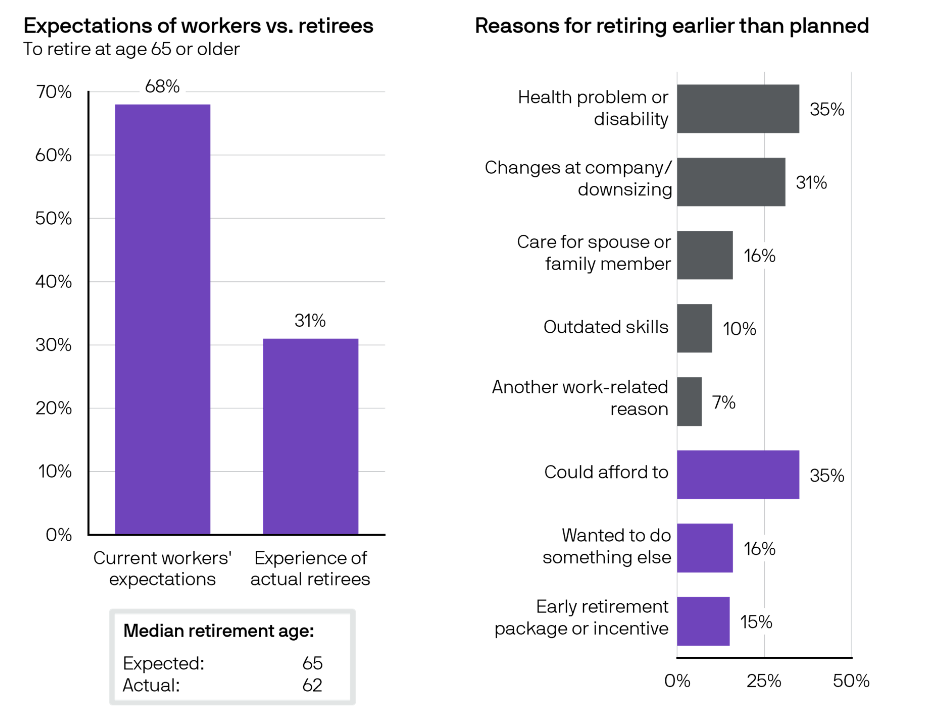
Source: When Life Forces Your Hand – https://awealthofcommonsense.com/2024/05/when-life-forces-your-hand/
Memorial Day 2024
The Boss once again is outside in the yard doing her thing. I’m inside doing my thing, drinking coffee, reading, writing. One of my addictions is staying current with the news and this post popped up in my RSS feed. At my age it doesn’t take much prompting for me to reflect on retirement. The Road to 70 is nearly complete. Soon I’ll be writing the next chapter of life The Road to 75. Dear Reader, if this sounds “old”, it is.
Critical thinking and understanding risk are the cornerstones of what I do. So when I have an opportunity to validate or repudiate the key assumptions in my plans I am in my Happy Place. When I decided not to retire several years ago my personal mantra focused on the following two critical variables in my retirement planning:
Stay healthy.
Find a willing employer.
Number One. I just had my annual wellness checkup. Bloodwork normal. Tendency towards obesity curtailed. Blood pressure elevated on two readings. Per Doctor’s orders I bought a BP machine and started keeping a log. All of my readings at home have been normal. A little white coat effect and the excitement of seeing my physician (Redhead Effect)…all good.
Number Two. Don’t underestimate how essential having or finding an employer who will pay you to work as you get older. Too many of us know the feeling of being cast out to the street for becoming too “old”.
As I prepare to write the next chapter it’s time to revisit and revise the two most important goals that got me to where I am. After some considerable time and effort here are my revised goals for the next five years.
Stay healthy.
Keep working for my current willing employer.
Happy Memorial Day.
More Random Thoughts on Retirement – The Dot Project May 2024
Again, you can’t connect the dots looking forward; you can only connect them looking backward. So you have to trust that the dots will somehow connect in your future. You have to trust in something — your gut, destiny, life, karma, whatever. This approach has never let me down, and it has made all the difference in my life.
Steve Jobs
Let’s be honest: If you keeled over at 68, it would be a family tragedy—but it wouldn’t be a financial one. At that juncture, all your financial problems would be over, and your family would likely be better off financially because they’d inherit your retirement nest egg, which would probably still be largely intact. Instead, the real financial risk is living to a ripe old age. That raises the question: As you make your retirement plans, shouldn’t you care more about the live version of your future self, rather than the dead one?
Long Odds – https://humbledollar.com/2024/05/long-odds/
When I wrote Save as Much as You Can Because Whatever You Manage to Save Will Never Be Enough – Random Thoughts on Retirement I started thinking more about the financial side of living too long. Well, it looks like a ton of media outlets are thinking the same thoughts.
Today’s life expectancies hover just below eighty, and if you reach the milestone of seventy they jump to the mid eighties. Due to advances in medicine and healthier lifestyles, reaching your nineties or even 100 is more realistic than ever. How do you ensure that you don’t run out of money? The answer is to start saving more now and plan to work longer. You’re Going to Live Past 90. Congrats! Here’s How to Pay For It. — https://www.esquire.com/news-politics/a60647995/how-to-afford-living-to-100/
A Big Dot
A little over four and a half years ago at the tender age of 65 my boss asked me if I was planning on retiring or if I wanted to continue working. I said I wanted to continue working. My FRA (full retirement age) for social security retirement benefits was still nearly a year away and I really didn’t want to collect a reduced benefit. As I connect the dots this decision turned out to be a Big Dot. Covid happened. Then inflation soared and continues to soar making everything cost more. I’m glad I didn’t retire back then and lock in a lower monthly lifetime benefit before the cost of everything went up.
Sometimes things in life work out as planned. Sometimes they don’t. When I decided to stay in the workforce the strategy was to wait until age 70 to collect social security benefits. The math was compelling.

https://www.ssa.gov/benefits/retirement/planner/delayret.html
My focus was simple. All I had to do was stay healthy and stay connected with an employer willing to keep an Old Guy with a particular set of skills on the payroll.
The Road to 70 is now just a short trip. Just 10% of people in one survey planned to wait until age 70 to claim Social Security – https://www.cnbc.com/2023/08/08/survey-just-10percent-plan-to-wait-until-age-70-to-claim-social-security.html. Time for another Big Dot related to this Big Dot. I think I’ll keep working for another 3-5 years, contingent upon the same variables of sustained good health and a willing employer. I have about another 30 years to go, so why not do a few more years of work?
Enough
In the pursuit of “fine” to “great,” we chase products. Through no fault of our own, we fall prey to messaging from social media users, algorithms, and expert marketers, urging us that this shampoo or this rug will shift the scales toward enoughness. “This is how the marketplace continues to work,” says Brooke Erin Duffy, an associate professor of communication at Cornell University, “which is by amplifying our inadequacies and insecurities.”
Baked into these social platforms is a natural ecosystem for comparison. In the past, people weighed themselves against celebrities in the media and those within their immediate social circles, Duffy says. Now, we can compare ourselves to the idealized version of millions of strangers online — who may be perpetuating an aesthetic trend inspiring us to buy in order to participate.
How to be enough
Our obsession with self-improvement is making us miserable. https://www.vox.com/the-highlight/24091379/how-to-be-enough-habituation-hedonic-treadmill-comparison
How to be enough.
How to have enough.
Know when enough is enough.
You’re welcome.
A Lego Lesson in Perceived Value
We recently took a trip to Texas with a trunk load full of old Legos to a Lego store that buys and sells Legos. Our entire intent was to de-clutter and get rid of some old sets and extra pieces. We were ready to donate the stuff. Give it away to Goodwill or another charity.
Well…

A Goodwill in Pennsylvania just sold a rare 14-karat gold Lego piece for $18,101.
Goodwill Listed This Rare Gold Lego Piece for $14.95. It Sold for $18,101 — https://www.smithsonianmag.com/smart-news/rare-gold-lego-piece-found-at-goodwill-sells-for-18101-180983913
Complications? What Complications? (just another GLP-1 receptor agonist post)
Adverse events are common in those using GLP-1 agonists, but the vast majority of these are minor. GI adverse effects are most common (20-70% of patients). Greater rate of GI effects with higher doses.
emDOCs Podcast – Episode 94: GLP-1 Agonist Complications — https://www.emdocs.net/?s=glp-1
- Most common problems: nausea (overall most common), vomiting, and diarrhea. Others included abdominal pain, dyspepsia, and constipation.
- Symptoms are typically more severe within the first four weeks of therapy or with sudden escalation of therapy and tend to decrease over time.
- Thought to be due to reduced gastric emptying and activation of centers involved in appetite regulation and nausea.
- Severe diarrhea and vomiting may lead to volume loss, dehydration, and hypotension (not common).
- There is an association with pancreatitis. GLP-1 agonists may stimulate pancreatic islet beta cells and exocrine duct cells leading to overgrowth and smaller duct size, which increase the pancreatic weight and risk of ductal occlusion.
- Retrospective study published in 2022 of 81,752 adverse events associated with GLP-1 agonist therapy found an increased risk of pancreatitis, particularly with liraglutide (ROR 32.67; 95% CI 29.44-36.25). 2023 observational study found increased risk of pancreatitis (adjusted HR of 9.09, 95% CI 1.25-66).
- Other GI issues include gallbladder and biliary tract disease (usually after 26 weeks of therapy and included cholelithiasis, cholecystitis, cholangitis), elevated LFTs, hepatitis, liver injury.
New Wonder Drug! Treat Diabetes, Obesity AND Addiction – (yup another GLP-1 receptor agonist post)
Why People Stop Using Drugs Like Ozempic – Wired (yet another GLP-1 receptor agonist post)
What the Scientists Who Pioneered Weight-Loss Drugs Want You to Know – Wired Magazine
 lifeunderwriter.net
You must be logged in to post a comment.