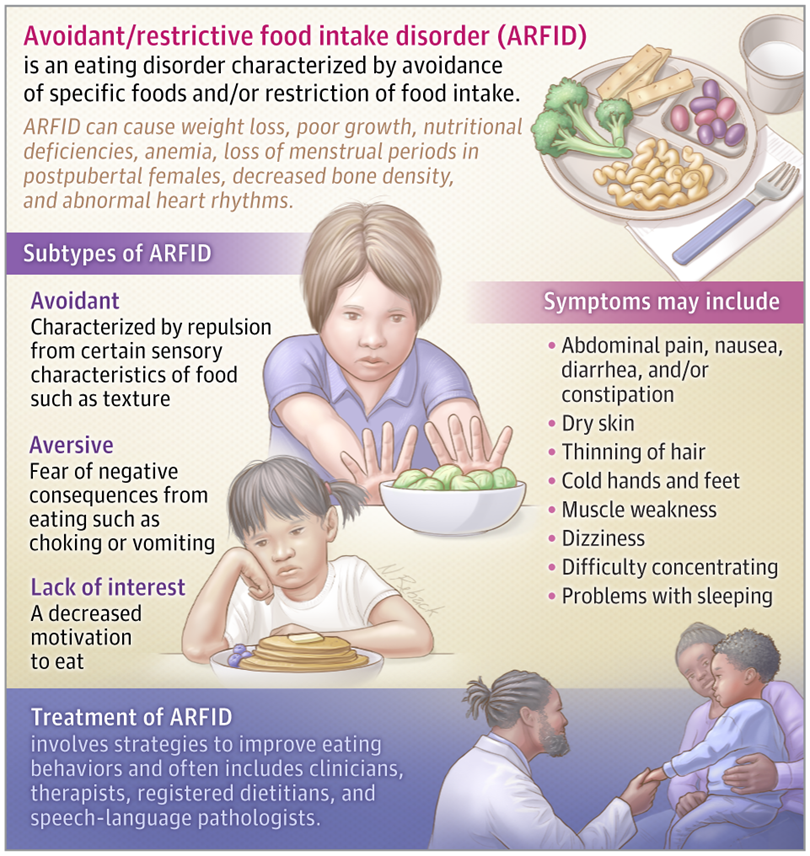
Yikes. https://jamanetwork.com/journals/jama/fullarticle/2842972

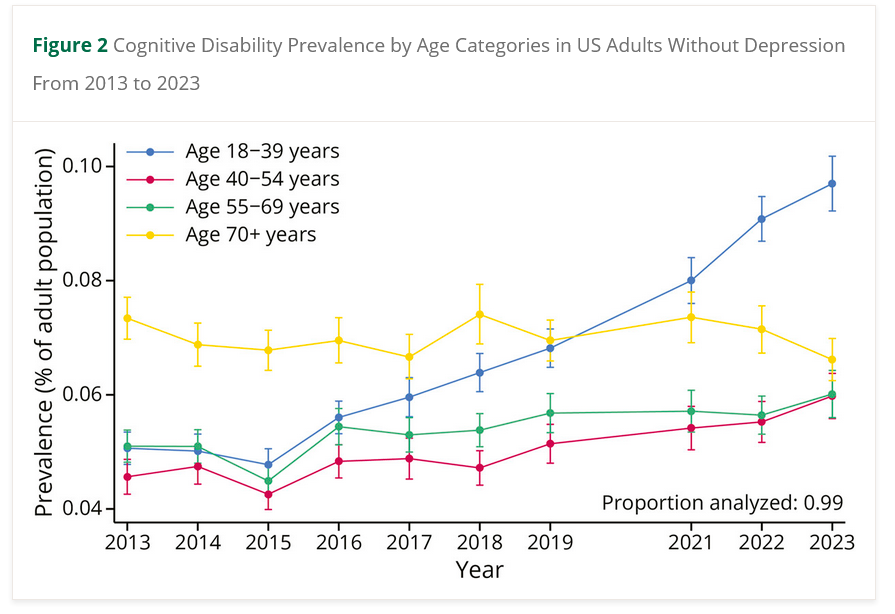
Cognitive disability was strongly associated with socioeconomic factors such as income and education. Adults with household incomes less than $35,000 consistently reported the highest prevalence, increasing from 8.8% (95% CI 8.5%–9.2%) in 2013 to 12.6% (95% CI 12.0%–13.2%) in 2023. By contrast, adults in the highest income bracket (household income ≥ $75,000) had substantially lower prevalence, with a more modest increase from 1.8% (95% CI 1.6%–2.0%) in 2013 to 3.9% (95% CI 3.6%–4.2%) in 2023. Rising Cognitive Disability as a Public Health Concern Among US Adults – Neurology October 21, 2025 issue 105 (8) e214226 https://doi.org/10.1212/WNL.0000000000214226

Overall, income is central to the aging experience. From how well they think they’re aging to how they rate their physical and mental health and financial security, older adults with upper incomes are doing better than those with middle or lower incomes. Aging well: How income and health shape the experiences of older Americans – https://www.pewresearch.org/social-trends/2025/11/06/aging-well-how-income-and-health-shape-the-experiences-of-older-americans/
Yikes.
Michael Gerlich, head of the Centre for Strategic Corporate Foresight and Sustainability at SBS Swiss Business School, began studying the impact of generative AI on critical thinking because he noticed the quality of classroom discussions decline. Sometimes he’d set his students a group exercise, and rather than talk to one another they continued to sit in silence, consulting their laptops. He spoke to other lecturers, who had noticed something similar. Gerlich recently conducted a study, involving 666 people of various ages, and found those who used AI more frequently scored lower on critical thinking. (As he notes, to date his work only provides evidence for a correlation between the two: it’s possible that people with lower critical thinking abilities are more likely to trust AI, for example.) Like many researchers, Gerlich believes that, used in the right way, AI can make us cleverer and more creative – but the way most people use it produces bland, unimaginative, factually questionable work. Are we living in a golden age of stupidity? – https://www.theguardian.com/technology/2025/oct/18/are-we-living-in-a-golden-age-of-stupidity-technology

Yikes.
The increasing rate of mental health disorders among children and adolescents is a concerning trend that has been observed for several decades, with survey studies revealing dramatic increases in anxiety, depression, and suicidal ideation.1 In the United States, suicide ranks as the second leading cause of death for those aged 10 to 19 years and the third leading cause of death for those aged 15 to 24 years.2 Antidepressant Prescriptions and Mental Health – https://publications.aap.org/pediatrics/article/153/3/e2023064677/196661/Antidepressant-Prescriptions-and-Mental-Health
Between January 2016 and December 2022, the monthly antidepressant dispensing rate increased 66.3%, from 2575.9 to 4284.8. Before March 2020, this rate increased by 17.0 per month (95% confidence interval: 15.2 to 18.8). The COVID-19 outbreak was not associated with a level change but was associated with a slope increase of 10.8 per month (95% confidence interval: 4.9 to 16.7). The monthly antidepressant dispensing rate increased 63.5% faster from March 2020 onwards compared with beforehand. In subgroup analyses, this rate increased 129.6% and 56.5% faster from March 2020 onwards compared with beforehand among females aged 12 to 17 years and 18 to 25 years, respectively. In contrast, the outbreak was associated with a level decrease among males aged 12 to 17 years and was not associated with a level or slope change among males aged 18 to 25 years. Antidepressant Dispensing to US Adolescents and Young Adults: 2016–2022 – https://publications.aap.org/pediatrics/article/153/3/e2023064245/196655/Antidepressant-Dispensing-to-US-Adolescents-and?autologincheck=redirected
Between 2020 and 2022, antidepressant prescriptions for girls aged 12-17 skyrocketed by 130%. Antidepressants Increase 130% for Teen Girls, Drop 7% For Boys – https://brownstone.org/articles/antidepressants-increase-130-for-teen-girls-drop-7-for-boys/
Yikes.
The latest study, published in Nature Human Behaviour today, used data from more than 14.8 million people in Taiwan, Denmark and Sweden. It examined the proportion of people in those couples who had one of nine psychiatric disorders: schizophrenia, bipolar disorder, depression, anxiety, attention-deficit hyperactivity disorder, autism, obsessive–compulsive disorder (OCD), substance-use disorder and anorexia nervosa…
The team found that when one partner was diagnosed with one of the nine conditions, the other was significantly more likely to be diagnosed with the same or another psychiatric condition. Spouses were more likely to have the same conditions than to have different ones, says co-author Chun Chieh Fan, a population and genetics researcher at the Laureate Institute for Brain Research in Tulsa, Oklahoma.
Spouses tend to share psychiatric disorders – https://www.nature.com/articles/d41586-025-02772-8
Yikes.
A Case of Bromism Influenced by Use of Artificial Intelligence
This case… highlights how the use of artificial intelligence (AI) can potentially contribute to the development of preventable adverse health outcomes – https://www.acpjournals.org/doi/10.7326/aimcc.2024.1260
Read more AI horror stories here – https://www.thehumanlineproject.org/media
Yikes.
In 2001, only about 1 out of every 7 U.S. workers was 55 or older. By 2021, the number jumped to almost 1 out of every 4 workers (a 93% increase). That’s almost twice the proportion of older workers as before.3 Older workers are staying on the job longer for various reasons, ranging from financial needs to the joy of work. More people are working past the age when they might have retired. They might be responding to the increase in the Social Security full retirement age, needing money or health insurance, or simply enjoying their jobs and being around their friends at work.⁴ Clearing Up Myths About Older Workers While Understanding and Supporting an Aging Workforce — https://blogs.cdc.gov/niosh-science-blog/2023/09/25/older-workers/
I just learned I have a high level of Crystallized intelligence. https://en.wikipedia.org/wiki/Fluid_and_crystallized_intelligence
I have an older post titled My Therapist is a Chatbot and if you liked it you’ll love this story.
Matt Turnbull, Executive Producer at Xbox Game Studios Publishing… looked at everything that has happened this week, particularly the bit where Xbox laid off a bunch of people at the same time Microsoft pledged to invest $80 billion in AI, and decided that not only does he need to give advice to those laid off, but that the advice should come in the form of…AI prompts, which will somehow give responses that will “help reduce the emotional and cognitive load that comes with job loss”. Xbox Producer Recommends Laid Off Workers Should Use AI To ‘Help Reduce The Emotional And Cognitive Load That Comes With Job Loss’ – https://aftermath.site/xbox-microsoft-layoffs-ai-prompt-chatgpt-matt
The source article contains a screen shot of Turnbull’s LinkedIn post. Well worth reading for the shock value alone.
Yikes.
Our research identifies six core attributes of cool people. Specifically, cool people tend to be powerful, hedonistic, adventurous, autonomous, open, and extroverted. Surprisingly, the attributes of cool people vary little across cultures. Cool People https://www.apa.org/pubs/journals/releases/xge-xge0001799.pdf
Sorry but I’m not cool.
 lifeunderwriter.net
You must be logged in to post a comment.