COVID Isolation and Anxiety Reinforce Eating Disorders

In March and April, the National Eating Disorders Association (NEDA) saw a 78% increase in messages sent to its helpline compared with the same period last year.

Dr. John Morton, medical director of bariatric surgery for Yale New Haven Health System, says he’s seeing patients via telehealth who have gained up to 30 pounds recently. He says it can happen within months.

In addition to a confidential and toll-free helpline, NEDA has created a list of free or low-cost resources related to eating disorders: https://www.nationaleatingdisorders.org/help-support/covid-19-resources-page.

COVID Isolation, Anxiety ‘Really Reinforce’ Eating Disorders

Georgia Health News © 2020

Citation: Judi Kanne. COVID Isolation, Anxiety ‘Really Reinforce’ Eating Disorders – Medscape – Aug 13, 2020.

The article focuses mainly on anorexia and bulemia but the quote from Dr. Morton caught my eye.  A 30 pound weight gain in a few months is pretty substantial.  I start to panic after a pound or two.  But if you lose 200 pounds and keep it off you tend to overreact  if the scale shows your weight creeping up.

My pandemic weight journey (so far) has been about taking a few of those stubborn pounds off.  I started the year at 192.  This morning I was 179.  There has to be more happy weight loss stories out there.  The article also didn’t mention anything on Orthorexia Nervosa.  I worry about those people too.
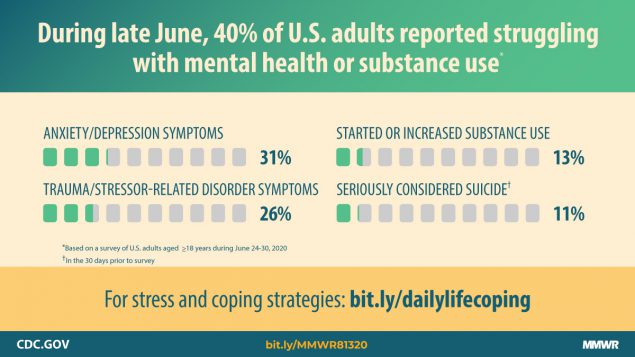
 

Mental Health, Substance Use, and Suicidal Ideation During the COVID-19 Pandemic — United States, June 24–30, 2020

MentalHealthCOVID19_IMAGE_14Aug20_1200x675-medium

The survey results are in line with recent data from Mental Health America, which indicate dramatic increases in depression, anxiety, and suicidality since the start of the COVID-19 pandemic.

Citation: Czeisler MÉ , Lane RI, Petrosky E, et al. Mental Health, Substance Use, and Suicidal Ideation During the COVID-19 Pandemic — United States, June 24–30, 2020. MMWR Morb Mortal Wkly Rep 2020;69:1049–1057. DOI: http://dx.doi.org/10.15585/mmwr.mm6932a1external icon.


‘Staggering’ Increase in COVID-Linked Depression, Anxiety

Since the start of the COVID-19 pandemic, there has been a dramatic increase in depression, anxiety, psychosis, and suicidality, new research shows.

The most profound health problems were found among adults younger than 25 years. Roughly 90% screened positive for moderate to severe depression, and 80% screened positive for moderate to severe anxiety.

One of the most alarming findings was that in June, 25,498 participants who screened positive for depression reported thinking of suicide or self-harm on “more than half of days to nearly every day.” A total of 14,607 participants said they had these thoughts every day.

‘Staggering’ Increase in COVID-Linked Depression, Anxiety

Sadly, not surprising.

Watch Your Quarantini Intake

Nielsen reports alcohol sales in stores were up 54% in late March compared to that time last year, while online sales were up nearly 500% in late April. According to a Morning Consult poll of 2,200 U.S. adults conducted in early April, 16% of all adults said they were drinking more during the pandemic, with higher rates among younger adults: One in 4 Millennials and nearly 1 in 5 Gen Xers said they had upped their alcohol intake.

COVID-19 pandemic brings new concerns about excessive drinking

Copyright is owned or held by the American Heart Association, Inc., and all rights are reserved. Permission is granted, at no cost and without need for further request, to link to, quote, excerpt or reprint from these stories in any medium as long as no text is altered and proper attribution is made to the American Heart Association News. See full terms of use.

I stumbled upon the same AHA news article in several other websites.  The entire article was reprinted in its entirety and just one website provided attribution to the source.  The copyright notice and proper attribution is included above.

Diabulimia

I live with “the world’s most dangerous” eating disorder

I have been struggling with diabulimia on and off since my diagnosis of type 1 diabetes in 2011, at age 30. I had just started a PhD and spent the first semester walking around campus with all the classic symptoms of type 1 diabetes: famished, dehydrated, constantly needing to urinate, and experiencing rapid weight loss. After my diabetes diagnosis, when I started injecting insulin, I gained the weight back—and then some. It didn’t take long to figure out that omitting insulin was not only an effective weight loss tool, compared with vomiting, it was a much less violent way to purge. Having a history of bulimia nervosa, I thought I had found the holy grail. I could eat what I wanted, not use insulin, and not gain weight.

And I thought Orthorexia Nervosa was bad.

More Drugs Please


According to Ginger, an organization that provides mental health services to companies, compared to January and February of this year, prescriptions for psychotropics, most of which were antidepressants, were up 86% for the months of March and April.

The stress of unemployment, social isolation and health concerns are all cited by Americans who say the lock down is having a serious impact on their mental health.

Pharmacy group Express Scripts also revealed that prescriptions for anti-anxiety medications were up 34.1% between mid-February and mid-March, while prescriptions for antidepressants increased 18.6%.

Link to the source article.

Wow.

Anorexia Nervosa – More Dangerous Than You Think

This article is written by an Emergency Medicine doctor for other Emergency Medicine doctors as a quick primer on recognizing and diagnosing anorexia.  While those of us in the life insurance business are not diagnosticians  you will definitely benefit from this short ten minute article on the next case you encounter where Momma Bear is applying for $2,000,000 on her skinny 15 year old daughter who can’t seem to gain weight no matter how much the kid eats.

AN is a common, severe psychiatric illness. It is often present with co-morbid psychiatric illnesses. There is a high mortality rate, 5.6% per decade. It is notoriously difficult to treat with psychotherapy and pharmacotherapy.

Anorexia Nervosa – More Dangerous Than You Think

Nationwide Moves To Permanent Work-From-Home Strategy

“We’ve been investing in our technological capabilities for years, and those investments really paid off when we needed to transition quickly to a 98 percent work-from-home model,” said Nationwide CEO Kirt Walker.

I’ve been working from home for nearly 14 years.  Social distancing comes naturally to me at this point in time.  It’s interesting to me a virus will be remembered as the Gladwell tipping point for showing the corporate world  a better way of working.

98% permanent WFH!