Binge Drinking Boosts Mortality Risk in Older Adults

Binge Drinking Boosts Mortality Risk in Older Adults.

They examined the association between episodic heavy drinking and total mortality among 446 regular moderate drinkers aged 55 to 65 years at baseline. Moderate drinking was defined as up to 1 standard drink per day for women and 2 for men.

Of the 446 adults, 74 engaged in episodic heavy drinking, defined as 4 or more drinks on 1 occasion for women and 5 for men.

During the course of 20 years, the death rate was higher in the moderate drinkers who binged (61%, 45 deaths) than in moderate drinkers who did not binge (37%, 137 deaths).

Although more men than women died during the 20-year period, the distribution of deaths across alcohol consumption groups was similar for women and men (P = .76).

In multiple logistic regression analyses, after adjusting for all covariates as well as overall alcohol consumption, moderate drinkers who engaged in episodic heavy drinking had more than 2 times higher odds of 20-year mortality in comparison with regular moderate drinkers (odds ratio, 2.13; 95% confidence interval, 1.14 – 3.97; P< .05).

And from the CDC –

CDC Online Newsroom – Press Release: January 10, 2012.

Binge drinking statistics from the CDC estimate more than 38 million US adults binge drink an average of 4 times a month and the most drinks they consume on average is 8. The report found that binge drinking is more common among households with incomes ≥$75,000, but the largest number of drinks consumed per occasion is highest among households with incomes of <$25,000
Older Patients & Motor Vehicle Crashes | Physician’s Weekly

Older Patients & Motor Vehicle Crashes | Physician’s Weekly.

According to current estimates, there are about 30 million licensed drivers in the United States aged 65 and older, but this figure is expected to jump to 57 million by 2030. Studies indicate that drivers aged 65 and older have higher rates of motor vehicle crashes (MVCs) per mile driven. Data also show that older motorists have higher rates of death and serious injury and incur greater costs for acute care and rehabilitation. “MVCs are the second leading cause of injury-related death among adults aged 65 and older,” says Jody A. Vogel, MD, MSc. “As the U.S. population ages, EDs will need to be prepared with appropriate resources and protocols to care for older adult MVC patients effectively.”

Higher BMI May Be Better for Older Adults

The association between all-cause mortality and BMI created a U-shaped curve with a broad base (P-nonlinearity <0.001). The “nadir of the curve for BMI and mortality was between 24.0 and 30.9, with the lowest risk being between 27.0 and 27.9 (HR 0.90, 95% CI 0.88-0.92),” wrote Caryl A. Nowson, PhD, of Deakin University in Melbourne, Australia, and her co-authors, in the American Journal of Clinical Nutrition.

They said that mortality risk did not increase with excess weight in this population until BMI was ≥33 (HR 1.08 for BMI of 33.0-33.9, 95% CI 1.00-1.15).

Risk of mortality was highest at a BMI lower than 23, the authors said. Using a BMI of 23.0 to 23.9 as the reference, there was a 12% greater risk of mortality for those with a BMI in the range of 21.0-21.9 (HR 1.12, 95% CI 1.10-1.13) and a 19% greater risk for those with a BMI in the range of 20.0-20.9 (HR 1.19, 95% CI 1.17-1.22), the authors said.

via Higher BMI May Be Better for Older Adults.

BMI and all-cause mortality in older adults: a meta-analysis.

How do I live longer? (get a plant)

In a study of nursing home patients by researchers Ellen Langer and Judith Rodin, residents on one floor were given a plant for which they themselves were expected to care (the experimental group) while residents on another floor were given a plant for which their nurses would care (the control group). After three weeks, 93 percent of residents in the experimental group showed an overall improvement in socialization, alertness, and general function; in contrast, for 71 percent of residents in the control group functioning actually declined. And in a follow-up study eighteen months later, half as many of the residents who’d received plants for which they were expected to care by themselves had died as the residents who’d been given plants for which their nurses cared.

via How do I live longer? Here are 10 ways backed by evidence.

Great post.  To sum up: exercise, be happy, be optimistic, tell yourself aging is a good thing, and get a plant.

Latest Facts & Figures Report | Alzheimer’s Association

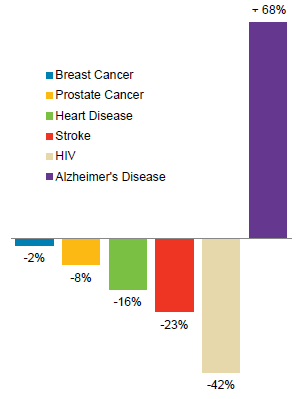
Alzheimer’s disease is the 6th leading cause of death in the United States overall and the 5th leading cause of death for those aged 65 and older. It is the only cause of death among the top 10 in America without a way to prevent it, cure it or even slow its progression. Deaths from Alzheimer’s increased 68 percent between 2000 and 2010, while deaths from other major diseases, including the number one cause of death (heart disease), decreased.

Change in Number of Deaths 2000 - 2010

via Latest Facts & Figures Report | Alzheimer’s Association.