Work as Paradox

The Job Satisfaction Paradox for the Self-Employed – BusinessWeek

How can the self-employed earn less money, work more hours, and experience more work-related stress than the wage employed—yet still report greater overall job satisfaction? The answer appears to be that people value highly the autonomy, flexibility, and opportunity to work in a small organization .

Many studies show that the desire to be one’s own boss is one of the leading motivators of self-employment. Others report flexible schedules are a key motivator of self-employment. Moreover, human beings have a preference for working in settings where they can interact with all the members of the organization, according to research by Bruno Frey and Matthias Benz of the Institute of Empirical Economics of the University of Zurich.

In short, the paradox isn’t such a paradox after all. People will work harder, earn less, and put up with more stress so that they can enjoy the freedom, flexibility, and work environment that self-employment provides.

The Generational Gap Goes Global

Facing Up to the Demographic Dilemma

This is a thought provoking article on the challenges and opportunities aging populations present to businesses.  Under Article Tools you can click the PDF button for a reprint rather than page through multiple web pages.  It still fascinates me to watch businesses in the US shed competent people of all ages while ignoring future workforce and critical skills needs.

ASTD Report – New Factors Compound the Growing Skills Shortage

February 2010 Bridging Skills Gap – Free – ASTD

Click on the link above and you’ll be taken to the original source article for the statistics provided below.  The charts themselves came from a newsletter called Workforce Training.  The percentages in bold are my emphasis.  Scary statistics but fixable.

Did I mention we conduct skills gap analysis and custom training to address the gaps?

SKILL GAPS
Seventy-nine percent of 1,179 companies surveyed by the American Society for Training & Development said they had a skill gap. The respondents listed their highest priority gaps as:
Skills of the current workforce do not match changes in company strategy, goals, markets or business models: 51%
Not enough bench strength in the company’s leadership ranks: 40%
Recent merger/acquisition where the organization brought in new employees or current employees are not up to speed on the new industry: 35
Training investments have been cut or there is lack of commitment by senior leaders to employee learning and development: 27
When hiring for certain types of jobs, there are too few qualified candidates (i.e., a gap in the pipeline): 25%
Lack of skilled talent in one or more of the company’s lines of business: 21%
Source: “Bridging the Skills Gap,” American Society for Training & Development, 2009
WHERE THE GAPS ARE
The same companies listed these as their greatest skill needs:
Leadership/executive level skills: 50%
Basic skills (traditional building blocks of business-level competencies): 46%
Professional or industry-specific skills: 41%
Managerial/supervisory skills: 31
Customer service skills: 31
Communication/interpersonal skills: 31
Technical/IT/systems skills: 30
Sales skills: 30
Process and project management skills: 20
Other: 43
Source: “Bridging the Skills Gap,” American Society for Training & Development, 2009

Another View of the War in Mexico

Business owners and investors!I’ll be in San Antonio for the annual AHOU meeting.

I’m looking forward to seeing how the city has changed since my last visit.

Who’s creating US jobs? Mexicans. / The Christian Science Monitor – CSMonitor.com

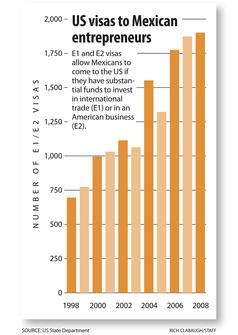
“In fiscal year 2008, the US issued E-1 and E-2 visas to 1901 Mexicans and their families, nearly three times the level of a decade before. “

Where are all of these Mexican immigrant investors going? San Antonio!

Remote Work – Who Are Those Guys?

What are the Top 10 nations for online workers? / The Christian Science Monitor – CSMonitor.com

And the fastest-growing major economy for freelance work?

The United States. “We’re seeing a huge number of Americans come online,” says Brian Goler, vice president of marketing for oDesk. “More and more people are working this way.”

Perhaps they have to because of the economic downturn. Perhaps they want to.

Permanent Elimination of Jobs

How a New Jobless Era Will Transform America – The Atlantic (March 2010)

The construction and finance industries, bloated by a decade-long housing bubble, are unlikely to regain their former share of the economy, and as a result many out-of-work finance professionals and construction workers won’t be able to simply pick up where they left off when growth returns—they’ll need to retrain and find new careers. (For different reasons, the same might be said of many media professionals and auto workers.) And even within industries that are likely to bounce back smartly, temporary layoffs have generally given way to the permanent elimination of jobs, the result of workplace restructuring. Manufacturing jobs have of course been moving overseas for decades, and still are; but recently, the outsourcing of much white-collar work has become possible. Companies that have cut domestic payrolls to the bone in this recession may choose to rebuild them in Shanghai, Guangzhou, or Bangalore, accelerating off-shoring decisions that otherwise might have occurred over many years.

The Contingent Workforce – a $425 Billion Market

You’re Hired. At Least for Now. – Kiplinger.com

The job is not a timeless fact of human existence.  It is a social artifact.

William Bridges wrote these words over 15 years ago.  We need to fully understand this concept and decide what kind of future we want for ourselves.  Do you want to be in or out?  Nearly four years ago I started my business on a part-time basis.  One year ago, I became  100% self-employed. If you are an underwriter, the time to be an independent for hire has never been better.

If you’re in underwriting management your options for creating the right hybrid model to fit your needs has never been better.  I’ve said it before and I’ll say it again:

I have a mortgage, two kids in college, and a small fleet of cars to support.  Hire me please.