NEJM Journal Watch – 06.05.20

Prevalence of asymptomatic disease: An estimated 40–45% of people who test positive for SARS-CoV-2 do not have symptoms at the time of testing, according to a narrative review of 16 cohorts in the Annals of Internal Medicine. In four cohorts with longitudinal data, few of the asymptomatic patients (0–10%) went on to develop symptoms. But in one skilled nursing facility, 89% of initially asymptomatic patients became sick. The researchers say, “It is imperative that testing programs include those without symptoms.” They add, “The early data that we have assembled on the prevalence of asymptomatic SARS-CoV-2 infection suggest that this is a significant factor in the rapid progression of the COVID-19 pandemic.”

COVID-19: Asymptomatic Disease Prevalence / N95 Mask Reuse / Oxygen Management Strategies / Anti-Racism Demonstrations / Studies Retracted

Smoking cigarettes — even one or less per day — is associated with increased mortality risk, a JAMA Network Open study shows.  Researchers combined data from several federal smoking surveys performed between 1992 and 2011. In those surveys, some 500,000 adults reported their smoking histories. National mortality data showed that, compared with never-smokers, daily smokers (averaging 600 cigarettes per month) bore a 2.3-fold higher all-cause mortality risk, with non-daily smokers (averaging 40 per month) sustaining a 1.8-fold higher risk.  Heightened mortality risks became apparent even at levels of 6 to 10 cigarettes per month.  The researchers conclude: “Thus, all smokers should quit, regardless of how infrequently they smoke.”

Infrequent Smoking Carries Heightened Mortality Risk

How the USAF Limited Covid-19 Transmission

USAF Covid

Nonpharmaceutical interventions (NPI) introduced among 10,579 basic trainees at Joint Base San Antonio-Lackland limited COVID-19 incidence to five cases (47 per 100,000 persons), three of which were in persons who were contacts of the first patient.

Citation for this article: Marcus JE, Frankel DN, Pawlak MT, et al. COVID-19 Monitoring and Response Among U.S. Air Force Basic Military Trainees — Texas, March–April 2020. MMWR Morb Mortal Wkly Rep. ePub: 2 June 2020. DOI: http://dx.doi.org/10.15585/mmwr.mm6922e2external icon.

An Interview With Erin Bromage

For every extra body you take out of a room, you are lowering the risk that somebody infected is in there to start off with. Then assuming that someone in that environment is infected, there is a gradient of respiratory droplets from that person that radiates out. So, certainly, having people spread out more in enclosed environments is an important way to reduce infection, but it’s not the solution to controlling all infections. Having a restaurant at half capacity that is still enclosed and has no or very little air exchange is going to be just as risky, but to fewer people.

Memo to Self:

Add the concept of dose-time to your Covid-19 risk reduction strategy.

Add a link to the Medscape interview with Erin Bromage.

An Interview With Erin Bromage

Covid-19 Buzz Cut – Done – 05.31.20

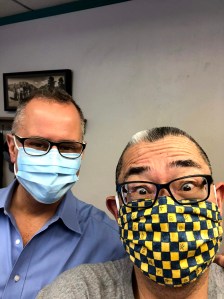
Getting WAY longer.  Note the Andy Rooney eyebrows.  The time had come to go back to my barber.

img_2008

Meanwhile in Oklahoma…we’re reopening but nearly nothing appears to be pre-Covid.  The outside world feels different from all of the behavioral changes.

SITUATION UPDATE: COVID-19

Screenshot_2020-05-31 COVID-19 Oklahoma State Department of Health

One of the changes at the barbershop was opening on Sunday mornings for cleaning and taking a few customers for haircuts by appointment only.  Business at the shop has been slow which tells me the customers here are still pretty much staying at home and sheltering in place.  They may have discovered the joys of cutting your own hair.  Or maybe money is tight, less frequent trips.  Or worse…

But for me this visit was about trust.  Trust in a man who has cut my hair for nearly fifteen years.  This is a man who would not put himself, his customers nor his business at risk.

Thanks Kevin.  I’ll see you again in a couple of weeks.

img_2009


Half of newly diagnosed coronavirus cases in Washington are in people under 40

Half of newly diagnosed coronavirus cases in Washington are in people under 40

cv-age-group-cases-W

Oops.

This shit is real and it is scary. COVID is taking patients down, and we do not know how to stop it. The images of overflowing EDs, overworked providers, patients who cannot breathe—these are real and it is happening. Do not let anyone tell you its not.

Rebecca Karb MD

This shit is real.  Don’t ever forget that.

More Drugs Please


According to Ginger, an organization that provides mental health services to companies, compared to January and February of this year, prescriptions for psychotropics, most of which were antidepressants, were up 86% for the months of March and April.

The stress of unemployment, social isolation and health concerns are all cited by Americans who say the lock down is having a serious impact on their mental health.

Pharmacy group Express Scripts also revealed that prescriptions for anti-anxiety medications were up 34.1% between mid-February and mid-March, while prescriptions for antidepressants increased 18.6%.

Link to the source article.

Wow.

Anorexia Nervosa – More Dangerous Than You Think

This article is written by an Emergency Medicine doctor for other Emergency Medicine doctors as a quick primer on recognizing and diagnosing anorexia.  While those of us in the life insurance business are not diagnosticians  you will definitely benefit from this short ten minute article on the next case you encounter where Momma Bear is applying for $2,000,000 on her skinny 15 year old daughter who can’t seem to gain weight no matter how much the kid eats.

AN is a common, severe psychiatric illness. It is often present with co-morbid psychiatric illnesses. There is a high mortality rate, 5.6% per decade. It is notoriously difficult to treat with psychotherapy and pharmacotherapy.

Anorexia Nervosa – More Dangerous Than You Think