
Remember when I posted about Oklahoma producing 64 times more marijuana than licensed users consume – The Oklahoman? Or about Rooms for Rent – Airbnb Crashes? Well, here’s a post about the best of both worlds.

If you noticed something about the people who were arrested I noticed the same thing. Mostly male.
The recent analysis in JAMA focused on serious stomach disorders and GLP-1 agonists.
Researchers in Canada compared safety outcomes for GLP-1 agonists and bupropion-naltrexone, an older class of weight-loss medication. The retrospective analysis included 4144 people with obesity who were prescribed liraglutide, 613 prescribed semaglutide, and 654 prescribed the older treatment. People with a diabetes code in their health record were excluded from the study.
The GLP-1 group had a 9 times greater risk of pancreatitis, a 4 times greater risk of bowel obstruction, and a more than 3 times greater risk of gastroparesis, which causes stomach paralysis. The absolute risks in the GLP-1 group, however, were all about 1% or less per year of GLP-1 use. And semaglutide and liraglutide were not associated with biliary disease, which affects the gallbladder and bile production.
As Semaglutide’s Popularity Soars, Rare but Serious Adverse Effects Are Emerging — https://jamanetwork.com/journals/jama/fullarticle/2812192
Sorry, but as a reasonably normal human who lost >200 pounds without surgery or drugs I just don’t get it. We all want the easy way out I guess.
John Mayer fan? Great. Not a fan? Skip this vid.
“We found that alcohol and THC together significantly reduced, and in some cases prevented, the ability of the prefrontal cortex in drug-exposed rats to undergo plasticity in the same way that the brains from control animals can,” said Linyuan Shi, a graduate student in the Gulley lab. “The effects were apparent in rats exposed to either drug alone, and they were most pronounced with co-exposure to both drugs. We also found the impaired plasticity was likely due to changes in signaling caused by gamma-aminobutyric acid, a chemical messenger in the brain. When we used a chemical that enhances GABA, it could rescue the deficits we saw in the animals that had been exposed to the drugs.”
Carl R. Woese Institute for Genomic Biology, University of Illinois at Urbana-Champaign. “Combined use of alcohol and THC can affect rat brains, study finds.” ScienceDaily. ScienceDaily, 30 November 2023 — https://www.sciencedaily.com/releases/2023/11/231130121946.htm
I’m glad I am not a rat.
Young adults who simultaneously use alcohol and marijuana (SAM) consume more drinks, are high for more hours in the day, and report more negative alcohol-related consequences.
On SAM use days, participants consumed an average of 37% more drinks, with 43% more negative alcohol consequences, were high for 10% more hours, and were more likely to feel clumsy or dizzy, compared with non-SAM use days.
Simultaneous Marijuana, Alcohol Use Linked to Worse Outcomes — https://www.medscape.com/viewarticle/996595?icd=login_success_gg_match_norm&isSocial
Hmmm…

Two fossilized specimens, each less than 2.5 inches in length, were originally thought to be plants. Now, scientists say they are preserved hatchling turtles. Society of Vertebrate Paleontology, December 2023 under CC BY 4.0 DEED
“We found that alcohol and THC together significantly reduced, and in some cases prevented, the ability of the prefrontal cortex in drug-exposed rats to undergo plasticity in the same way that the brains from control animals can,” said Linyuan Shi, a graduate student in the Gulley lab. “The effects were apparent in rats exposed to either drug alone, and they were most pronounced with co-exposure to both drugs. We also found the impaired plasticity was likely due to changes in signaling caused by gamma-aminobutyric acid, a chemical messenger in the brain. When we used a chemical that enhances GABA, it could rescue the deficits we saw in the animals that had been exposed to the drugs.”
Carl R. Woese Institute for Genomic Biology, University of Illinois at Urbana-Champaign. “Combined use of alcohol and THC can affect rat brains, study finds.” ScienceDaily. ScienceDaily, 30 November 2023 — https://www.sciencedaily.com/releases/2023/11/231130121946.htm
I’m glad I am not a rat.
My favorite excerpt from the letter:
Let’s be honest, some people in academia are horrible, arrogant, selfish and narcissistic. And no matter how much the people at the top say they deal with bad behaviour, the nasty folk do have an annoying habit of getting promoted. The way in which academia selects and rewards particular skill sets produces an over-concentration of people who are low on empathy. I’ve met a lot of those ‘special’ colleagues over the years (no names mentioned obviously). I will not miss them one jot. They create a toxic working environment , dominate the discourse, ride roughshod over the rules, and cause a great deal of harm to others and get away scot-free. They’ve done me significant mental damage, but I can now happily forget them and move on with life.
My recommendation to anyone starting out in academia is stand your ground, challenge these energy vampires and politely make it clear that you don’t want to play their stupid toxic games. They really don’t have the power that they want you to believe they have, even though the system tends to promote them to roles that are beyond their emotional competence to fulfill. Pity them for the lack of other things to do with their lives. And, remember that 98% of what we do as academics is of no importance at all out there in the real world, so when a self-entitled colleague insists that their work on their favourite gene is earth-shattering; more important than anything you could ever do; and a good reason for their career to be advanced faster than yours; just smile and ignore them. Do your own thing, at your own pace. Have a life outside the university and remember that it’s just a job.
https://journalofhumannutritionanddieteticseditor.wordpress.com/2023/11/27/thats-it/
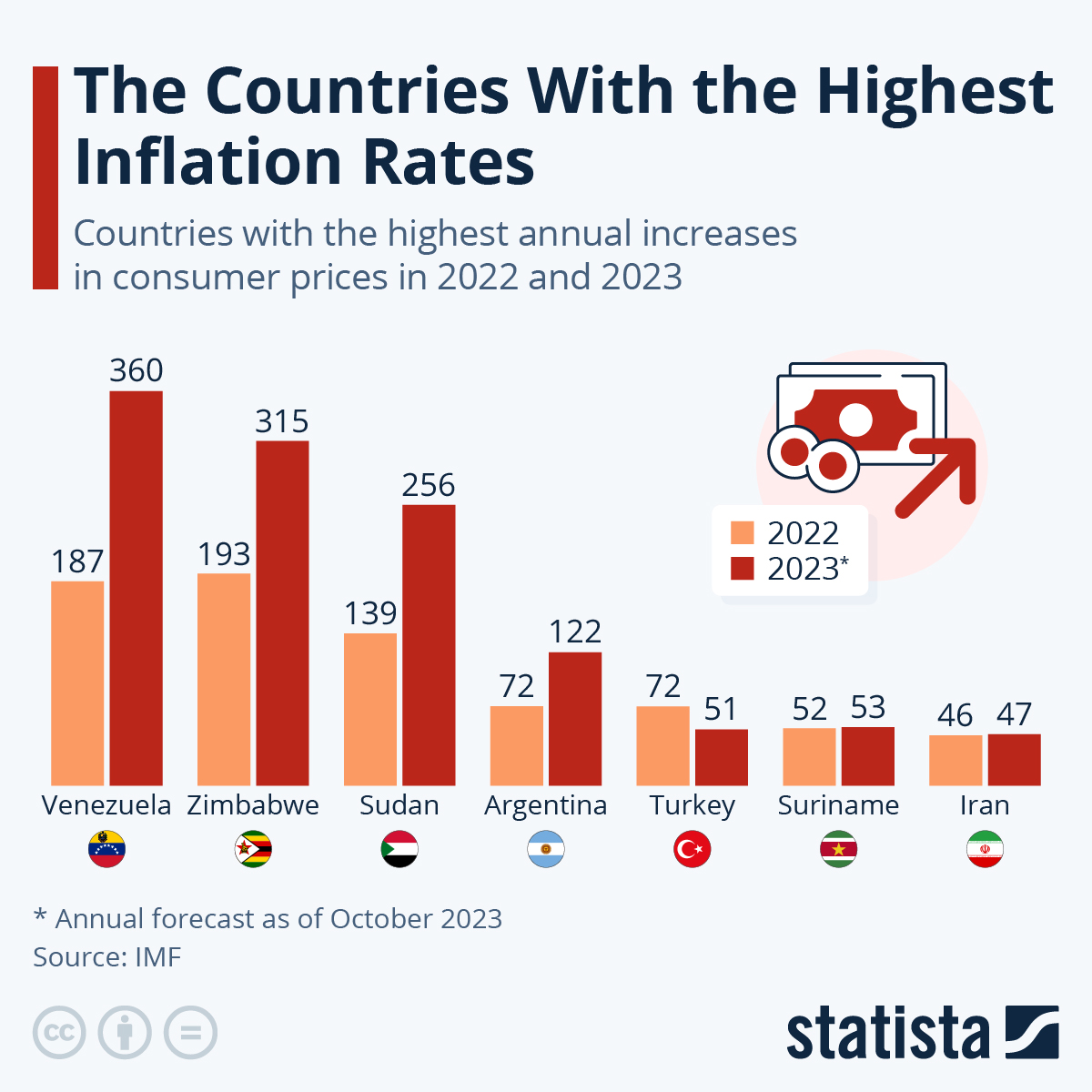
Source: https://www.statista.com/chart/31306/countries-with-the-highest-annual-increases-in-consumer-prices/
I suppose this should make us feel better about higher prices in the US.
More good news – lithium is cheap again.

Lithium “Shortage” Bubble Implodes (Again), Price Collapsed 77% in a Year, as Demand and Production Both Surged – https://wolfstreet.com/2023/11/23/lithium-shortage-bubble-implodes-once-again-as-demand-and-production-both-surged/
Now all we need to do is find people who want and can afford to buy an EV.
Last month, Ford had laid off some workers building the F-150 Lightning electric pickup truck. Competitor General Motors also said it was postponing adding more production capacity for its electric Chevrolet Silverado EV citing slow-growing demand.
Ford battery plant is back on track but scaled down — https://www.cnn.com/2023/11/21/business/ford-battery-plant-downscaled/index.html
Average new electric vehicle prices are actually down by more than $14,000 compared with 2022, settling at around $50,683 on average, thanks to a combination of increased supply, the arrival of more affordable models and trim levels and aggressive price cuts by Tesla, the largest EV manufacturer in the US.
Cheapest Electric Cars for 2023 — https://www.cnet.com/roadshow/news/the-most-affordable-electric-cars-for-2023/
 lifeunderwriter.net
You must be logged in to post a comment.