Failure to Launch was a movie released in 2006 starring Matthew McConaughey. Failure to Launch 2020 version is summarized in this chart:
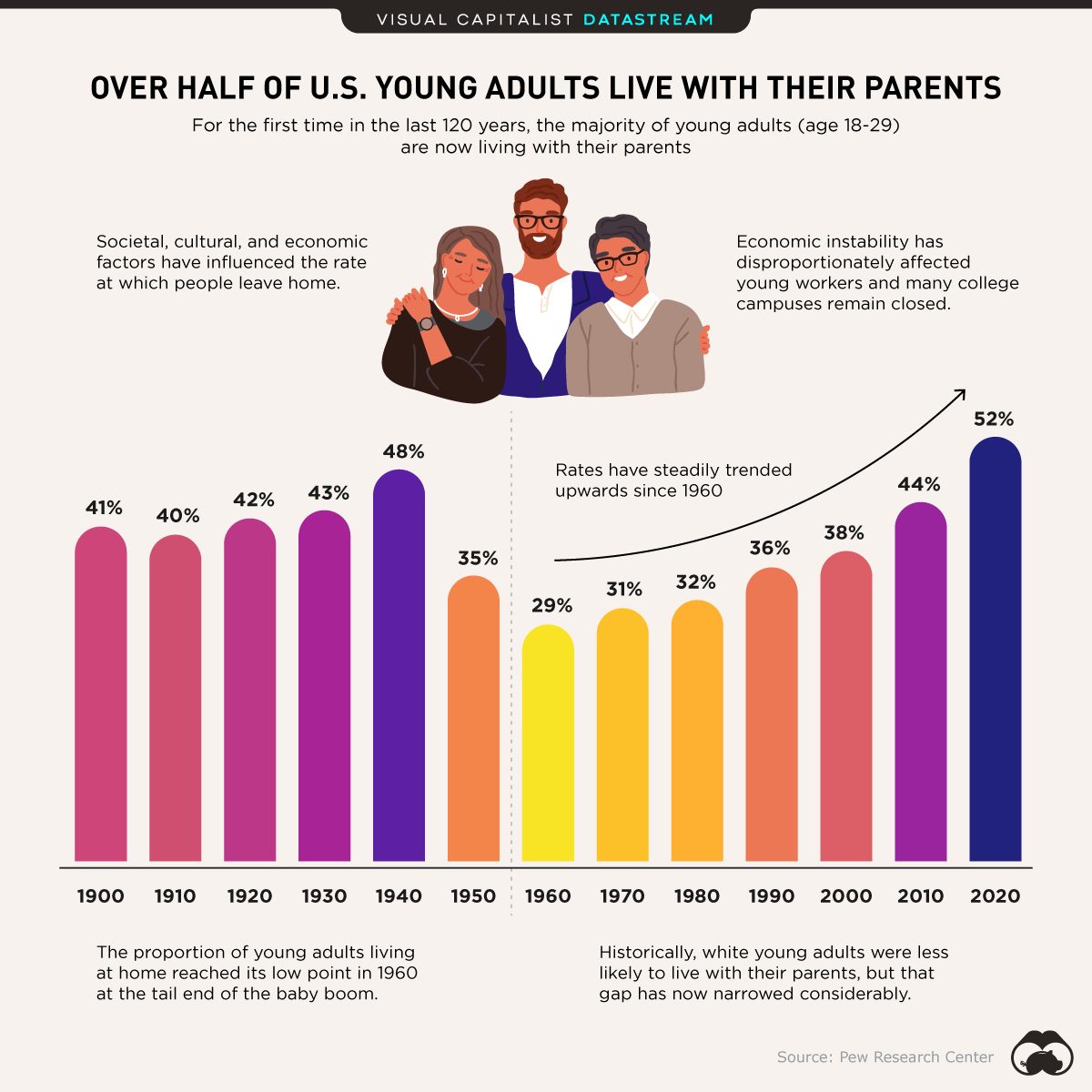
Failure to Launch was a movie released in 2006 starring Matthew McConaughey. Failure to Launch 2020 version is summarized in this chart:
“Everybody has a plan until they get punched in the mouth.”
Mike Tyson

The drop in the volume of employment in a given sector always has a ripple effect in the national economy. The loss of so many high-paying jobs in a short time will be a dent in the coffers of Los Angeles County and for New York state in the short term. Michele Evermore, senior policy analyst for the Washington, D.C.-based National Employment Law Project, says it hits at a time when other industries are undergoing similar sweeping realignments with huge human toll.
“Nobody’s got a plan for how to transition these massive sectors of the workforce into a different thing,” Evermore says.
Hollywood Grapples With Mass Layoffs as the Biz Redefines Itself for Streaming Future — https://variety.com/2020/tv/news/hollywood-layoffs-streaming-future-1234838650/
I sat for a few minutes thinking about what to write next when Charlie Hunter popped into my head. Hunter titled one of his albums with the Tyson quote.
Which was then followed by some great advice from Charlie on his strategy for success and survival in the years to come.
Don’t wait until you get punched in the mouth to make your Plan B. And while you’re at it you might want to come up with a Plan C as well.
Just another Saturday morning except this day starts the second half of a long four day Thanksgiving holiday break. We have given our thanks for the things we are grateful for. Today I’m asking all who read this post to give thanks for all of our front line healthcare workers for whom there is no break from work. We have many dedicated people who are spending the holiday away from their families while most of us are spending time with our families. These brave souls are putting their own health and safety on the line for the rest of us.
I’m getting better at writing effective click-bait blog post titles.
Test avoidance appears to be a growing problem, at least anecdotally. Many of the same people who dismiss the need to test feel the same way about wearing a mask, in part because they think no one has the right to tell them to do either.
First It Was Masks; Now Some Refuse Testing for SARS-CoV-2 – JAMA. 2020;324(20):2015-2016. doi:10.1001/jama.2020.22003 – https://jamanetwork.com/journals/jama/fullarticle/2772860
I am speechless.
This article has not been edited and the article was originally published on The Conversation. https://theconversation.com/planning-a-road-trip-in-a-pandemic-11-tips-for-before-you-leave-on-the-road-and-when-you-arrive-149620
Planning a road trip in a pandemic? 11 tips for before you leave, on the road and when you arrive
November 26, 2020
Author – Thea van de Mortel
Professor, Nursing and Deputy Head (Learning & Teaching), School of Nursing and Midwifery, Griffith University
As restrictions ease around the country and the prospect of travel beckons, many of us will be planning road trips for the holiday season.
To ensure your trip is memorable in the best rather than the worst way, here are some things you and your fellow travellers can do to reduce the risk of becoming infected with, or spreading, COVID on your trip.
Before you go
On your trip
When you arrive
Following these simple steps can help to keep your trip memorable in the best possible way. Happy holidays!
Copyright © 2010–2020, The Conversation US, Inc.
The most robust predictor of toilet paper stockpiling was the perceived threat posed by the pandemic; people who felt more threatened tended to stockpile more toilet paper. Around 20 percent of this effect was also based on the personality factor of emotionality — people who generally tend to worry a lot and feel anxious are most likely to feel threatened and stockpile toilet paper. The personality domain of conscientiousness — which includes traits of organization, diligence, perfectionism and prudence — was also a predictor of stockpiling.
Max Planck Institute for Evolutionary Anthropology. “Personality traits linked to toilet paper stockpiling: High levels of emotionality and conscientiousness are indicators for stockpiling behavior.” ScienceDaily. http://www.sciencedaily.com/releases/2020/06/200612172227.htm (accessed November 25, 2020).
In case you haven’t noticed it’s happening again. Where’s the toilet paper?
If you’ve been anywhere near the internet I’m sure the headlines caught your eye. But a 43% higher risk of fractures just seemed really high to me with a meat free diet as the cause. I found the following article online. Since most people nowadays can’t get past the headlines you’ll find the second paragraph completely ignored by the media.
Compared with people who ate meat, vegans with lower calcium and protein intakes on average, had a 43% higher risk of fractures anywhere in the body (total fractures), as well as higher risks of site-specific fractures of the hips, legs and vertebrae, according to a study published in the open access journal BMC Medicine. Vegetarians and people who ate fish but not meat had a higher risk of hip fractures, compared to people who ate meat. However, the risk of fractures was partly reduced once body mass index (BMI), dietary calcium and dietary protein intake were taken into account.
The authors caution that they were unable to differentiate between fractures that were caused by poorer bone health (such as fractures due to a fall from standing height or less) and those that were caused by accidents because data on the causes of the fractures were not available. No data were available on differences in calcium supplement use between the different diet groups, and as in all dietary studies the estimates of nutrients such as dietary calcium or dietary protein are subject to measurement error. As the study predominantly included white European participants, generalisability to other populations or ethnicities may be limited, which could be important considering previously observed differences in bone mineral density and fracture risks by ethnicity, according to the authors.
Vegans, vegetarians and pescetarians may be at higher risk of bone fractures — https://www.eurekalert.org/pub_releases/2020-11/bc-vva111820.php
As I was gathering my thoughts the algorithms started doing what they do and this popped up in YouTube.
Let’s discuss the latest paper from the EPIC database. Excuse me eating while working. Not enough hours in day. Short version: this is a database from 90’s. Average fiber intake is 20 gm so not healthiest plant based eaters. Meat eaters got more vitamin D. Also (forgot to mention in video) used hormone replacement therapy up to 50% more. Both associated with stronger bones. Other studies have shown that plant based eaters have great bone health BUT you have to be healthy. Get dark greens. Drink or eat soy (studies show as good dairy for bones). Exercise and use resistance training. And take supplements if needed. I like multivitamins that have K2 as that may be a nutrient vegans are deficient in unless you eat natto 🤮. Definitely vitamin D if deficient. The EPIC Oxford cohort are not the healthiest vegans and vegetarians BUT have less ischemic stroke, weight less, generally better heart and less of certain cancers despite poor supplementation and diet habits.
Dr. Garth Davis YouTube post 11.23.20
I love it when someone else does the work for me. If you have eleven minutes listen to Dr. Davis’ analysis. I am now less confused.
“I’m sick to death of people saying we’ve made 11 albums that sound exactly the same. In fact, we’ve made 12 albums that sound exactly the same.”
Angus Young AC/DC
The researchers found that after one day of total isolation, the sight of people having fun together activates the same brain region that lights up when someone who hasn’t eaten all day sees a picture of a plate of cheesy pasta.
“People who are forced to be isolated crave social interactions similarly to the way a hungry person craves food. Our finding fits the intuitive idea that positive social interactions are a basic human need, and acute loneliness is an aversive state that motivates people to repair what is lacking, similar to hunger,” says Rebecca Saxe, the John W. Jarve Professor of Brain and Cognitive Sciences at MIT, a member of MIT’s McGovern Institute for Brain Research, and the senior author of the study.
The research team collected the data for this study in 2018 and 2019, long before the coronavirus pandemic and resulting lockdowns. Their new findings, described today in Nature Neuroscience, are part of a larger research program focusing on how social stress affects people’s behavior and motivation.
Massachusetts Institute of Technology. “A hunger for social contact: Neuroscientists find that isolation provokes brain activity similar to that seen during hunger cravings.” ScienceDaily. http://www.sciencedaily.com/releases/2020/11/201123120724.htm (accessed November 23, 2020).
Taxpayers face a loss of $435 billion on the $1.37 trillion in student loans on the government’s financial statement at the beginning of this year, even if no additional loans are issued going forward, according to an internal study by the Department of Education, reported by the Wall Street Journal which reviewed the documents. Most of the losses would come from the already established income-based repayment programs and the debt forgiveness at the end of their term.
But who ultimately got this money, since students were just the conduit? The educational-financial-industrial complex, of course, the entities that have lined up to clean out the taxpayer via these student loans. Billionaires have been printed in the process, enabled and encouraged by the government since 2009. Any solution to the student-loan crisis needs to include measures that shut down that money-transfer and return the government’s role in student loans to where it had been before 2009.
Taxpayers Face $435 Billion in Student-Loan Losses, Already Baked in: Leaked Education-Department Study — https://wolfstreet.com/2020/11/22/taxpayers-face-435-billion-in-student-loan-losses-already-baked-in-department-of-education-study/
And let’s not forget who The Great Enabler was behind the college leaders’ lack of caring for their students College Presidents Fail to Protect Students from Covid-19 – College Clusterfuck Update 11.22.20. Politicians, of course.
We. Are. Doomed.
 lifeunderwriter.net
You must be logged in to post a comment.