Amazon has announced a massive recall of a version of its Ring doorbell, according to a notice posted on the U.S. Consumer Product Safety Commission (CPSC) website. The recall involves the Ring Video Doorbell (2nd Generation) with the model number 5UM5E5. The reason for the recall is because the “video doorbell’s battery can overheat when the incorrect screws are used for installation, posing fire and burn hazards,” according to the CPSC.
350,000 Amazon Ring doorbells recalled after some units catch fire
Fast Company
Pfizer and BioNTech Announce Vaccine Candidate Against COVID-19 Achieved Success in First Interim Analysis from Phase 3 Study
Vaccine candidate was found to be more than 90% effective in preventing COVID-19 in participants without evidence of prior SARS-CoV-2 infection in the first interim efficacy analysis
Analysis evaluated 94 confirmed cases of COVID-19 in trial participants
Study enrolled 43,538 participants, with 42% having diverse backgrounds, and no serious safety concerns have been observed; Safety and additional efficacy data continue to be collected
Submission for Emergency Use Authorization (EUA) to the U.S. Food and Drug Administration (FDA) planned for soon after the required safety milestone is achieved, which is currently expected to occur in the third week of November
Clinical trial to continue through to final analysis at 164 confirmed cases in order to collect further data and characterize the vaccine candidate’s performance against other study endpoints
Press Release — https://www.pfizer.com/news/press-release/press-release-detail/pfizer-and-biontech-announce-vaccine-candidate-against
How Pfizer’s COVID-19 vaccine works: mRNA
“There was always a discussion: Is the spike protein the right target? Well, now we know it’s the right target,” Anthony Fauci, director of the National Institute of Allergy and Infectious Diseases, told STAT on Monday. “So, it’s not only immediate good news, it really is optimistic about what’s going to roll out in the next several months with the other vaccines.”
Four reasons for encouragement based on Pfizer’s Covid-19 vaccine results — https://www.statnews.com/2020/11/09/four-reasons-for-encouragement-based-on-pfizers-covid-19-vaccine-results/?utm_campaign=rss
Meanwhile in Oklahoma – 11.08.20 (exponential growth UPDATE)
State Health Commissioner Dr. Lance Frye said the following in a statement released Sunday: “Today’s individual case number, 4,507, is a corrected version of yesterday’s number with all duplicate cases removed. Today we will not be releasing a new daily case number, allowing our data reporting system to catch up and ensure duplications are removed from the daily number prior to release moving forward. Starting tomorrow, the daily number released will not include any duplicates. We are committed to giving the public and media accurate and transparent data, and this will ensure the daily number reflects the actual case count. We will continue to point to the 7-day average, percent positivity and hospitalizations in addition to the daily number to give a more complete picture of trends. We have no reason to believe our revised number is an anomaly, but instead shows community spread is occurring. We continue to urge all Oklahomans to take this highly-contagious virus seriously and act immediately to avoid large gatherings, wear a mask, wash your hands and watch your distance to others. Together we can bring these numbers down and protect our friends, family and neighbors.”
Source: https://kfor.com/news/health/coronavirus/osdh-releases-statement-regarding-corrected-covid-19-case-count-now-4507/
4507 NOT 4741!
My original post follows below. I’m glad we got this number fixed. Am I supposed to feel better now?
The headline came across my Twitter feed and my eyes just froze. Oklahoma reported 4,741 new coronavirus cases which obliterated the previous single-day record. I am still in a state of shock and tried to confirm the number at https://coronavirus.health.ok.gov/. Unfortunately the state’s webpage has numbers are only updated to 11.06.20.
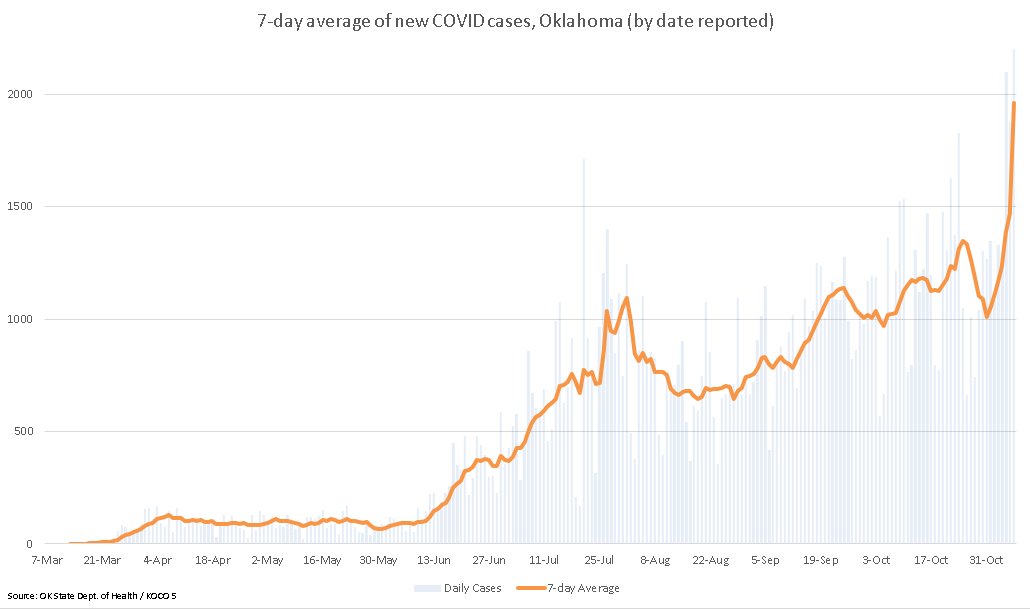
If today’s reported numbers turn out to be accurate it’s going to be a long, cold, nasty winter.
Update
The Oklahoma State Department of Health reported 4,741 new infections on Saturday, shattering the previous daily record of 2,101 that was set on Thursday, and moving Oklahoma’s 7-day average to near 2,000 new cases. There have been 136,492 cases of COVID-19 diagnosed in Oklahoma since the pandemic began.
Oklahoma officials place responsibility on state residents after huge surge in COVID cases — https://oklahoman.com/article/5675726/oklahoma-officials-place-responsibility-on-state-residents-after-huge-surge-in-covid-cases
The record number of new infections today is confirmed.
Tomorrow I go shopping to stock up the pantry.
Quote for Today (and for a better tomorrow) – 11.08.20
You can’t build a healthy economy on a sick population.
Kim Henry -executive director of Sarkeys Foundation https://www.sarkeys.org/ and Oklahoma’s former first lady — Source: https://oklahoman.com/article/5675776/opinion-you-cant-build-a-healthy-economy-on-a-sick-population
Every tomorrow starts with today.

Lung Ultrasound Beats Chest X-Ray for COVID-19 Diagnosis
Point-of-care lung ultrasound is better than chest x-ray for diagnosis of COVID-19 pneumonia, according to new research.
Lung Ultrasound Beats Chest X-Ray for COVID-19 Diagnosis – Medscape – Nov 06, 2020 — https://www.medscape.com/viewarticle/940563?src=rss
Meanwhile in Oklahoma – 11.07.20 (exponential growth)
The headline came across my Twitter feed and my eyes just froze. Oklahoma reported 4,741 new coronavirus cases which obliterated the previous single-day record. I am still in a state of shock and tried to confirm the number at https://coronavirus.health.ok.gov/. Unfortunately the state’s webpage has numbers are only updated to 11.06.20.
If today’s reported numbers turn out to be accurate it’s going to be a long, cold, nasty winter.
Update
The Oklahoma State Department of Health reported 4,741 new infections on Saturday, shattering the previous daily record of 2,101 that was set on Thursday, and moving Oklahoma’s 7-day average to near 2,000 new cases. There have been 136,492 cases of COVID-19 diagnosed in Oklahoma since the pandemic began.
Oklahoma officials place responsibility on state residents after huge surge in COVID cases — https://oklahoman.com/article/5675726/oklahoma-officials-place-responsibility-on-state-residents-after-huge-surge-in-covid-cases
The record number of new infections today is confirmed.
Tomorrow I go shopping to stock up the pantry.
Scary Charts San Francisco Edition – Nov. 2020
There were 2,532 homes listed for sale in San Francisco at the end of October, up 77% from the same week a year ago, according to data from Redfin. About two-thirds were condos. According to data from Compass, inventory of condos for sale was up 85% year-over-year. Inventory of single-family houses was up 25%:
Condo Prices Drop 9% in San Francisco, All-Time Record Inventory Glut Piles Up — https://wolfstreet.com/2020/11/05/condo-prices-drop-9-in-san-francisco-all-time-record-inventory-glut-piles-up/

Meanwhile in Aspen…
In 2019 throughout the entire year, 27 residential properties sold for a price over $10 million. So far this year, a record 48 properties have sold for prices over $10 million, of which 39 have sold since April. This is twice the volume of 2019 and we still have almost four months remaining in the year.At the beginning of 2019, the median price per square foot of a residential property in Aspen was about $1,350. At the end of August, that median square-foot price had risen roughly 15% to about $1,550. In the Snowmass market at the beginning of 2019, the median price per square foot for a residential property was about $680. At the end of August, that median price had risen to about $760, a roughly 12% increase.
Small: The pandemic and rising real estate values locally — https://www.aspendailynews.com/opinion/small-the-pandemic-and-rising-real-estate-values-locally/article_3d9ffcfc-fbaa-11ea-8b7b-379359f41398.html
And since I have your attention down here near the end of the post about that mask debate in Oklahoma…


The Mink Link – Science Chronicle

Since June, 214 people in Denmark have been reported to have been infected with a variant of the novel coronavirus — cluster 5 — associated with farmed minks. This includes 12 cases reported on November 5, eight of whom had a link with mink farming while four cases were from the community. Preliminary findings indicate […]
No evidence to suggest cluster 5 variant increases coronavirus transmissibility, disease severity — Science Chronicle
A good article to read when you think of the mink link and Covid-19.
Mothers’ Lifestyle Predicts When Offspring will have First Heart Attack or Stroke
Previous research has shown that parents pass on health to their offspring through both genes and shared environment/lifestyle. This was the first study to examine whether parents’ heart health was associated with the age at which offspring develop cardiovascular disease. In addition, it investigated the influence of each parent separately.
The study was conducted in offspring-mother-father trios from the Framingham Heart Study — a total of 1,989 offspring, 1,989 mothers, and 1,989 fathers. Offspring were enrolled at an average age of 32 years and followed over 46 years (1971-2017) for the development of cardiovascular events. “Crucially, the study followed offspring into most of their adult life when heart attacks and strokes actually occur,” explained Dr. Muchira
European Society of Cardiology. “Mothers’ lifestyle predicts when offspring will have first heart attack or stroke.” ScienceDaily, 4 November 2020. www.sciencedaily.com/releases/2020/11/201104194708.htm.
Journal Reference: Muchira JM, Gona PN, Mogos MF, et al. Parental cardiovascular health predicts time to onset of cardiovascular disease in offspring. Eur J Prev Cardiol., 2020 DOI: 10.1093/eurjpc/zwaa072
 lifeunderwriter.net
You must be logged in to post a comment.