Trends in Behavioral Health Medications

Nurse practitioners had the largest increases in prescribing incident prescriptions across the 5 drug classes. This is consistent with a study that found that behavioral health visits among Medicare beneficiaries conducted by psychiatric behavioral health nurse practitioners increased by 162%, whereas those by psychiatrists decreased by 6% from 2011 to 2019.35 Our study, based on incident prescription data, suggests an increasing contribution of nurse practitioners initiating medication treatment of behavioral health conditions compared with other health care practitioners.

Chai G, Xu J, Goyal S, et al. Trends in Incident Prescriptions for Behavioral Health Medications in the US, 2018-2022. JAMA Psychiatry. Published online January 10, 2024. doi:10.1001/jamapsychiatry.2023.5045 — https://jamanetwork.com/journals/jamapsychiatry/fullarticle/2813980

Welcome to our new world of self-diagnosed ADHD, online pill mills, and “shortages” of prescription medications.

The past couple of decades have seen a continuous increase in attention deficit hyperactivity disorder (ADHD) diagnoses. National population surveys reflect an increase in the prevalence from 6.1% to 10.2% in the 20-year period from 1997 to 2016 and experts continue to debate and disagree on the causes for this trend.1

ADHD Diagnostic Trends: Increased Recognition or Overdiagnosis? Mo Med. 2022 Sep-Oct; 119(5): 467–473.– https://www.ncbi.nlm.nih.gov/pmc/articles/PMC9616454/

Too Old To Grow Up?

Percentage change in the leading health conditions affecting millennials in the United States from 2014 to 2018 — https://www.statista.com/statistics/1276447/percentage-change-of-the-leading-conditions-affecting-millennials

I was doing my usual Saturday morning routine, catching up on whatever was catching my attention and I came across this Scary Chart looking for ADHD incidence in Millennials. Whoa…check out the early CAD percentage increase.

Scary Charts – 08.13.23 (and yet another Dark Side of Tik Tok)

APC indicates annual percentage change. This study of alcohol-related mortality in the US suggests there has been a significantly higher rate of increase in deaths among female individuals in recent years.

Trends in Alcohol-Related Deaths by Sex in the US, 1999-2020 — http://10.1001/jamanetworkopen.2023.26346

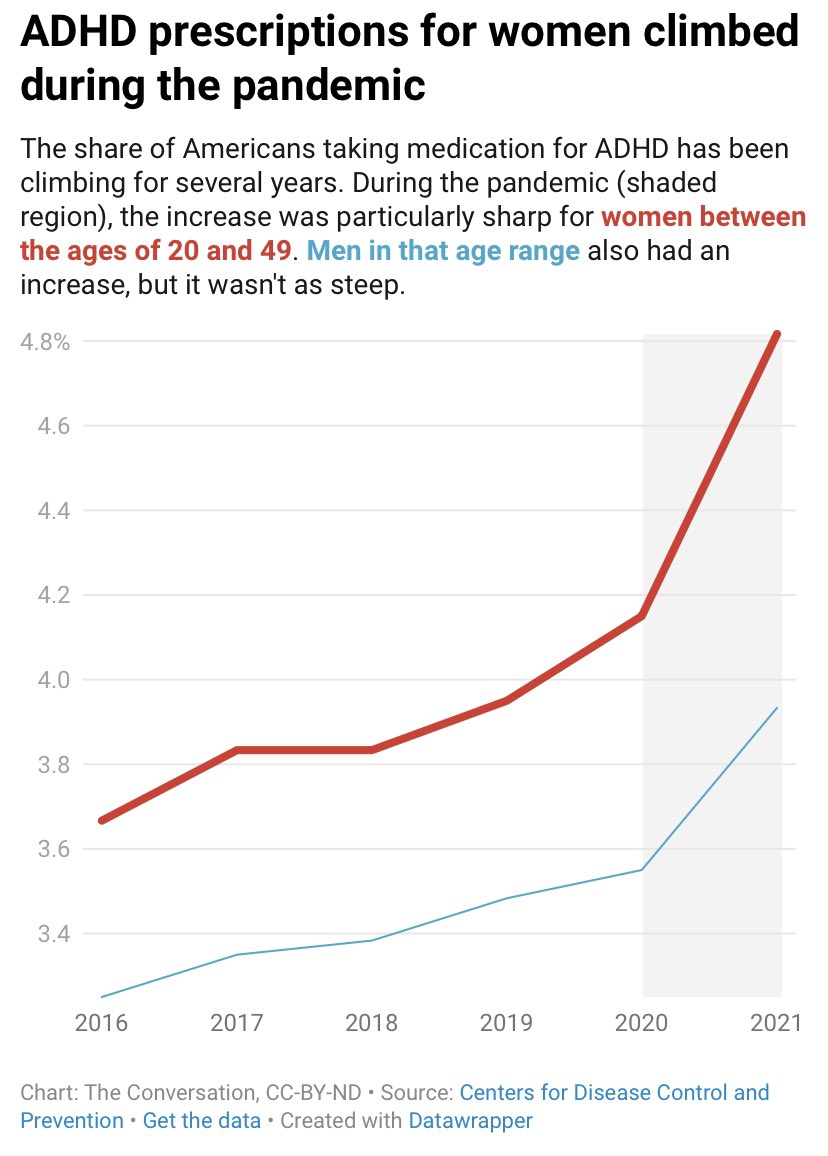
In March 2023, the U.S. Centers for Disease Control and Prevention reported an unprecedented spike in stimulant prescriptions between 2020 and 2021. Perhaps most surprising was that the demographic showing the greatest increases in stimulant use – an increase of almost 20% in one year – were in women in their 20s and 30s…

But while the internet exploded with ADHD content, researchers in Canada began sorting #ADHD TikTok videos into categories based on their accuracy and helpfulness. They reported something important: A majority of #ADHD content was misleading. Only 21% of the posts provided useful and accurate information.

More adults than ever have been seeking ADHD medications – an ADHD expert explains what could be driving the trendhttps://theconversation.com/more-adults-than-ever-have-been-seeking-adhd-medications-an-adhd-expert-explains-what-could-be-driving-the-trend-206052

Alcohol AND amphetamines. Self-diagnosed ADHD. SMH.

ADHD, financial distress, and suicide in adulthood: A population study

Abstract

Attention-deficit/hyperactivity disorder (ADHD) exerts lifelong impairment, including difficulty sustaining employment, poor credit, and suicide risk. To date, however, studies have assessed selected samples, often via self-report. Using mental health data from the entire Swedish population (N = 11.55 million) and a random sample of credit data (N = 189,267), we provide the first study of objective financial outcomes among adults with ADHD, including associations with suicide. Controlling for psychiatric comorbidities, substance use, education, and income, those with ADHD start adulthood with normal credit demand and default rates. However, in middle age, their default rates grow exponentially, yielding poor credit scores and diminished credit access despite high demand. Sympathomimetic prescriptions are unassociated with improved financial behaviors. Last, financial distress is associated with fourfold higher risk of suicide among those with ADHD. For men but not women with ADHD who suicide, outstanding debt increases in the 3 years prior. No such pattern exists for others who suicide.

Science Advances 
30 Sep 2020:
Vol. 6, no. 40, eaba1551
DOI: 10.1126/sciadv.aba1551 — https://advances.sciencemag.org/content/6/40/eaba1551

Here in the US we’ve seen an steady increase in ADHD diagnoses.

ADHD diagnosis throughout the years: Estimates from published nationally representative survey data — https://www.cdc.gov/ncbddd/adhd/timeline.html

And an alarming increase in suicide.

https://www.nimh.nih.gov/health/statistics/suicide.shtml

Then my mind wanders to drugs (to drugs, not due to drugs).

To summarize, the psychiatric side effects of methylphenidate are quite similar to those of cocaine and amphetamines, giving more support to the idea that almost all CNS stimulants will produce a similar clinical picture. A person using cocaine can experience nervousness,57,58 restlessness,58 agitation,57 suspiciousness,60 paranoia,61–63 hallucinations and delusions,61,63 impaired cognitive functions,64 delirium,65 violence,57,58,62,65,66 suicide,67 and homicide.67–70

Methylphenidate Abuse and Psychiatric Side Effects — http://Prim Care Companion J Clin Psychiatry. 2000 Oct; 2(5): 159–164. doi: 10.4088/pcc.v02n0502

I just hope I’m wrong.

ADHD Prescriptions Skyrocket Among Young Women

The percentage of women who filled a prescription for an ADHD medication rose from 0.9% in 2003 to 4.0% in 2015 ― an increase of 344%, the researchers report.

ADHD prescriptions increased for all subgroups of female patients aged 15 years to 44 years (analyzed in 5-year increments), and in all geographic regions of the country. The largest increase in ADHD prescriptions occurred among women aged 25 to 29 years (700% increase), followed by women aged 30 to 34 (560% increase).

WHY???  Read the Medscape article (and comments) here and the MMWR report at this link.


Brain imaging reveals ADHD as a collection of different disorders

The study, published in Biological Psychiatry: Cognitive Neuroscience and Neuroimaging, has the potential to radically reframe how researchers think about ADHD. “This study found evidence that clearly supports the idea that ADHD-diagnosed adolescents are not all the same neurobiologically,” said first author Dr. Michael Stevens, of the Olin Neuropsychiatry Research Center, Hartford, CT, and Yale University. Rather than a single disorder with small variations, the findings suggest that the diagnosis instead encompasses a “constellation” of different types of ADHD in which the brain functions in completely different ways.

Click here for the full article.

Workers Seeking Productivity in a Pill Are Abusing A.D.H.D. Drugs – NYTimes.com

A 2013 report by the federal Substance Abuse and Mental Health Services Administration found that emergency room visits related to nonmedical use of prescription stimulants among adults 18 to 34 tripled from 2005 to 2011, to almost 23,000.

via Workers Seeking Productivity in a Pill Are Abusing A.D.H.D. Drugs – NYTimes.com.

“It is necessary — necessary for survival of the best and the smartest and highest-achieving people.”