Improve Your Child’s Academic Performance!

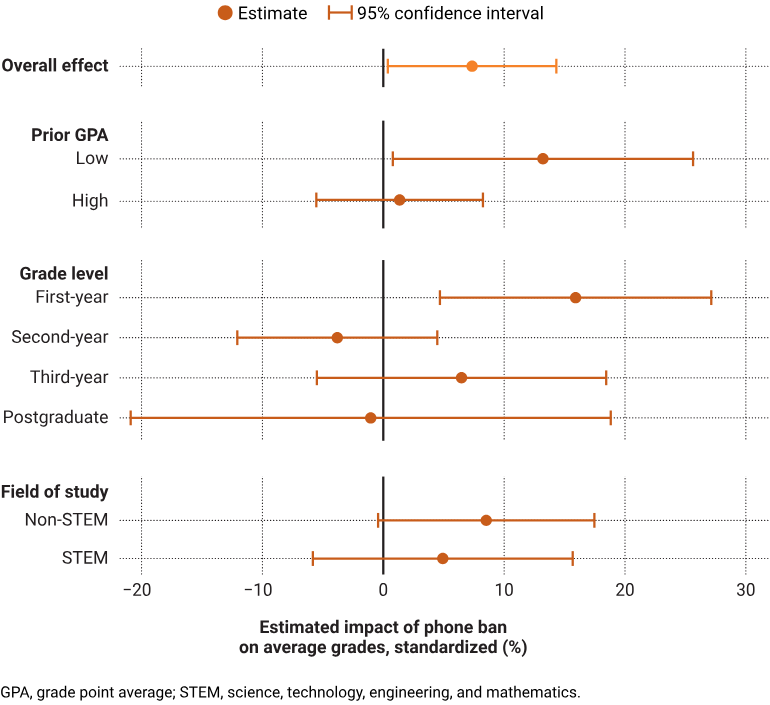
Phone ban impact on student academic achievement

The top estimate is the estimated average treatment effect of the phone ban on student academic achievement across the full population. The next estimates contain heterogeneous treatment effects for subgroups split by prior average academic achievement (above or below preexperiment median), years of study, and field of study.

Source: Alp Sungu et al.,Phones impede learning: Evidence from a massive phone-free classroom experiment.Science394,178-181(2026).DOI:10.1126/science.aef7249 https://www.science.org/doi/10.1126/science.aef7249

I’m Taking Your Phone Away (and you didn’t do anything wrong)

When People Did Not Have Access to Mobile Internet, they Spent More Time Socializing in Person, Exercising, and Being in Nature.

Wait…I need to check my phone.

Improve Your Child’s Mental Health and Academic Performance!

Results  This study included 5515 adolescent participants (2640 [47.9%] female; mean [SD] age 11.93 [0.65] years) using step counters. Higher step count was associated with lower total mental health problems (B [SE], −0.080 [0.015]; t = −5.497; P < .001) and greater cortical thickness in the paracentral (B [SE], 0.057 [0.016]; t = 3.621; P < .001) and rostral anterior cingulate (B[SE], 0.052 [0.016]; t = 3.319; P = .001) regions. Further analyses showed a significant dose-response association, with progressively lower mental health problems across higher step categories compared with the under 5000-step group. Mediation analyses revealed that greater paracentral thickness statistically mediated the association between higher daily step count and fewer mental health problems 1 year later.

Conclusions and Relevance  In this cohort study, higher daily step counts were associated with structural differences in the brains of adolescents, which were in turn associated with better mental outcomes prospectively. Beneficial associations for mental health appeared to accrue continuously across the observed range, with no evidence of a threshold or plateau, highlighting that every step counts and the potential value of promoting daily steps in adolescents. https://jamanetwork.com/journals/jamanetworkopen/fullarticle/2854698

Li Q, Paluch A, Rakesh D. Physical Activity and Adolescent Brain Structure, Mental Health, and Academic Outcomes. JAMA Netw Open. 2026;9(10):e2636973. doi:10.1001/jamanetworkopen.2026.36973

Greater cortical thickness too!

WOOHOO.

Thinking About Retirement (or just another fine Saturday Morning)

Andel’s suggestion to anyone contemplating retirement: “Find a new routine that’s meaningful.” He points to people living in the Blue Zones, regions of the world that have been identified to be home to a greater number of residents who’ve reached the age of 100 and beyond. One of the common characteristics among Blue Zone inhabitants is, says Andel, “these people all have purpose.”

Think Retirement Is Smooth Sailing? A Look at Its Potential Effects on the Brain — https://getpocket.com/read/2840794990

The funny thing about life at “retirement age” and still working is you think about retirement a lot.

Since I still work a full time job I have a lot of trouble envisioning what my retirement will look like.

After reading this article and listening to Andel’s short talk I am now scared of retirement.

I need to figure out how to avoid brain rot. But my journal tells me I already have.

My Purpose is to educate others on diet and disease, weight loss and weight management by sharing my personal journey through writing and other teaching activities.