The Six Secrets to a Bulletproof Career – Guest Blog Post by Andrew Neitlich | paulacaligiuri.com
Check out this blog post.
The Six Secrets to a Bulletproof Career – Guest Blog Post by Andrew Neitlich | paulacaligiuri.com
Check out this blog post.
Information Arbitrage – Preparing for and adapting to tomorrow’s world
Read Think Apply Plan Act.
(hat tip abnormalreturns.com)
You may not agree with all of the authors’ recommendations (I do not agree with all of their points) but you’ll find some great food for thought.
Get Your Goals Back on Track – Heidi Grant Halvorson – The Conversation – Harvard Business Review
I think it’s important to distinguish between specificity and inflexibility. While I can’t think of a single study where specificity hurt performance, I can think of many where a dogged insistence on staying the original course proved harmful. People need to be able to respond to changing conditions. So one qualification might be “clarity is helpful when it does not rule out flexibility and responsiveness.”
Second, I think a lack of specificity at the organizational level isn’t quite the same thing as a lack at the individual level. Even in the instances you mentioned, the individual employees probably had some specific shorter-term goals they set for themselves. If you are trying out different strategies and exploring possibilities, you still benefit from having a clear idea what “successful” looks like, so you’ll know when a strategy is promising and when to switch to something else.
Why Is The US Taxpayer Subsidizing Facebook – And The Next Bubble? « The Baseline Scenario
If you don’t care about Facebook you will after reading this excellent article.
EconomPic: An Employment Report We’ve Been Waiting For
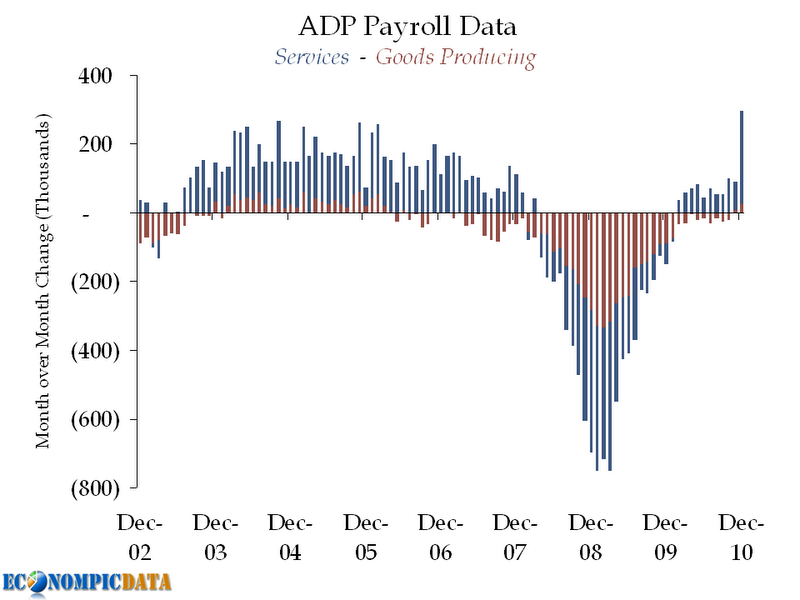
I hope some underwriters are in those December statistics
Surprise! IRS Audits Up 11% This Year
Read this wonderful post on how the Federal Budget deficit is getting reduced, one audit at a time.
According to the IRS, the agency audited 1,581,394 individual returns last year, up from 1,425,888 in 2009. Did the increased audits produce increased revenues? You bet. The IRS collected $57.6 billion in enforcement revenues in 2010, up from $48.90 billion in 2009. Enforcement revenues have grown dramatically from the $33.8 billion that was collected in 2001.
The Yawning of a New Era | workforce.com
America’s workforce is weary. Employees of all ages report feeling fatigued, stressed, burned out or depressed, brought down by a heavier workload, layoffs and an assortment of other adverse conditions workers feel they have little or no power to control.
The hamsters are starting to fall off their wheels.
All kidding aside, this is a serious management issue. So what’s a little fatigue. A plane crash here, a truck crash there right?
All we do is put risk on the books.
So what’s a little higher error ratio?
 lifeunderwriter.net
You must be logged in to post a comment.