Children are Silent Spreaders of Covid-19

“I was surprised by the high levels of virus we found in children of all ages, especially in the first two days of infection,” says Lael Yonker, MD, director of the MGH Cystic Fibrosis Center and lead author of the study, “Pediatric SARS-CoV-2: Clinical Presentation, Infectivity, and Immune Reponses,” published in the Journal of Pediatrics. “I was not expecting the viral load to be so high. You think of a hospital, and of all of the precautions taken to treat severely ill adults, but the viral loads of these hospitalized patients are significantly lower than a ‘healthy child’ who is walking around with a high SARS-CoV-2 viral load.”

Massachusetts General Hospital. “Researchers show children are silent spreaders of virus that causes COVID-19: Comprehensive pediatric study examines viral load, immune response and hyperinflammation in pediatric COVID-19.” ScienceDaily. http://www.sciencedaily.com/releases/2020/08/200820102442.htm (accessed August 20, 2020).

This article is a must read for parents and politicians. In person school around the country has started. Be prepared in case your kid brings back more than just homework from school.

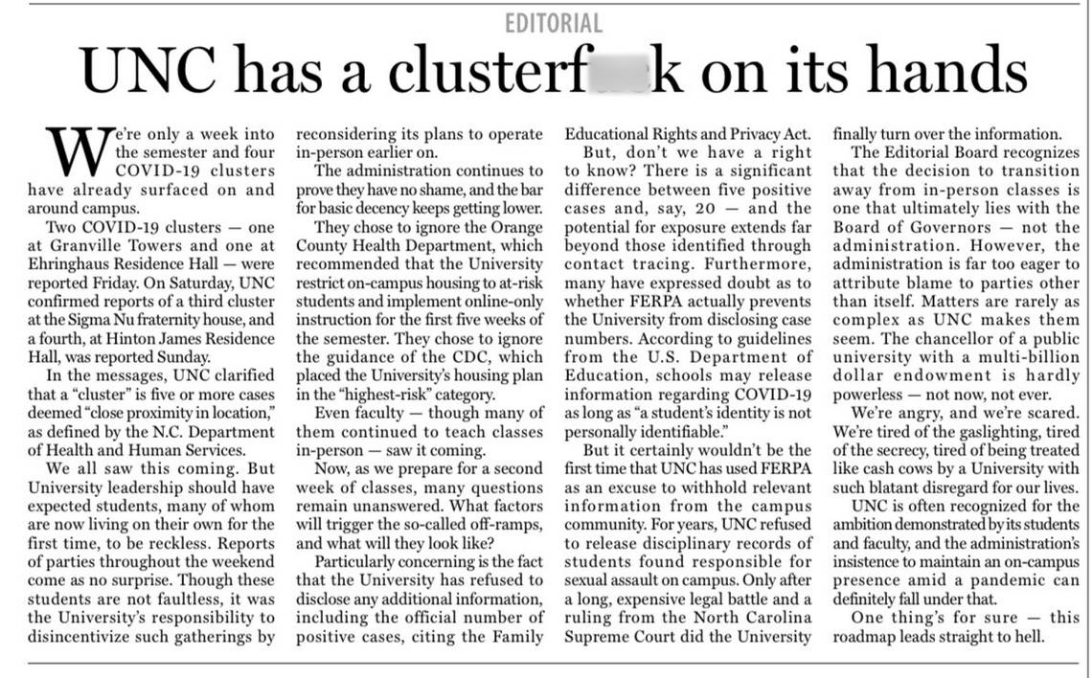
Clusterf**k at UNC

Screenshot_2020-08-18 COVID-19 cases at UNC are ‘cluster #$%,’ student newspaper says in scathing editorial

The Daily Tar Heel, UNC Chapel Hill’s independent student newspaper, wasn’t holding back in an editorial published Monday, August 17, 2020, criticizing the university’s administration after four COVID-19 clusters were reported on campus. Editor’s note: Letters in the headline were blurred by McClatchy News. The Daily Tar Heel

Read more here: https://www.newsobserver.com/news/coronavirus/article245017180.html

As of Monday, 177 students were in isolation at UNC-Chapel Hill after testing positive for COVID-19, and hundreds more were in quarantine. Through last week, the test positivity rate on campus jumped over 10 percentage points to 13.6 percent. Such a high positivity rate indicates that the virus is spreading through the campus community. (According to the World Health Organization, anything over 5 percent is cause for concern.) There are likely students infected with the virus who aren’t showing symptoms, and they could leave campus without knowing they’re sick.

https://www.theverge.com/2020/8/18/21373482/unc-covid-outbreak-students-home-testing-university

UNC is sending some students back home without testing them for COVID-19

Using a public restroom? Mask up!


Flushing public restroom toilets or urinals can spew clouds of particles carrying viruses, including COVID-19

The researchers’ work clearly shows public restrooms can be dangerous places for potentially becoming infected from a virus, especially during the COVID-19 pandemic. Other work has shown that both feces- and urine-based virus transmission is possible.

What the simulations revealed is disturbing. The trajectory of the tiny particles ejected by flushing a urinal “manifests an external spread type, with more than 57% of the particles traveling away from the urinal,” said Liu.

Journal Reference: Ji-Xiang Wang, Yun-Yun Li, Xiang-Dong Liu, Xiang Cao. Virus transmission from urinals. Physics of Fluids, 2020; 32 (8): 081703 DOI: 10.1063/5.0021450

Using a public restroom? Mask up!

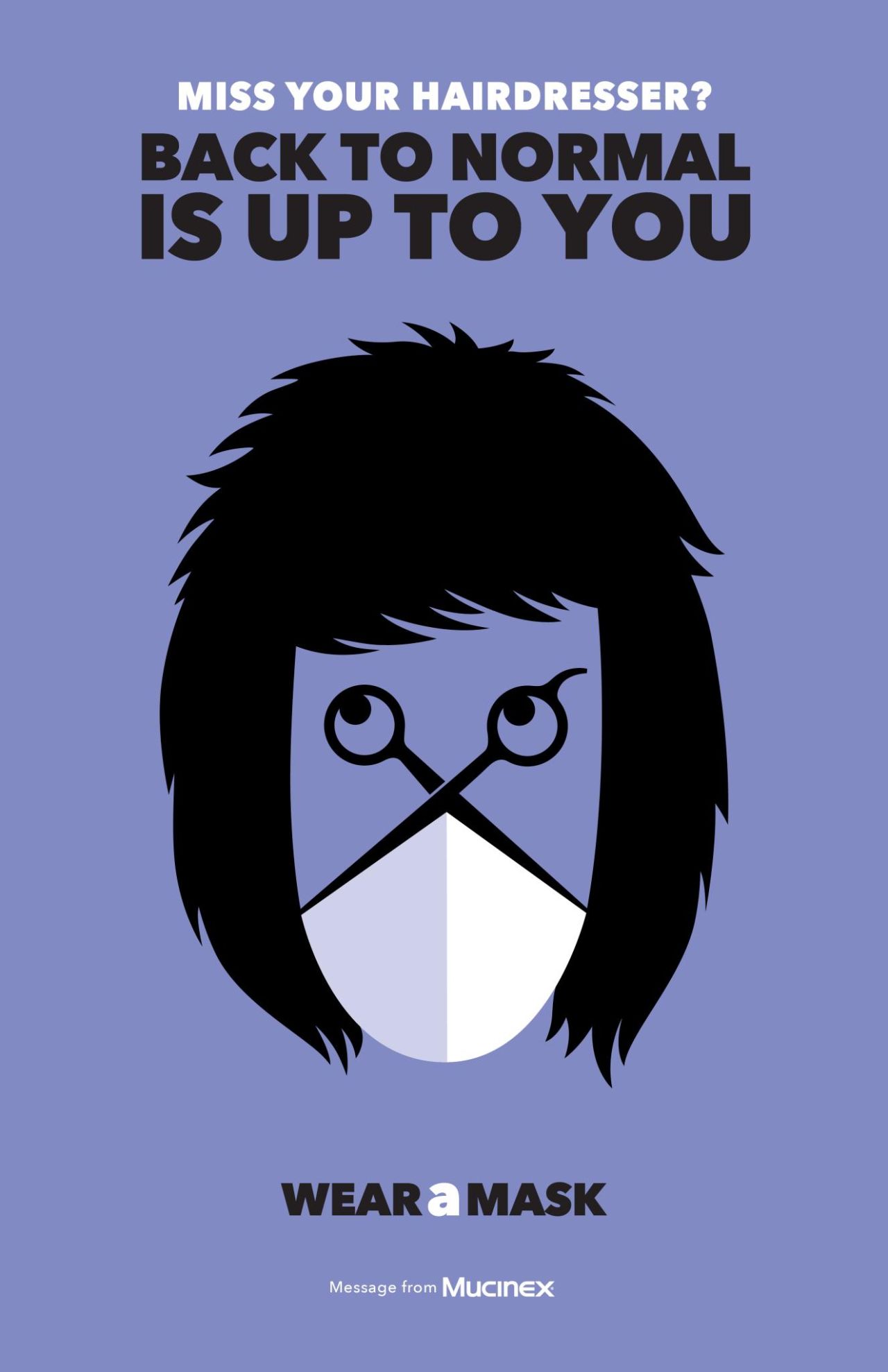
Wear a mask.  Don’t flush.  Hold your breath.

Better yet, don’t pee in a public restroom.

EfVgeCNXsAIyKBn


Pune coronavirus sero survey results find 51.5% seroprevalence — Science Chronicle

The sero survey carried out in five zones in Pune has found 51.5% seroprevalence, with the spread ranging from 36.1% in the lower bound to 65.4% in higher bound. The spread of the virus was found across all types of dwellings. Those living in hutments (62%) and tenement (56.2%) had the highest seroprevalence, while those […]

“With the peak yet to reach, 51% seroprevalence is intriguing,” Dr Giridhara Babu, epidemiologist from Public Health Foundation of India, Bengaluru says in a tweet.

via Pune coronavirus sero survey results find 51.5% seroprevalence — Science Chronicle

Only a scientist would refer to 51% seroprevalence as “intriguing”.

I find the following more “intriguing”.

The role of shared toilets in increasing virus spread has once again become apparent in this study. While the seropositivity was 45.3% among people (1,045 adults) who have access to independent toilets, 619 adults who share toilets have a high 62.2% seroprevalence. “There is no difference between men (n=861, 52.8%) and women (n=803, 50.1%), while 171 persons of older age (above 66 years) have a lower prevalence (39.8%),” the report posted on the University website says. Those in the age group 51-65 years had the highest seroprevalence of 54.8%. Those in the age group 18-30 years and 31-50 had seroprevalence of 52.5% and 52.1%, respectively.

I’m headed down to Texas next weekend.  If I limit fluids prior to starting the trip maybe I won’t have to stop along the way…

The Implosion of Freelance Work

I live in LA, and the article is really about people who work in entertainment/media — every tv show, commercial, music video and movie is the result of anywhere from a few dozen to hundreds of people who work for the run of the project, then move on to another project. It’s everything from the building trades – carpentry, electrical, rigging/framing – to business services — legal, accounting, HR – to tech heavy work – video/sound editing — and finally, a lot of musicians — people who write and play the music you hear. All of these people are employees of the production, not AB5 type gig workers.

It’s a lifestyle/career choice and not for everyone. People hustle, build relationships and are always on the lookout for the next gig. But the work has been steady for decades, and then very suddenly the whole sector shut down hard.

Los Angeles Hit Hard by Implosion of Freelance Work


The pandemic has only exacerbated tenuous financial conditions for many in the flexible workforce.  According to a survey of more than 1,100 U.S.-based respondents interested in flexible work, more than half (53%) of people are currently earning half or less of their pre-pandemic income. Approximately one-third (31%) of respondents have lost their entire income since the pandemic started. This survey was conducted by FlexJobs, fielded in partnership with Prudential (1), in late June 2020.

Demographic breakdown of the 1,100 U.S.-based respondents interested in flexible work. Gender: female (81%), Male (17%) Prefer not to identify (2%) Ages: 20-39 (29%), 40-59 (53%), 60+ (18%); Education: high school degree or equivalent (4%), some college but no degree (15%), associate or bachelor’s degree (48%), graduate degree (33%); Career level: entry-level (11%), experienced (56%), manager (21%), senior level or higher (12%). Household income: Less than less than $50,000 (35%), $50,000 to less than $75,000 (18%); $75,000 to less than $100,000 (17%), $100,000 to less than $150,000 (17%), $150,000+ (13%). 34% of respondents were unemployed and looking for work.

Survey Finds 53% Earning Half Or Less Of Their Pre-COVID-19 Income

As a former freelancer my heart goes out to all of the gig workers whose lives have been upended by the pandemic.  I transitioned back to the world of W-2 work quite some time ago and haven’t regretted the move.

Meanwhile in Georgia…

“I think quite honestly this week went real well other than a couple of virtual photos,” Gov. Brian Kemp said at a news conference with the U.S. surgeon general.

Georgia governor: School openings going well except photos of crowded hallways

3rd Cherokee County school closes due to new COVID-19 cases
EfVgeCPXYAAU2GP


FDA Approval – SalivaDirect

The Food and Drug Administration on Saturday authorized emergency use of a new and inexpensive saliva test for Covid-19 that could greatly expand testing capacity.

The new test, which is called SalivaDirect and was developed by researchers at the Yale School of Public Health, allows saliva samples to be collected in any sterile container. It is a much less invasive process than the nasal swabs currently used to test for the virus that causes Covid-19, but one that has so far yielded highly sensitive and similar results. The test also avoids a key step that has caused shortages of chemical reagents used in other tests.

The research team validated SalivaDirect in part by testing NBA players, coaches, and staff, and Yale said the test is now being studied in asymptomatic people through the program with the NBA and its players union.

FDA clears saliva test for Covid-19, opening door to wider testing

Get tested and wear a mask.

EfVgeCLWsAQSVXt

To understand why this is a potential game changer this article on rapid screening tests.

First, frequent testing catches the vast majority of cases. Someone who is infected but gets a false-negative and slips through the cracks is likely to be caught the next time they’re tested. For a test that misses 20% of positive cases, the chance of an infected person getting two false negatives in a row may be as low as 4%. It’s like bailing a boat with a leaky bucket: You just have to bail more quickly to get the job done.

Second, most people who get false-negative results are unlikely to be contagious. Antigen-based screening tests are good at detecting the high virus levels needed to be contagious. By design, screening tests sacrifice accuracy where it matters least to achieve low costs, speed and ease of use.

AND I learned that the SalivaDirect test was funded by the NBA.

“My goal is not to test athletes,” Grubaugh said. “That’s not my target population. My target population is everybody. There were concerns about partnering with the NBA when all these other people need testing. But the simple answer ended up being the NBA was going to do all this testing anyway, so why not partner with them and try to create something for everyone?”

The NBA, Yale and the players’ association do not intend to take royalties from any use of the testing method, Grubaugh and others said. The NBA and union contributed more than $500,000 combined to fund the Yale work, sources told ESPN.

Saliva-based coronavirus test funded by NBA, NBPA gets emergency authorization from FDA

COVID Isolation and Anxiety Reinforce Eating Disorders

In March and April, the National Eating Disorders Association (NEDA) saw a 78% increase in messages sent to its helpline compared with the same period last year.

Dr. John Morton, medical director of bariatric surgery for Yale New Haven Health System, says he’s seeing patients via telehealth who have gained up to 30 pounds recently. He says it can happen within months.

In addition to a confidential and toll-free helpline, NEDA has created a list of free or low-cost resources related to eating disorders: https://www.nationaleatingdisorders.org/help-support/covid-19-resources-page.

COVID Isolation, Anxiety ‘Really Reinforce’ Eating Disorders

Georgia Health News © 2020

Citation: Judi Kanne. COVID Isolation, Anxiety ‘Really Reinforce’ Eating Disorders – Medscape – Aug 13, 2020.

The article focuses mainly on anorexia and bulemia but the quote from Dr. Morton caught my eye.  A 30 pound weight gain in a few months is pretty substantial.  I start to panic after a pound or two.  But if you lose 200 pounds and keep it off you tend to overreact  if the scale shows your weight creeping up.

My pandemic weight journey (so far) has been about taking a few of those stubborn pounds off.  I started the year at 192.  This morning I was 179.  There has to be more happy weight loss stories out there.  The article also didn’t mention anything on Orthorexia Nervosa.  I worry about those people too.


Mental Health, Substance Use, and Suicidal Ideation During the COVID-19 Pandemic — United States, June 24–30, 2020

MentalHealthCOVID19_IMAGE_14Aug20_1200x675-medium

The survey results are in line with recent data from Mental Health America, which indicate dramatic increases in depression, anxiety, and suicidality since the start of the COVID-19 pandemic.

Citation: Czeisler MÉ , Lane RI, Petrosky E, et al. Mental Health, Substance Use, and Suicidal Ideation During the COVID-19 Pandemic — United States, June 24–30, 2020. MMWR Morb Mortal Wkly Rep 2020;69:1049–1057. DOI: http://dx.doi.org/10.15585/mmwr.mm6932a1external icon.


COVID-19 Cases in Children Up 90% in Four Weeks

Screenshot_2020-08-13 COVID-19 Cases in Children Nearly Doubled in Just 4 Weeks

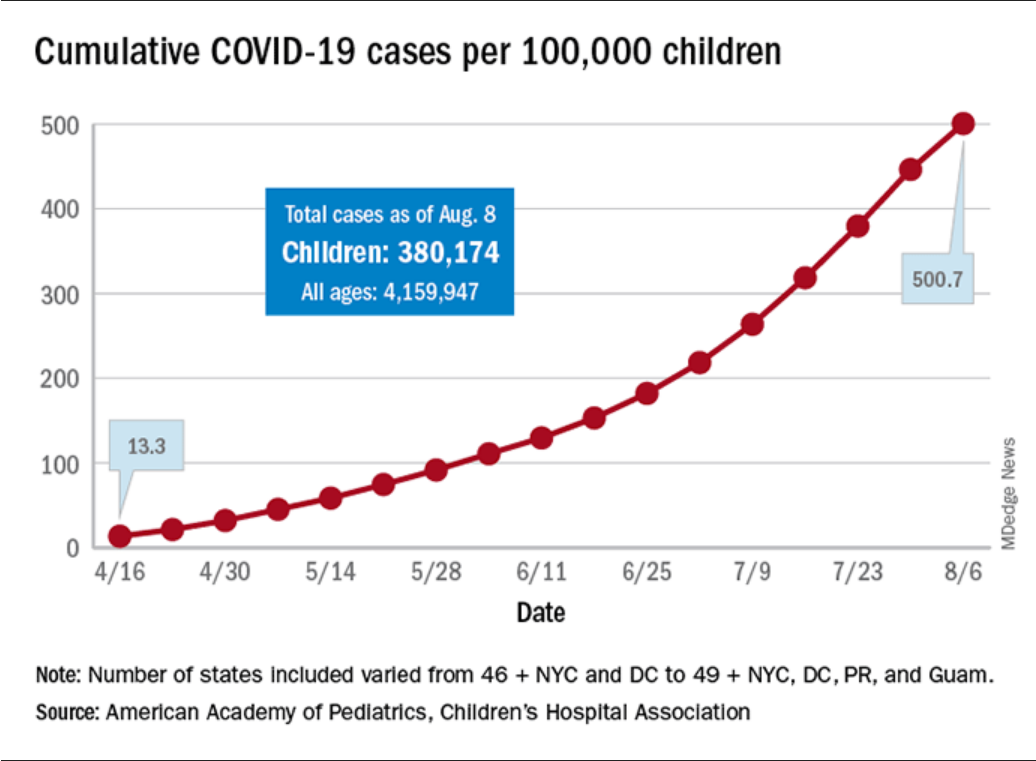
The joint report from the AAP and the Children’s Hospital Association draws on data from state and local health departments in 49 states, New York City, the District of Columbia, Puerto Rico, and Guam.  The cumulative number of COVID-19 cases in children as of Aug. 6, 2020, was 380,174, and that number is 90% higher – an increase of 179,990 cases – than the total on July 9, just 4 weeks earlier, the two organizations said in the report.

Yikes!