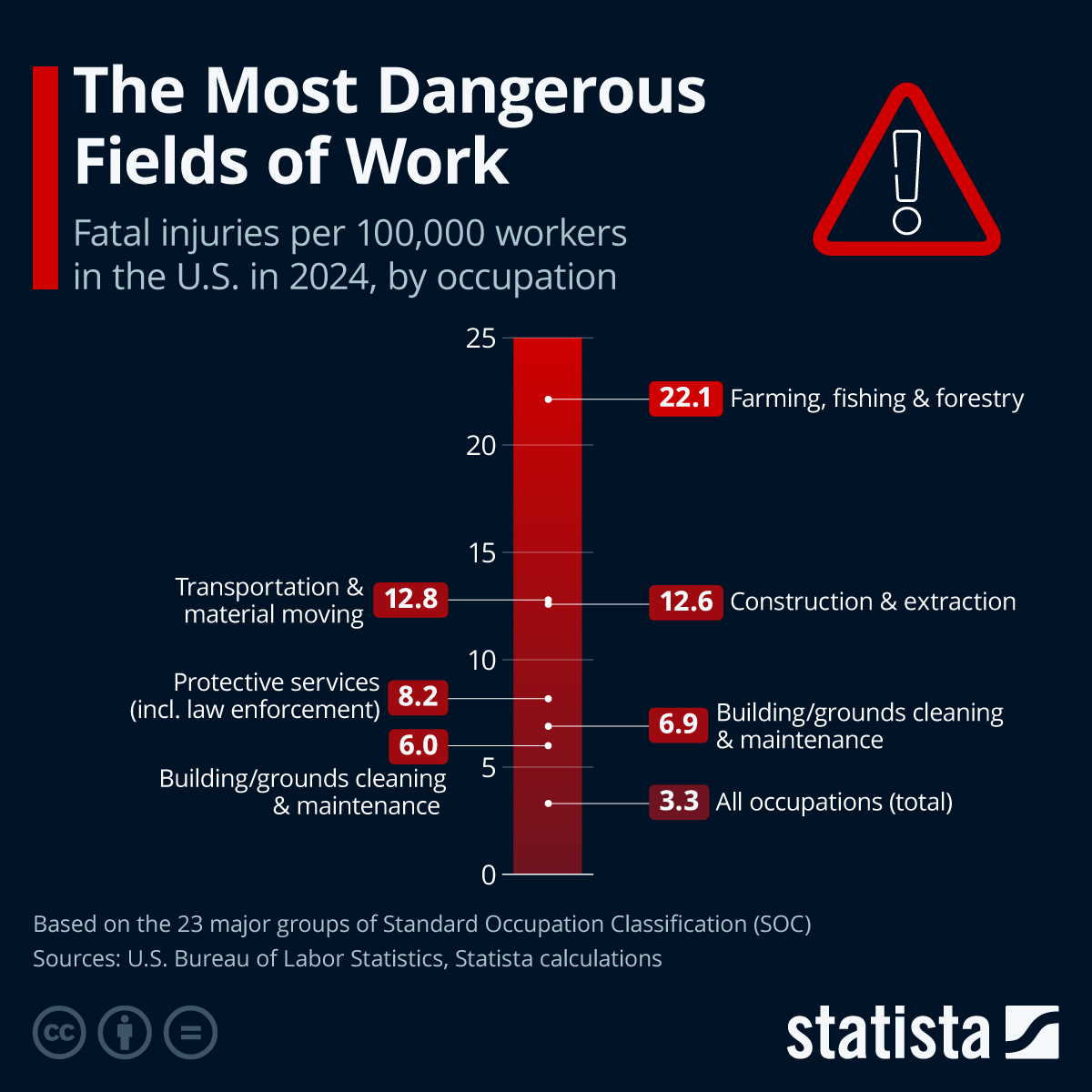
Death by Occupation
Drive By Truckers 2.0
Total drug violations reported into the clearinghouse in 2022, including positive tests and refusals to take a drug test, increased 18% to 69,668 compared with last year’s 59,011, according to the most recent statistics released this week by the Federal Motor Carrier Safety Administration. That rate almost doubled the 9.2% annual increase in drug violations reported in 2021. Much of the increase can be attributed to violations related to marijuana, the substance identified most in positive tests. Marijuana violations increased 31.6% in 2022 compared with 2021, to 40,916. That compares to a 5.3% increase between 2020 and 2021.
Truckers’ positive drug tests up 18% in 2022 — https://www.freightwaves.com/news/truckers-positive-drug-tests-up-18-in-2022
At least binge drinking prevalence is just 19%
Truck drivers have been reported as a highly vulnerable working population due to different risk factors [16,17,18] including hypertension, fatigue [19], obstructive sleep apnea (OSA) and sleep deprivation [20,21], and insufficient physical activity [22]. Other risk factors are exposure to diesel exhaust and risk of developing lung cancer [23], poor diet, obesity, dyslipidemia, and other metabolic disorders [24]. Furthermore, they are prone to risky behaviors and lifestyles such as smoking, drinking, using psychoactive substances, and having casual sexual contacts [25].
Patterns of Harmful Alcohol Consumption among Truck Drivers: Implications for Occupational Health and Work Safety from a Systematic Review and Meta-Analysis — Int J Environ Res Public Health. 2018 Jun; 15(6): 1121.
Published online 2018 May 30. doi: 10.3390/ijerph15061121
I ask them why the industry has a 90 percent attrition rate within the first year. All instantly respond: “No money.” They describe a predatory apprenticeship system that conspires against new drivers seeking to enter the profession. The industry is made up of thousands of mostly small-fleet owners—95 percent of them with 20 trucks or fewer—but dominated by about two dozen giant companies that serve as its gatekeepers. These megacarriers often house schools where some 400,000 new truckers receive commercial driver’s licenses annually. The companies entice people with promises of financial plenty, even as they ensnare them in “training contracts”—binding agreements that require them to drive for the company at below-market wages for a year in exchange for training or else be hit with an exorbitant fee for that training, to be paid off at high interest. Many drivers stick around for the full year to avoid those fees, enduring what amounts to debt peonage.
“I have panic attacks,” he says. “That’s why I drink.”
Life as a 21st-Century Trucker — https://www.wired.com/story/life-as-a-21st-century-trucker/
For the first post in this series see Drive By Truckers.
Authors Guild Survey Shows Drastic 42 Percent Decline in Authors Earnings in Last Decade
The Authors Guild’s 2018 Author Income Survey, the largest survey of writing-related earnings by American authors ever conducted finds incomes falling to historic lows to a median of $6,080 in 2017, down 42 percent from 2009.
The Authors Guild surveyed its membership and the members of 14 other writers organizations in 2018, receiving detailed responses from 5,067 authors. This included traditionally, hybrid and self-published authors who have commercially published one or more books. When discussing median incomes, the survey looked at both full-time and part-time authors.
The respondents reported a median author income of $6,080, continuing a sharp decline over the last decade: $8,000 in 2014 and $10,500 in 2009 (per the Authors Guild’s 2015 Survey), down again from $12,850 in 2007, as reported in a joint Authors Guild/PEN survey.
Earnings from book income alone fell even more, declining 21 percent to $3,100 in 2017 from $3,900 in 2013 and just over 50 percent from 2009’s median book earnings of $6,250.
The survey showed a shift in book earnings to other writing-related activities, such as speaking engagements, book reviewing or teaching. Including those sources, respondents who identified themselves as full-time book authors still only earned a median income of $20,300, well below the federal poverty line for a family of three or more.
Add writer to the list of occupations to steer your grandchildren away from.
I am a non-professional non-paid writer. And professional writers don’t make much more than I do writing.
Read the entire article here.
 lifeunderwriter.net
You must be logged in to post a comment.