Alternative Dementia Screening Tests | News Brief
October 7, 2015
Source: Alternative Dementia Screening Tests | Physician’s Weekly
Source: Alternative Dementia Screening Tests | Physician’s Weekly
Fish Oil Slows Cognitive Decline, With Caveats.
Disclosures
Alzheimer’s disease is the 6th leading cause of death in the United States overall and the 5th leading cause of death for those aged 65 and older. It is the only cause of death among the top 10 in America without a way to prevent it, cure it or even slow its progression. Deaths from Alzheimer’s increased 68 percent between 2000 and 2010, while deaths from other major diseases, including the number one cause of death (heart disease), decreased.
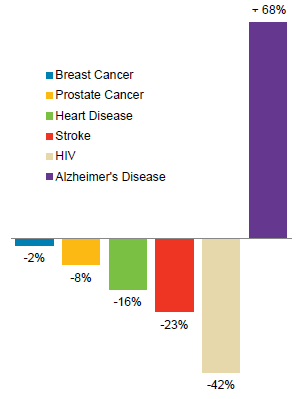
via Latest Facts & Figures Report | Alzheimer’s Association.
One in three older adults has Alzheimer’s disease or another type of dementia at the time of death. As the nation’s population ages, the number of people with the progressive neurological disorder could triple in the next 40 years, said a study published online Feb. 6 in Neurology.
via 1 in 3 Americans has dementia at time of death – amednews.com.
Epidemiologic data suggest that individuals at all stages of CKD have a higher risk of developing cognitive disorders and dementia. This risk is generally explained by the high prevalence of both symptomatic and subclinical ischemic cerebrovascular lesions.
via Cognitive Disorders and Dementia in CKD: The Neglected Kidney-Brain Axis.
A new study published in Chemical Research in Toxicology showed that the butter flavoring diacetyl (DA) increases the type of protein clumping linked to Alzheimer’s disease. The chemical is found in many processed foods, iA new study published in Chemical Research in Toxicology showed that the butter flavoring diacetyl (DA) increases the type of protein clumping linked to Alzheimer’s disease. The chemical is found in many processed foods, including microwave popcorn, snack foods, baked goods, and margarine. In fact, the researchers say that diacetyl is “ubiquitous” in the modern diet.ncluding microwave popcorn, snack foods, baked goods, and margarine. In fact, the researchers say that diacetyl is “ubiquitous” in the modern diet.
via Butter Flavoring Linked to Alzheimer’s Disease | Food Poisoning Bulletin.
Popcorn anyone?
People who had a lot of omega-3 fatty acids in their diets tended to have lower plasma levels of beta-amyloid proteins, possibly reducing their risk of Alzheimer’s disease, researchers said.
In a cross-sectional study of more than 1,200 cognitively normal individuals older than 65, omega-3 fatty acid intake was significantly predictive of plasma levels of the 40- and 42-residue forms of beta-amyloid protein (AB40 and AB42, respectively), according to Nikolaos Scarmeas, MD, of Columbia University in New York City, and colleagues.
The NEJM Resident e-Bulletin is one of the ways I keep up with medical information. While it will not be possible for me to reproduce every email that comes from this service, on occasion I will post topics of interest. Copyright remains vested with the NEJM so don’t try and steal this to make money.
R.C. Petersen


MCI represents an intermediate state of cognitive function between the changes seen in aging and those fulfilling criteria for dementia, often Alzheimer’s disease (AD).
 What is the estimated prevalence of MCI?
The estimated prevalence of MCI in population-based studies ranges from 10 to 20%. In the Mayo Clinic Study of Aging, a prospective, population-based study of non-demented persons ages 70 to 89 years at enrollment, the prevalence of amnestic MCI was 11.1% and of nonamnestic MCI, 4.9%.
How can the “worried well” be differentiated from patients with MCI?Neuropsychological testing may be necessary to corroborate a history of decline in cognition, usually memory. At times, the “worried well” can give a convincing history for memory loss, but neuropsychological testing reveals normal performance.
Figure 1. Diagnostic Algorithm for Amnestic and Nonamnestic Mild Cognitive Impairment.
A. As compared with the incidence rate for dementia in the general population of 1 to 2% per year, the incidence of dementia in patients with MCI is significantly increased, with an annual rate of 5 to 10% in community-based populations and 10 to 15% in clinic-based populations. The degree of cognitive impairment at presentation is a clinical predictor of progression; those with greater baseline impairment appear more likely to progress more rapidly. The presence of the apolipoprotein E ε4 allele is also predictive of progression rate. Several MRI measures have also been reported to predict a faster rate of progression, including atrophic hippocampi, dilated ventricles, reduced total brain volume, and the presence of white matter hyperintensities.
A. Limited data support the potential benefit of cognitive rehabilitation approaches. Several clinical trials that treated persons with MCI with cholinesterase inhibitors used for AD (donepezil, galantamine, and rivastigmine) at standard AD treatment doses for 2 to 4 years have shown no significant reduction in the rates of progression to dementia.
Conclusions – In this large cohort, heavy smoking in midlife was associated with a greater than 100% increase in risk of dementia, AD, and VaD more than 2 decades later. These results suggest that the brain is not immune to long-term consequences of heavy smoking.

Underwriting Quick Notes:
Memantine seems to improve global clinical status and behavioural symptoms of patients with mild to moderate DLB, and might be an option for treatment of these patients.
 lifeunderwriter.net
You must be logged in to post a comment.