
Association ofPlant Protein Intake With Risk of Incident CKD: A UK Biobank Study — https://www.ajkd.org/article/S0272-6386(23)00742-4/fulltext
Association ofPlant Protein Intake With Risk of Incident CKD: A UK Biobank Study — https://www.ajkd.org/article/S0272-6386(23)00742-4/fulltext

The value of the BMI for tracking the current epidemic of obesity is clearly illustrated in the study by Rodgers et al., which traced the change in the BMI for many subgroups of the US population from 1962 to the year 2000 [23]. (See Figure 1) They showed that the US epidemic of obesity began about 1975 in all age, sex and ethnic groups and continued over the next 25 years. This fact limits the plausible explanations for the current epidemic of obesity. Rodgers and colleagues believe that it is implausible that each age, sex and ethnic group, with massive differences in life experience and attitudes, had a simultaneous decline in willpower related to healthy nutrition or exercise, or that intrauterine exposures played a major causative role. Likewise, changes in genetic make-up are unlikely to have occurred over this short period and to have affected all age groups simultaneously. Similarly, they note that it is unlikely that any factor with a long induction period had a major role in the US epidemic. Rather, they believe that the epidemic must have been caused by factors that led to rapid population-wide changes such as changes in the food supply, and I tend to agree with their conclusion.
Beyond BMI by George A. Bray – Nutrients 2023, 15(10), 2254 – https://doi.org/10.3390/nu15102254
Agree.
Plant foods, high in fiber, can reduce the contact of potential carcinogens with cells lining the digestive tract. The fiber causes food to travel faster through a person’s digestive system. This also reduces intestinal cells’ contact with bile acids, which can promote cancer growth. Fruits, vegetables, whole grains, and legumes also provide phytonutrients and antioxidants, which can help repair damaged cells and reduce cancer risk.
Why poor diets are contributing to a surge in colorectal cancer cases among young people — https://www.kevinmd.com/2023/04/why-poor-diets-are-contributing-to-a-surge-in-colorectal-cancer-cases-among-young-people.html
Life is short and science takes too long.
Change your diet. If you have any changes in your bowel habits, talk to your physician.
Fresh Produce Is an Increasingly Popular Prescription for Chronically Ill Patients
By Carly Graf March 23, 2023
When Mackenzie Sachs, a registered dietitian on the Blackfeet Reservation, in northwestern Montana, sees a patient experiencing high blood pressure, diabetes, or another chronic illness, her first thought isn’t necessarily to recommend medication.
Rather, if the patient doesn’t have easy access to fruit and vegetables, she’ll enroll the person in the FAST Blackfeet produce prescription program. FAST, which stands for Food Access and Sustainability Team, provides vouchers to people who are ill or have insecure food access to reduce their cost for healthy foods. Since 2021, Sachs has recommended a fruit-and-vegetable treatment plan to 84 patients. Increased consumption of vitamins, fiber, and minerals has improved those patients’ health, she said.
“The vouchers help me feel confident that the patients will be able to buy the foods I’m recommending they eat,” she said. “I know other dietitians don’t have that assurance.”
Sachs is one of a growing number of health providers across Montana who now have the option to write a different kind of prescription — not for pills, but for produce.
The Montana Produce Prescription Collaborative, or MTPRx, brings together several nonprofits and health care providers across Montana. Led by the Community Food & Agriculture Coalition, the initiative was recently awarded a federal grant of $500,000 to support Montana produce prescription programs throughout the state over the next three years, with the goal of reaching more than 200 people across 14 counties in the first year.
Participating partners screen patients for chronic health conditions and food access. Eligible patients receive prescriptions in the form of vouchers or coupons for fresh fruits and vegetables that can be redeemed at farmers markets, food banks, and stores. During the winter months, when many farmers markets close, MTPRx partners rely more heavily on stores, food banks, and nonprofit food organizations to get fruits and vegetables to patients.
The irony is that rural areas, where food is often grown, can also be food deserts for their residents. Katie Garfield, a researcher and clinical instructor with Harvard’s Food is Medicine project, said produce prescription programs in rural areas are less likely than others to have reliable access to produce through grocers or other retailers. A report from No Kid Hungry concluded 91% of the counties nationwide whose residents have the most difficulty accessing adequate and nutritious food are rural.
“Diet-related chronic illness is really an epidemic in the United States,” Garfield said. “Those high rates of chronic conditions are associated with huge human and economic costs. The idea of being able to bend the curve of diet-related chronic disease needs to be at the forefront of health care policy right now.”
Produce prescription programs have been around since the 1960s, when Dr. Jack Geiger opened a clinic in Mound Bayou, a small city in the Mississippi Delta. There, Dr. Geiger saw the need for “social medicine” to treat the chronic health conditions he saw, many the result of poverty. He prescribed food to families with malnourished children and paid for it out of the clinic’s pharmacy budget.
A study by the consulting firm DAISA Enterprises identified 108 produce prescription programs in the U.S., all partnered with health care facilities, that launched between 2010 and 2020, with 30% in the Northeast and 28% in the Midwest. Early results show the promise of integrating produce into a clinician-guided treatment plan, but the viability of the approach is less proven in rural communities such as many of those in Montana.
In Montana, 31,000 children do not have consistent access to food, according to the Montana Food Bank Network. Half of the state’s 56 counties are considered food deserts, where low-income residents must travel more than 10 miles to the nearest supermarket — which is one definition the U.S Department of Agriculture uses for low food access in a rural area.
Research shows long travel distances and lack of transportation are significant barriers to accessing healthy food.
“Living in an agriculturally rich community, it’s easy to assume everyone has access,” said Gretchen Boyer, executive director of Land to Hand Montana. The organization works with nearby health care system Logan Health to provide more than 100 people with regular produce allotments.
“Food and nutritional insecurity are rampant everywhere, and if you grow up in generational poverty you probably haven’t had access to fruits and vegetables at a regular rate your whole life,” Boyer said.
More than 9% of Montana adults have Type 2 diabetes and nearly 35% are pre-diabetic, according to Merry Hutton, regional director of community health investment for Providence, a health care provider that operates clinics throughout western Montana and is one of the MTPRx clinical partners.
Brittany Coburn, a family nurse practitioner at Logan Health, sees these conditions often in the population she serves, but she believes produce prescriptions have tremendous capacity to improve patients’ health.
“Real food matters and increasing fruits and veggies can reverse some forms of diabetes, eliminate elevated cholesterol, and impact blood pressure in a positive way,” she said.
Produce prescription programs have the potential to reduce the costs of treating chronic health conditions that overburden the broader health care system.
“If we treat food as part of health care treatment and prevention plans, we are going to get improved outcomes and reduced health care costs,” Garfield said. “If diet is driving health outcomes in the United States, then diet needs to be a centerpiece of health policy moving forward. Otherwise, it’s a missed opportunity.”
The question is, Do food prescription initiatives work? They typically lack the funding needed to foster long-term, sustainable change, and they often fail to track data that shows the relationship between increased produce consumption and improved health, according to a comprehensive survey of over 6,000 studies on such programs.
Data collection is key for MTPRx, and partners and health care providers track how participation in the program influences participants’ essential health indicators such as blood sugar, lipids, and cholesterol, organizers said.
“We really want to see these results and use them to make this more of a norm,” said Bridget McDonald, the MTPRx program director at CFAC. “We want to make the ‘food is medicine’ movement mainstream.”
Sachs acknowledged that “some conditions can’t usually be reversed,” which means some patients may need medication too.
However, MTPRx partners hope to make the case that produce prescriptions should be considered a viable clinical intervention on a larger scale.
“Together, we may be able to advocate for funding and policy change,” Sachs said.
KHN (Kaiser Health News) is a national newsroom that produces in-depth journalism about health issues. Together with Policy Analysis and Polling, KHN is one of the three major operating programs at KFF (Kaiser Family Foundation). KFF is an endowed nonprofit organization providing information on health issues to the nation.
What can Okinawans tell us? Why does Ogimi and elsewhere on the island have a history of long life? That comes down to three main factors—diet, social practices, and genetics—explains Craig Willcox, a professor of public health and gerontology at Okinawa International University and a co-principal investigator of the Okinawa Centenarian Study, which has been investigating Okinawan longevity since 1975.“
About two-thirds of longevity is related to diet and way of life, the rest is genetics. Generally speaking, you need the genetic rocket booster if you want to get into the hundreds, not just a good diet,” Willcox says. “We haven’t looked into whether or not Okinawa has a genetic advantage over other parts of Japan, but longevity does run in families here.”
This island unlocked the secret to long life—and knows how to get through tough times — https://www.nationalgeographic.com/travel/article/uncover-the-secrets-of-longevity-in-this-japanese-village
Older Okinawans clinging to the islands’ traditionally healthful diet still boast the longest life expectancy in Japan, the country with the world’s longest-living people. But younger islanders, who grew up coveting the America they peeked at inside the bases here, began gobbling up hamburgers, fried chicken and pizzas as soon as their incomes permitted them to do so.
Urasoe Journal; On U.S. Fast Food, More Okinawans Grow Super-Sized — https://www.nytimes.com/2004/03/30/world/urasoe-journal-on-us-fast-food-more-okinawans-grow-super-sized.html
I need to go to the grocery store today.
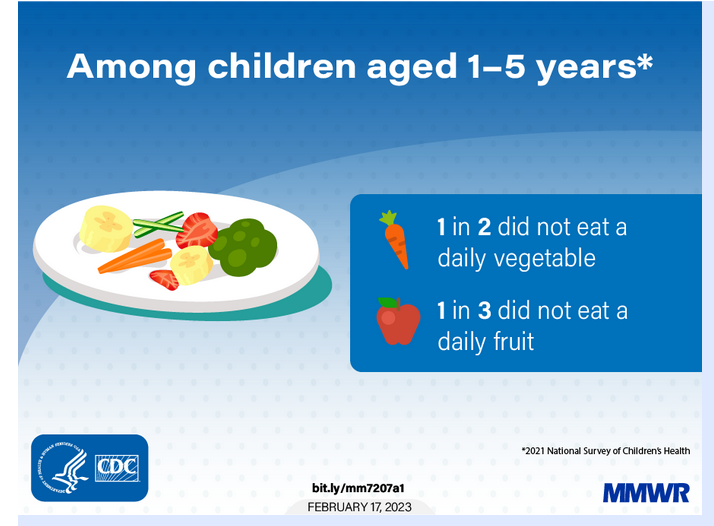
Hamner HC, Dooyema CA, Blanck HM, et al. Fruit, Vegetable, and Sugar-Sweetened Beverage Intake Among Young Children, by State — United States, 2021. MMWR Morb Mortal Wkly Rep 2023;72:165–170. DOI: http://dx.doi.org/10.15585/mmwr.mm7207a1.
Yikes!

The JHND Editor’s Pick for February 2022 is a systematic review by Amal Aldossari, Jana Sremanakova, Anne Marie Sowerbutts, Debra Jones, Mark Hann and Sorrel Burden. This is a very timely review of the evidence as the numbers of people who are now living with and beyond cancer is at a historic high. Whilst 1 in 2 adults […]
Do people change their eating habits after a diagnosis of cancer? A systematic review. — Journal of Human Nutrition and Dietetics Notes
Increased consumption of ultraprocessed foods (UPFs) was associated with more than 10% of all-cause premature, preventable deaths in Brazil in 2019. That is the finding of a new peer-reviewed study in the American Journal of Preventive Medicine.
Examples of UPFs are prepackaged soups, sauces, frozen pizza, ready-to-eat meals, hot dogs, sausages, sodas, ice cream, and store-bought cookies, cakes, candies and doughnuts.
UPFs have steadily replaced the consumption of traditional whole foods, such as rice and beans, in Brazil.
Millions Suffer as Junk Food Industry Rakes in Profit, by Colin Todhunter — STRAIGHT LINE LOGIC
Here is a link to the original study https://www.ajpmonline.org/article/S0749-3797(22)00429-9/fulltext

The skeptical cardiologist was asked to give a lecture in July on diet to the cardiology fellows in our training program at Saint Louis University. Needless to say, I didn’t hew to current recommendations from the American Heart Association or the Dietary Guidelines for Americans. For example, these recommendations are still promoting the narrative that…
What is the Optimal Diet for the Prevention of Atherosclerotic Cardiovascular Disease? — The Skeptical Cardiologist
Great lecture. Thank you Dr. Pearson.
 lifeunderwriter.net
You must be logged in to post a comment.