Random Thoughts on Retirement (or why I continue to work)

Congress needs to get serious about tweaking various aspects of Social Security, but this time to improve the financial aspects of the system, and not to make them worse, as it had done in January.Social Security Fiscal Year 2025: Trust Fund Balance, Income, Outgo, Deficit, and Interest Rates https://wolfstreet.com/2025/11/18/social-security-fiscal-year-2025-trust-fund-balance-income-outgo-deficit-and-interest-rates/

The Boss (SWMBO) and I talk about this often. Once the W2 income stops and we have to rely upon a small corporate pension, savings, and a shaky Social Security promise we’ll have to get conservative on our spending. No more Stratocasters. Less purchases for wardrobe enhancements. Gas station beer instead of craft brews.

Time will tell.

SWMBO – She Who Must Be Obeyed

Yikes.

Scary Charts 11.15.25 (income matters)

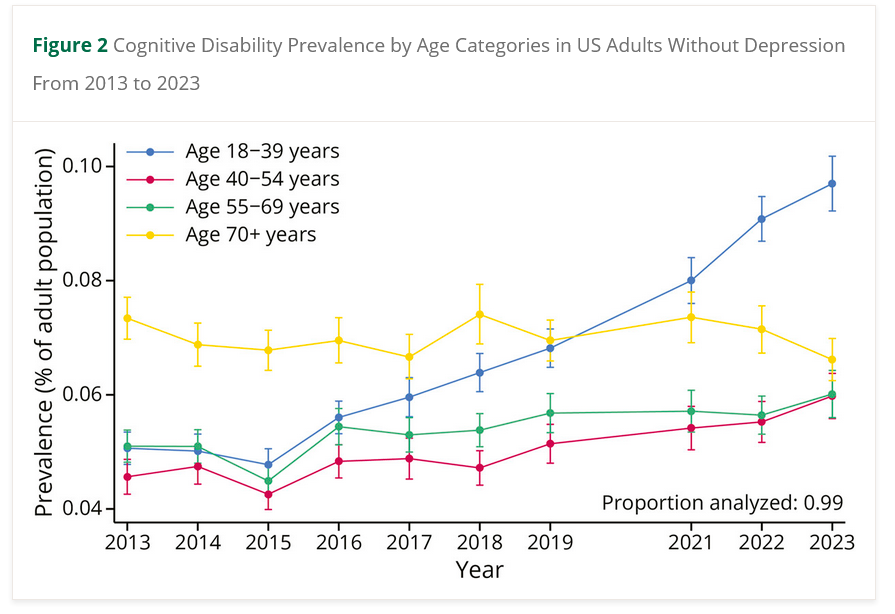
Cognitive disability was strongly associated with socioeconomic factors such as income and education. Adults with household incomes less than $35,000 consistently reported the highest prevalence, increasing from 8.8% (95% CI 8.5%–9.2%) in 2013 to 12.6% (95% CI 12.0%–13.2%) in 2023. By contrast, adults in the highest income bracket (household income ≥ $75,000) had substantially lower prevalence, with a more modest increase from 1.8% (95% CI 1.6%–2.0%) in 2013 to 3.9% (95% CI 3.6%–4.2%) in 2023. Rising Cognitive Disability as a Public Health Concern Among US Adults – Neurology October 21, 2025 issue 105 (8) e214226 https://doi.org/10.1212/WNL.0000000000214226

Overall, income is central to the aging experience. From how well they think they’re aging to how they rate their physical and mental health and financial security, older adults with upper incomes are doing better than those with middle or lower incomes. Aging well: How income and health shape the experiences of older Americans – https://www.pewresearch.org/social-trends/2025/11/06/aging-well-how-income-and-health-shape-the-experiences-of-older-americans/

Yikes.

Scary Charts – 09.13.25

Interestingly, older workers (65+) earn around $3,000 more than those in the 25 to 34 bracket, reflecting a group of late-career professionals who continue to command strong wages. Charted: Median U.S. Salaries by Age Group https://www.visualcapitalist.com/charted-median-u-s-salaries-by-age-group/

Late-career professional. There seem to be a lot more of us now.

Three in four workers (75 percent) plan to work for pay in retirement, compared with just 29 percent of retirees who report they have actually worked for pay in retirement. In fact, the RCS has consistently found that workers are far more likely to plan to work for pay in retirement than retirees are to have actually done so. 2025 Retirement Confidence Surveyhttps://www.ebri.org/retirement/retirement-confidence-survey

But if you’re working for pay in retirement how can this be considered retirement?

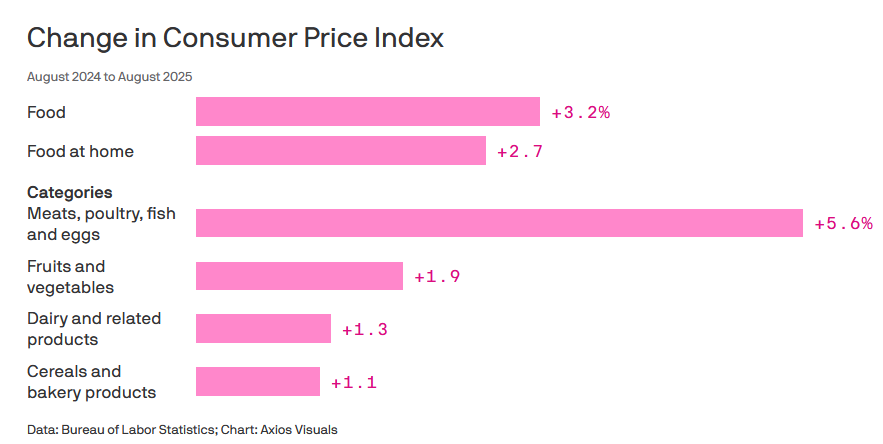
Source: https://www.axios.com/2025/09/11/trump-tariffs-grocery-prices-rise-cpi

FYI, the BLS statistics are BS. Real world eyeball prices at the market tell me so.

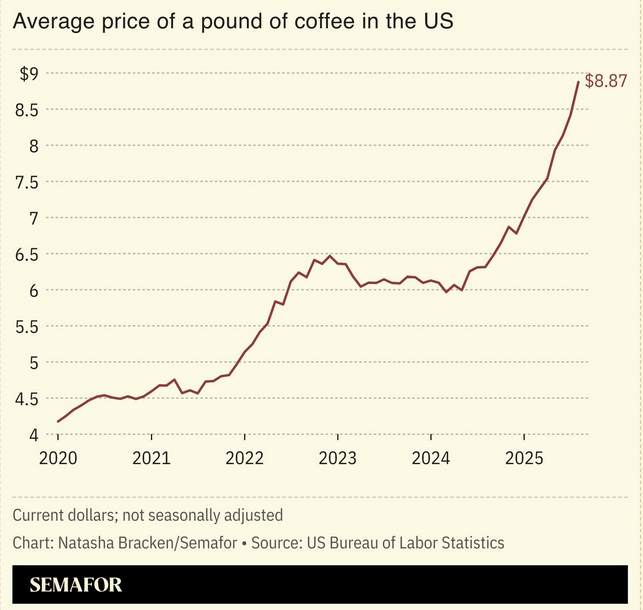
Like coffee. Coffee prices in the US has surged more than 20% in the last year.

US coffee prices surge as tariffs take effecthttps://www.semafor.com/article/09/12/2025/us-coffee-prices-surge-as-tariffs-take-effect

Ooh…not just coffee.

Here’s the inflation breakdown for August 2025 — in one charthttps://www.cnbc.com/2025/09/11/inflation-breakdown-for-august-2025.html

I guess I’ll keep working in “retirement”.

Clearing Up Myths About Older Workers

In 2001, only about 1 out of every 7 U.S. workers was 55 or older. By 2021, the number jumped to almost 1 out of every 4 workers (a 93% increase). That’s almost twice the proportion of older workers as before.3 Older workers are staying on the job longer for various reasons, ranging from financial needs to the joy of work.  More people are working past the age when they might have retired. They might be responding to the increase in the Social Security full retirement age, needing money or health insurance, or simply enjoying their jobs and being around their friends at work.⁴ Clearing Up Myths About Older Workers While Understanding and Supporting an Aging Workforcehttps://blogs.cdc.gov/niosh-science-blog/2023/09/25/older-workers/

I just learned I have a high level of Crystallized intelligence. https://en.wikipedia.org/wiki/Fluid_and_crystallized_intelligence

Diet and Healthy Aging

In the journal Nature Medicine this week there was an important open-access publication about a large combined cohort of over 105,000 health professionals prospectively followed for 30 years. Only 9.3% reached the age of 70 years with “healthy aging” —without 11 major chronic diseases and no impairment of cognitive or physical function or mental health. Our Diet and Healthy Aging Eric Topol, MD – https://erictopol.substack.com/p/our-diet-and-healthy-aging

Dr. Eric Topol’s assessment of this study is well balanced and thoughtfully written. His bio is here: https://www.scripps.edu/faculty/topol/

Healthy aging in this study is described as reaching age 70 without developing any of 11 major diseases: cancer (except for non-melanoma skin cancers), diabetes, heart attack, coronary artery disease, congestive heart failure, stroke, kidney failure, chronic obstructive pulmonary disease, Parkinson disease, multiple sclerosis and amyotrophic lateral sclerosis.

My Half-Birthday is coming up soon. I’ll be 70.5 years young. The biggest take home lesson for me is this:

Beer is better for you than pizza.

Ah, Houston, we’ve had a problem (Scary Charts 03.10.25)

Source – https://www.apolloacademy.com/there-is-a-significant-need-for-retirement-savings-in-the-us/

Short of forcing people to save for retirement, Social Security remains the safety net for those who lack access to retirement vehicles or don’t have the means to save. – How Many Americans Don’t Save For Retirement? https://awealthofcommonsense.com/2025/03/how-many-americans-dont-save-for-retirement/

TBH, Social Security is a much higher portion of our retirement income than I had planned for.

Baby Boomers Are Aging Into the Group Most Affected by Hoarding Disorder

Studies have estimated that hoarding disorder affects around 2.5% of the general population — a higher rate than schizophrenia. The mental illness was previously considered a sub-type of obsessive-compulsive disorder, but in 2013 it was given its own diagnostic criteria in the Diagnostic and Statistical Manual of Mental Disorders, the DSM-5.

For Seniors With Hoarding Disorder, a Support Group Helps Confront Stigma and Isolationhttps://kffhealthnews.org/news/article/hoarding-disorder-support-groups-pennsylvania-baby-boomers/

Yikes.

Antidepressant Use Associated With Cognitive decline in Patients with Dementia

In this cohort study, use of antidepressants was associated with faster cognitive decline in patients with dementia, in particular SSRIs (i.e., citalopram, sertraline and escitalopram) and mirtazapine. These effects appeared to be more pronounced in patients with more severe dementia. Compared with sertraline, escitalopram presented faster cognitive decline, while citalopram was linked to a slower cognitive decline. Additionally, higher dispensed doses of SSRIs were associated with greater cognitive decline, as well as increased risks of severe dementia, all-cause mortality, and fracture. Our study cannot distinguish whether these findings are due to the antidepressants or the underlying psychiatric indication. Mo, M., Abzhandadze, T., Hoang, M.T. et al. Antidepressant use and cognitive decline in patients with dementia: a national cohort study. BMC Med 23, 82 (2025). https://doi.org/10.1186/s12916-025-03851-3

If I develop dementia no SSRI’s for me please.

Men Are Bad at Retirement

When envisioning retirement, many men imagine traveling, playing with grandchildren and driving that sexy convertible they can finally afford. The reality? For those over 70, 94% of adults watch television every day, with nearly 10% spending more than nine hours a day staring at the shows.

Men die earlier, with an average life expectancy of 73.5 years, according to a 2021 study. That’s about five years earlier than women in the U.S. One study found that men who considered themselves “traditional” men — unemotional and self-reliant — were more likely to ignore medical problems, and suffered worse health outcomes than women. And the problem gets worse as they get older. About 74% of men 55 and older go to the doctor for an annual check-up, compared to 43% of men age 35-54 and 26% of men age 18-34. Why So Many Men are Bad at Retirement https://getpocket.com/explore/item/why-so-many-men-are-bad-at-retirement?

This is an interesting article. Just more reasons why I’m not retired.

Retire. Watch TV all day long. Repeat.

Yikes.