Train Your Brain

Underwriters love stuff like this!

How Your Brain Connects the Future to the Past – Jeff Brown and Mark Fenske – Your Health at Work – Harvard Business Review

In the business world, it’s a distinct advantage to have a brain that anticipates future demands and negotiates them well. Accurate predictions typically translate to success. Being able to envision future scenarios helps foster strategic planning and resist immediate rewards in favor of longer-term gains. The proactive brain flexibly recombines details from past experiences that, by analogy with your current surroundings, help you make sense of where you are, anticipate what will come next, and successfully navigate the transition.

Scary Charts of the Day – 09.20.2010

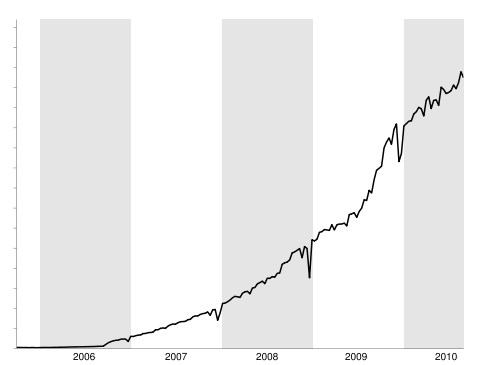
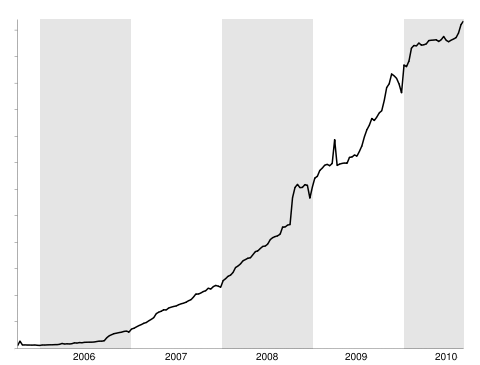
Number of People Using Google Reader Minimum Once WeeklyNumber of Google Reader Items Read Per Day

Official Google Reader Blog: A welcome and a look back

These charts should be extremely scary especially to folks in the newspaper and media businesses.  If you wanted some hard evidence on consumer preferences for news outlets shifting to the Internet, here you go.  The top chart is the number of people who use Google Reader at least once a week.  The bottom chart is the number of items read on Google Reader.

Personally, we still buy a daily newspaper.

Kindle Ebooks Outselling Dead Tree Versions

I am still holding out for lower prices on my Ebook reader of choice.  Besides I like dead tree versions of books.

Amazon: Kindle Books Now Outselling Hardcovers

E-books have hit a significant milestone. In each of the last three months, Amazon reports that sales of books for Kindle have outpaced the sale of hardcover books, and that growth is only accelerating.

In a statement, Amazon says that, “over the past three months, for every 100 hardcover books Amazon.com has sold, it has sold 143 Kindle books. Over the past month, for every 100 hardcover books Amazon.com has sold, it has sold 180 Kindle books.”

Mind Shift

The hidden trend in the monthly jobs report — and what it means for you | paulacaligiuri.com

There is a big change on the horizon in the way we should conceive of the concept of jobs – and it is dramatically changing how job security will be created in the future. For many, jobs of the future may be more like multiple income generating activities (or gigs) where we leverage our talents and skills. Job security will no longer be derived from being employed 40 hours/week. Rather, it will be something we create for ourselves when our talents and skills are in demand.

This is a mind shift.

The emphasis of the future will be on the skills you bring, rather than the job you occupy. There will be a far greater focus on self-management of both our skills and our network, two critical components of career success. Possessing more sought-out skills and having a strong network will be related to more income opportunities, whether working for a single organization or as an independent contractor.

Perhaps we need to take a collective deep breath and realize that, while change is afoot, this free agent mentality may also come with some upsides:

  • You will now have tremendous flexibility to plan and grow your own career, no longer relinquishing career management to an employer.
  • You will now have the ability to craft your sources of income across multiple opportunities if this is what you chose to do.
  • You will now have the opportunity to engage in a career that fits with your life – and not vice versa.

Thanks Paula.  I could not have said this better myself.
Less is More

For Real Productivity, Less is Truly More – The Conversation – Harvard Business Review

The way we’re working isn’t working — for employees or for their employers. There is a better way to fuel productivity and high performance. The first key to changing the way we work is recognizing that the value of those you manage isn’t generated by the number of hours they work, but rather by how much value they produce during the hours we are working. Working longer hours, juggling more tasks and answering more emails isn’t the solution.

Read a Book a Week – Update 5/15/10

The Future of E-Readers Is Brighter Than We Knew | The Big Money

The report has much more information, including the stunning number that 49 percent of the respondents—whether they were familiar with e-readers—were planning to buy a tablet device within the next three years. (Holy smokes!)

I recall an exchange between one of my readers who posted a comment on one of my read a book a week posts.  He was a fervent admirer of ebooks.  I hereby dedicate this post to that anonymous reader.
I am saddened to report I have read just 16 books this year.  Working too much and not spending enough free time reading is my excuse.
And no ebook reader…yet.