Drawing on a nationally representative survey of 1,591 U.S. adults ages 22–75, this research uncovers a five-year difference between when current retirees, on average, actually left the workforce (age 57) and when future retirees expect to retire (age 62), with half of those planning to retire anticipating they’ll need to delay even further. Future retirees are shifting away from traditional income sources like Social Security and pensions, planning instead to rely more heavily on personal savings and continued employment. Career interruptions remain a significant but underappreciated threat to retirement security, as half of U.S. adults have left the workforce for more than a year.
The entire study Bridging retirement expectation gaps New evidence and insights can be downloaded here:
Yes dear reader, yet another post in the never ending series of random thoughts on retirement. For the curious, here’s a link to some previous posts https://lifeunderwriter.net/tag/retirement/. I am an Old Guy who is old enough to be retired but isn’t retired and still working. After many mornings spent in deep contemplation and many posts where I think out loud I’ve finally accepted my fate and come to a deeper understanding of why I do what I do.
I’ve spent a lifetime working in risk management. Finally, the light bulb came on.
I am actively managing my longevity risk. It’s what I do. I manage risks.
The majority of our friends are retired. I’m always asked when I’m going to retire. My answer was always “Don’t know”. I subsequently modified my response to “Two to four years”. This has been my answer for the past two years. But now when someone asks when I will retire, my answer will be:
I am managing my longevity risk. I am managing future inflation risk.
Imagine you retire at 65, feeling confident. You’ve budgeted $80,000 a year to live comfortably — travel, dining out, covering healthcare, the works.
Fast-forward 25 years.
At age 85, you’re still spending about $80,000 a year … but that no longer buys what it used to.
That nice dinner out that cost $100 now costs about $210
A $5,000 annual vacation is now closer to $10,500
Groceries that ran $10,000 a year are now over $21,000
In other words, your $80,000 lifestyle now costs roughly $168,000 to maintain.
Ghilarducci is spot on with her assessment. My plan on working longer wasn’t really a plan so much as it was a set of assumptions. Everything had to go as “planned” or forget about working longer. The two major variables were continued good health and finding an employer that values older workers.
I got lucky. My illusion is working (pun intended).
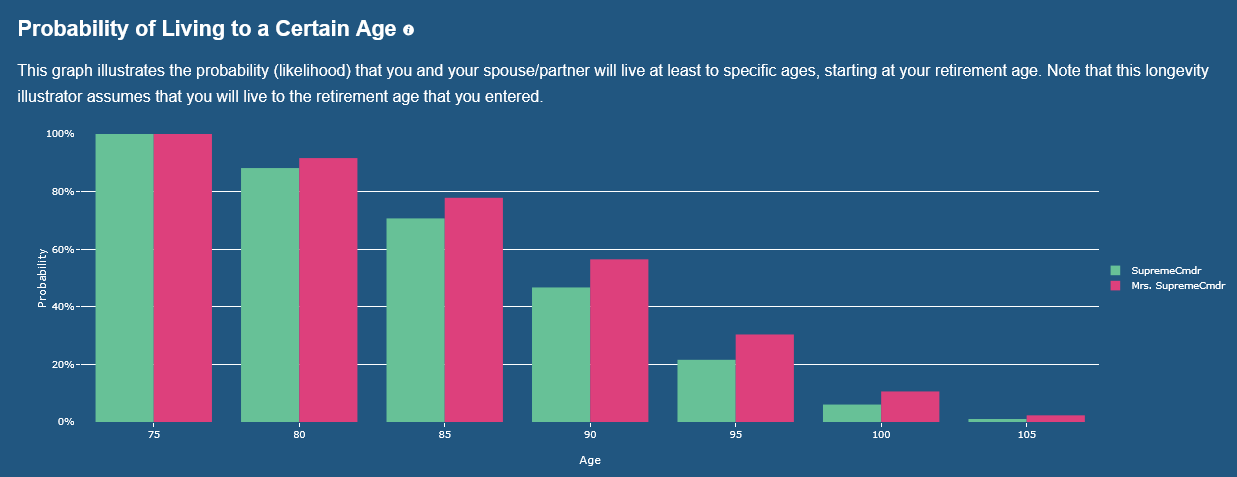
There is a significant chance that you will live for many years beyond the average, and you should consider this possibility when thinking about your retirement. The Actuaries Longevity Illustrator (“ALI”) has been developed as an educational tool by the American Academy of Actuaries and the Society of Actuaries to help you gauge what those chances are. Reflecting on your longevity will allow you to consider the risks of outliving your financial resources, i.e., the chance of running out of money during your lifetime, which we refer to as retiree financial longevity risk . The ALI helps you to consider those risks by letting you see how long you might live. https://www.longevityillustrator.org/
Try this calculator to see your probability of living to certain ripe old age.
“We have to understand that anything in the past takes you out of the present moment. Anything in the future takes you out of the present moment.”
Zen Master Daigneault
To readers who are visiting this blog for the first time my posts on Random Thoughts About Retirement and Unretirement are written by an Old Guy who is old enough to be retired but isn’t retired and is still working. I had another birthday and the older I get the more I think about retirement. Back in 2023 I was thinking about what retirement for me would look like (see More Random Thoughts on Retirement – June 2023). But decisions such as this take serious thought and consideration. At first I thought I wanted to retire to a quiet life of blogging and writing my Future Best Seller titled The Man Who Had No Hobbies. After much thought I decided to add a short term goal to my retirement plan. My new short term goal is to avoid unretirement.
My RSS feed feeds me headlines on unretirement.
According to a new report from T. Rowe Price around 7% of retirees are looking for work in retirement, while 20% say they’re already working part time or full time…The two main reasons for coming back into the workforce are a tale of opposites. While 45% chose to work for social and emotional benefits… a slightly larger percentage — 48% — felt they needed to work for financial reasons.
Once an eagerly awaited milestone, retirement is currently undergoing a transformative reevaluation. Traditionally seen as a well-deserved period of rest and relaxation, the dream of early retirement is now being challenged by a new perspective – that of embracing lifelong work. This paradigm shift reflects the changing nature of work, increased life expectancy, and the desire for personal fulfillment.
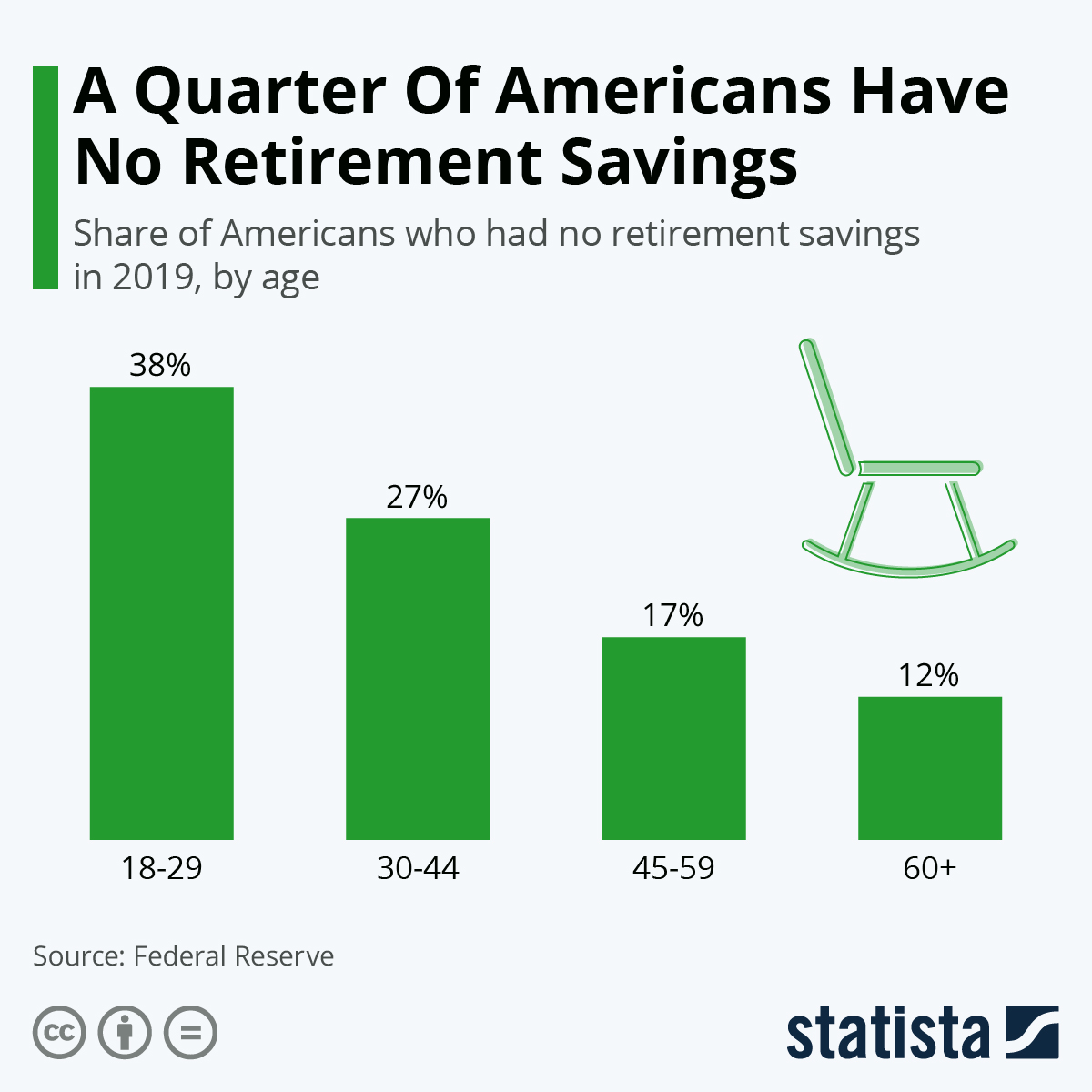
The reality is many won’t have a choice. The following chart illustrates retirement savings as of 2019.
Americans are having trouble financially preparing themselves for life after work. A recent Federal Reserve report found that nearly a quarter of U.S. adults have absolutely no retirement savings or pension. Even though the level of preparation increases as people get older, concern about inadequate savings is still readily apparent across all age groups, even older people in their 60s.
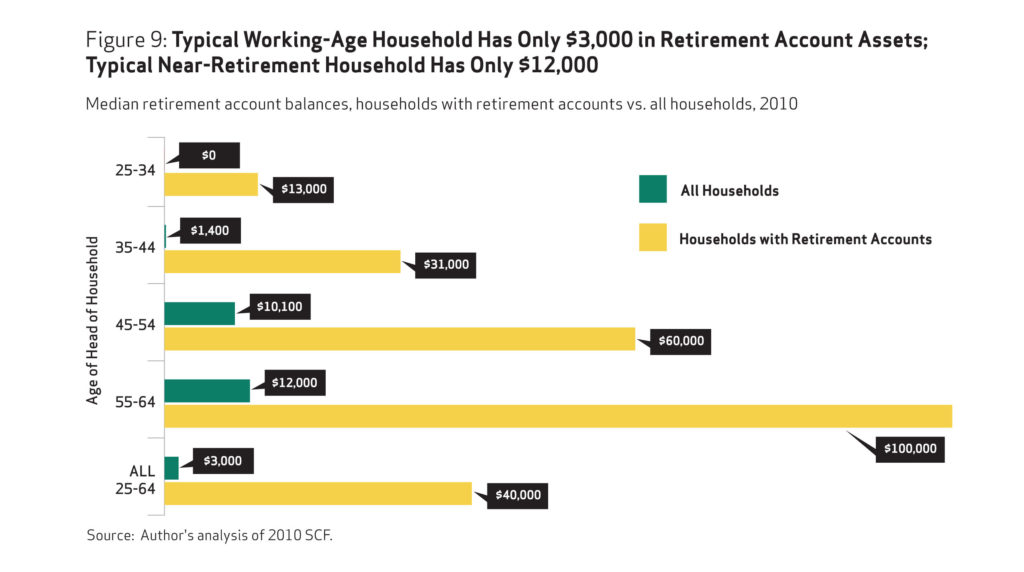
OOPS. I’m glad I didn’t click the Publish button. The savings situation appears to be worse than I thought. The study below was an analysis of data from 2010!
The study broadly examines how American households are faring in relation to retirement savings targets recommended by some financial services firms. It uses the Federal Reserve’s Survey of Consumer Finances to analyze retirement plan participation, savings, and overall assets of all U.S. households age 25 to 64, not just those with retirement account assets. This is important because some 45 percent, or 38 million working-age households, do not have any retirement account assets.
The average working household has virtually no retirement savings. When all households are included— not just households with retirement accounts—the median retirement account balance is $3,000 for all working-age households and $12,000 for near-retirement households. Two-thirds of working households age 55-64 with at least one earner have retirement savings less than one times their annual income, which is far below what they will need to maintain their standard of living in retirement.
The findings confirm that the American Dream of retiring comfortably after a lifetime of work will be impossible for many. Based on 401(k)–type account and IRA balances alone, some 92 percent of working households do not meet conservative retirement savings targets for their age and income. Even when counting their entire net worth, 65 percent still fall short.
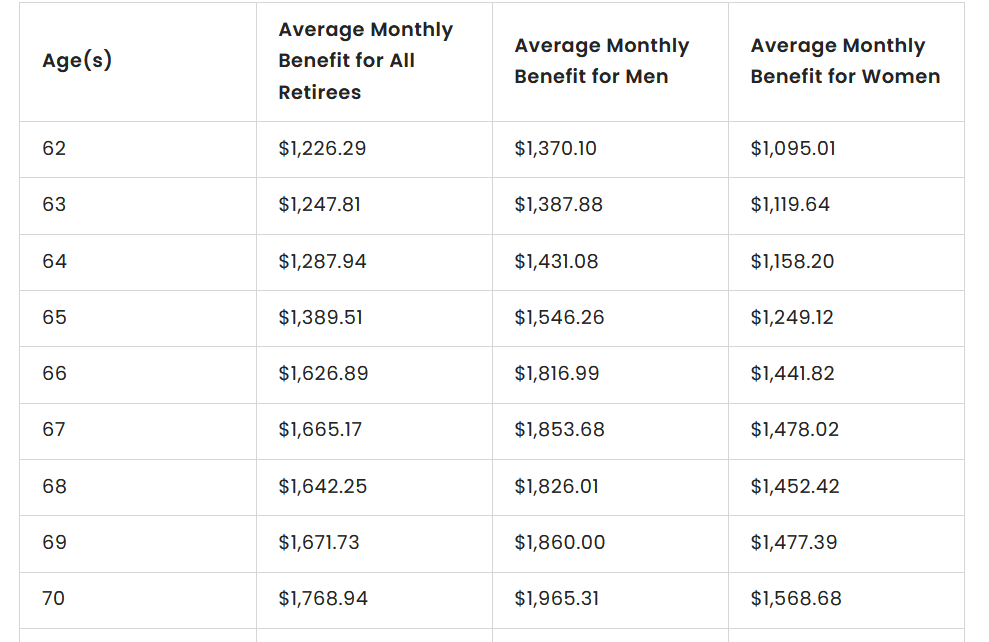
So how will you afford retirement without any savings? Don’t look to Social Security. Here’s some numbers on average Social Security payments. The full chart at the source website goes up to age 100.
As of December 31, 2021, the average Social Security payment for all retirees was $1,658.03 a month, according to the Social Security Administration’s Annual Statistical Supplement for 2022. For men, the overall average was $1,838.08. For women, the average was $1,483.75 — a difference of $354.33 per month.
Whether people unretire or simply stay in the workforce longer, some of the largest financial benefits of additional years of work are delaying retirement account withdrawals and delaying claiming Social Security benefits. These actions essentially shorten the amount of time your assets will need to support you in retirement. Even a few additional years of income have a positive effect on the probability that you won’t outlive your funds.
I’ve decided not to retire. Wait, let me clarify my statement.
I’ve not changed my mind about my decision not to retire five years ago.
I love double negative sentences.
Fewer than twenty percent of older people worldwide enjoy a retirement pension that is enough for them to live off. Although countries like China and India are now also developing their pension systems, the prospect of most older people receiving pensions totaling 60 to 70% of their final salaries remains a long way off.
The majority of our friends are retired. I’m always asked when I’m going to retire. My quick answer was always “Don’t know”. I’ve since modified my response to “Two to four years”. This has been my answer for the past two years. Might still be my answer next year too.



You must be logged in to post a comment.