Random Thoughts on Retirement (or why I continue to work)

Congress needs to get serious about tweaking various aspects of Social Security, but this time to improve the financial aspects of the system, and not to make them worse, as it had done in January.Social Security Fiscal Year 2025: Trust Fund Balance, Income, Outgo, Deficit, and Interest Rates https://wolfstreet.com/2025/11/18/social-security-fiscal-year-2025-trust-fund-balance-income-outgo-deficit-and-interest-rates/

The Boss (SWMBO) and I talk about this often. Once the W2 income stops and we have to rely upon a small corporate pension, savings, and a shaky Social Security promise we’ll have to get conservative on our spending. No more Stratocasters. Less purchases for wardrobe enhancements. Gas station beer instead of craft brews.

Time will tell.

SWMBO – She Who Must Be Obeyed

Yikes.

Social Frailty

Social frailty is a corollary to physical frailty, a set of vulnerabilities (including weakness, exhaustion, unintentional weight loss, slowness, and low physical activity) shown to increase the risk of falls, disability, hospitalization, poor surgical outcomes, admission to a nursing home, and earlier death in older adults.

For seniors who want to think about their own social vulnerability, consider this five-item index, developed by researchers in Japan.

(1) Do you go out less frequently now than last year?

(2) Do you sometimes visit your friends?

(3) Do you feel you are helpful to friends or family?

(4) Do you live alone?

(5) Do you talk to someone every day?

Being ‘Socially Frail’ Comes With Health Risks for Older Adults — https://khn.org/news/article/socially-frail-older-adults-health-risks/

I passed the quiz.

Nutrition and Obesity in Covid-19

USCOVID19_IMAGE

NEJM

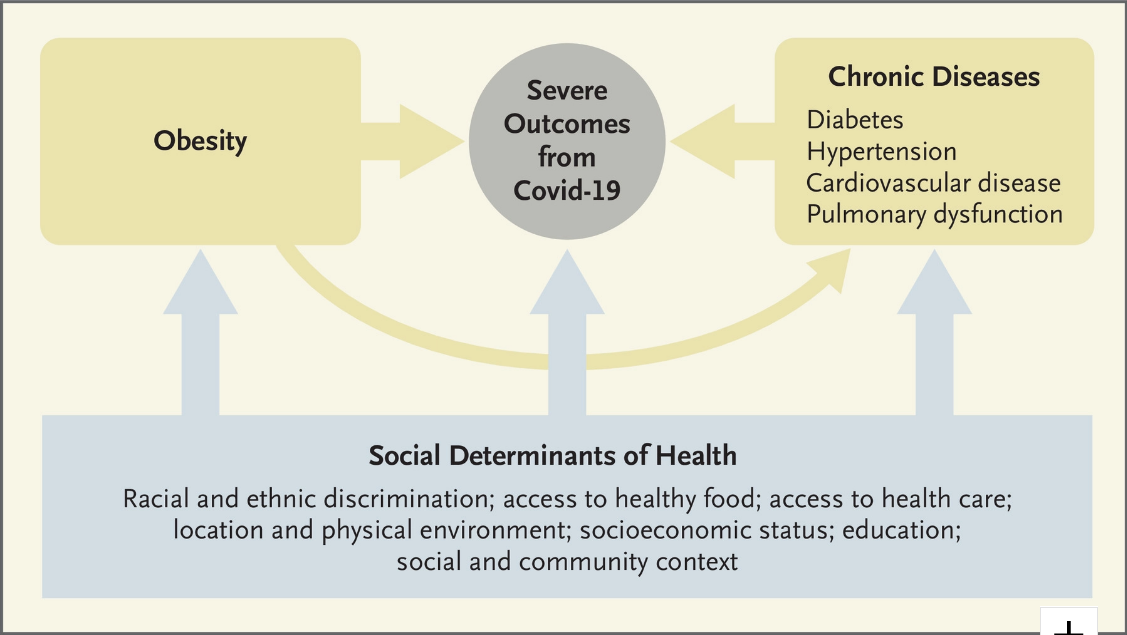
A healthy diet, rich in fruits and vegetables and low in sugar and calorie-dense processed foods, is essential to health. The ability to eat a healthy diet is largely determined by one’s access to affordable, healthy foods — a consequence of the conditions and environment in which one lives. In the United States, poor diet is the leading underlying cause of death, having surpassed tobacco use in related mortality.2 A study of dietary trends among U.S. adults between 1999 and 2012 showed overall improvement in the American diet, with the proportion of people who reported having a poor-quality diet decreasing from 55.9% to 45.6%; additional analyses, however, revealed persistent or worsening disparities in nutrition based on race or ethnicity, education, and income level.3

Covid-19 and Disparities in Nutrition and Obesity

Screenshot_2020-07-19 Covid-19 and Disparities in Nutrition and Obesity NEJM

The BMJ

Global efforts to develop treatments for covid-19 have focused on drug repurposing, immunotherapies including convalescent plasma and monoclonal antibodies, and vaccines. Despite obesity prevalence rates of 40% in the United States, 29% in England, and 13% globally, to our knowledge none of the several thousand clinical studies of covid-19 in international clinical trial registries proactively recruit participants with obesity. On the contrary, several studies consider overweight or obesity as exclusion criteria. We call for proportional representation of people with obesity in clinical trials of drugs and vaccines, including dose finding studies.

Obesity and covid-19: the unseen risks

More from The BMJ

Covid-19: What we eat matters all the more now

our food systems are making us ill.11 The covid-19 outbreaks at meat packing plants have focused minds on the meat industry as a driver for acute and chronic disease.12 Last month Monique Tan and colleagues wrote that the food industry should be held partly accountable “not only for the obesity pandemic but also for the severity of covid-19 disease and its devastating consequences.”13 The government must do more to hold the industry to account.

BMJ 2020; 370 doi: https://doi.org/10.1136/bmj.m2840

Lose weight.  Make better food choices.  Wear a mask.


slide16b7e185fa68643949edb6b68fed65ae3