Cardiovascular Risk Factors in CKD Associate with Both ESRD and Mortality.
Link above is to the JASN abstract. Link below is the AHA Life’s Simple 7 initiative.
Cardiovascular Risk Factors in CKD Associate with Both ESRD and Mortality.
Link above is to the JASN abstract. Link below is the AHA Life’s Simple 7 initiative.
Action Points
Researchers have discovered a new tick-borne illness, caused by Borrelia miyamotoi, whose symptoms are similar to that of Lyme disease and other tick-borne illnesses, but that does not respond to conventional doxycycline in the same way.
Patients with the new illness, due to Borrelia miyamotoi, presented much like the others, with patients complaining of acute febrile illness, with myalgia, headache, neutropenia, thrombocytopenia, and elevated hepatic aminotransferase levels.
Entrepreneurs Get Better with Age – Whitney Johnson – Harvard Business Review.
Independent Work May Be Inevitable – Whitney Johnson – Harvard Business Review.
Just as larger businesses provide economic stability to society in the form of higher pay, better medical care, and retirement, experienced workers provide intellectual and emotional ballast in the workplace including innovation expertise. Think about it — disruptive innovation is about playing where no one wants to play (low-end), or has thought of playing (new market).
Disruptive innovation. The more I think about this term the more I begin to realize it is time to change once again. As a life underwriting expert witness I’ve played in an area where few underwriters get to play. As I look back on the recent past expert witness work was never the main focus. The more I think about this the more I come to realize it is time to refocus.
So where do you want to play?
Alzheimer’s disease is the 6th leading cause of death in the United States overall and the 5th leading cause of death for those aged 65 and older. It is the only cause of death among the top 10 in America without a way to prevent it, cure it or even slow its progression. Deaths from Alzheimer’s increased 68 percent between 2000 and 2010, while deaths from other major diseases, including the number one cause of death (heart disease), decreased.
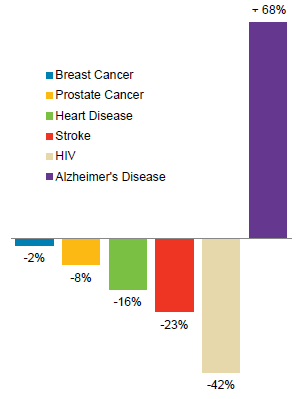
via Latest Facts & Figures Report | Alzheimer’s Association.
Through a median of 13 years of follow-up, twins who had PTSD at baseline had a significantly higher rate of incident coronary heart disease compared with those without PTSD (22.6% versus 8.9%), according to Viola Vaccarino, MD, PhD, of Emory University in Atlanta, and colleagues.
The difference was not due to established risk factors, since the association remained significant after adjustment for sociodemographic factors, service in Southeast Asia, lifestyle factors, coronary heart disease risk factors, major depression, and other psychiatric diagnoses (OR 2.1, 95% CI 1.1-3.9), the researchers reported online in the Journal of the American College of Cardiology.
Individuals who added more than half a serving a day of red meat to their diet saw a 48% increase in their risk of type 2 diabetes onset over the next 4 years compared with those who stayed at that level, An Pan, PhD, of the Harvard School of Public Health and National University of Singapore, and colleagues found.
Cutting intake by the same amount during the first 4 years of follow-up lowered that risk by 14% during the following 12 to 16 years, the researchers reported online in JAMA Internal Medicine.
Levels of free thyroxine at the higher end of the normal range are associated with all-cause mortality in older men who do not have thyroid disease, researchers found.
After adjustment for other risk factors, each 10% decrease in the lowest nocturnal oxygen saturation among adults undergoing a first-time polysomnogram for suspected sleep-disordered breathing was associated with a 14% greater risk of sudden cardiac death or resuscitated cardiac arrest (HR 1.14, 95% CI 1.01 to 1.27), according to Virend Somers, MD, PhD, of the Mayo Clinic in Rochester, Minn., and colleagues.
Sleep factors associated with a significantly greater likelihood of remaining free from sudden cardiac death or resuscitated cardiac arrest included an apnea-hypopnea index of less than 20 events per hour (HR 1.60, 95% CI 1.14-2.24), a mean nocturnal oxygen saturation of 93% or higher (HR 2.93, 95% CI 1.98-4.33), and a lowest nocturnal oxygen saturation of 78% or higher (HR 1.81, 95% CI 1.28-2.56), the researchers reported online in the Journal of the American College of Cardiology.
via Apnea: ‘Sleeping Gun’ in Sudden Death
Yes. CPAP compliance matters.
Note that this large genetic analysis demonstrated that individuals with genes linked to lower vitamin D levels are more likely to have hypertension mediated by low vitamin D, strengthening the argument for a causal link.
Be aware that the absolute effect of vitamin D levels on blood pressure was negligible, even though statistically significant.
Annals of Internal Medicine | Gun-Related Deaths: How Australia Stepped Off “The American Path”.
Article link presented as a public service. There is a link in the article for a free PDF copy of the author’s book on how Australia implemented gun control.
 lifeunderwriter.net
You must be logged in to post a comment.