DM1 Mortality Rate Improves

Type 1 Diabetes Death Rate is Falling, But Not Fast Enough

When the researchers broke the mortality rate down by the time of diagnosis, they found that those diagnosed later had a much improved mortality rate. The group diagnosed in the 1960s had a 9.3 times higher mortality rate than the general population, while the early 1970s group had a 7.5 times higher mortality than the general population. For the late 1970s group, mortality had dropped to 5.6 times higher than the general population. 

Watch Those Uric Acid Levels

Medical News: ACR: Lowering Uric Acid Cuts Cardiac Death Rate – in Meeting Coverage, ACR from MedPage Today

There is a significant association between lowering uric acid in patients with high levels and a reduction of their mortality from cardiovascular disease, researchers said here. 

During the study period, hyperuricemia patients who were treated with urate lowering drugs such as allopurinol achieved a 44% reduction in death caused by heart disease and a 58% reduction in deaths caused by stroke (P<0.001 for both), according to Jiunn-Horng Chen, MD, PhD, of China Medical University, Taichung, Republic of China (Taiwan).

Smoking and Dementia Risk

Arch Intern Med — Abstract: Heavy Smoking in Midlife and Long-term Risk of Alzheimer Disease and Vascular Dementia, October 25, 2010, Rusanen et al. 0 (2010): archinternmed.2010.393v1

Conclusions – In this large cohort, heavy smoking in midlife was associated with a greater than 100% increase in risk of dementia, AD, and VaD more than 2 decades later. These results suggest that the brain is not immune to long-term consequences of heavy smoking. 

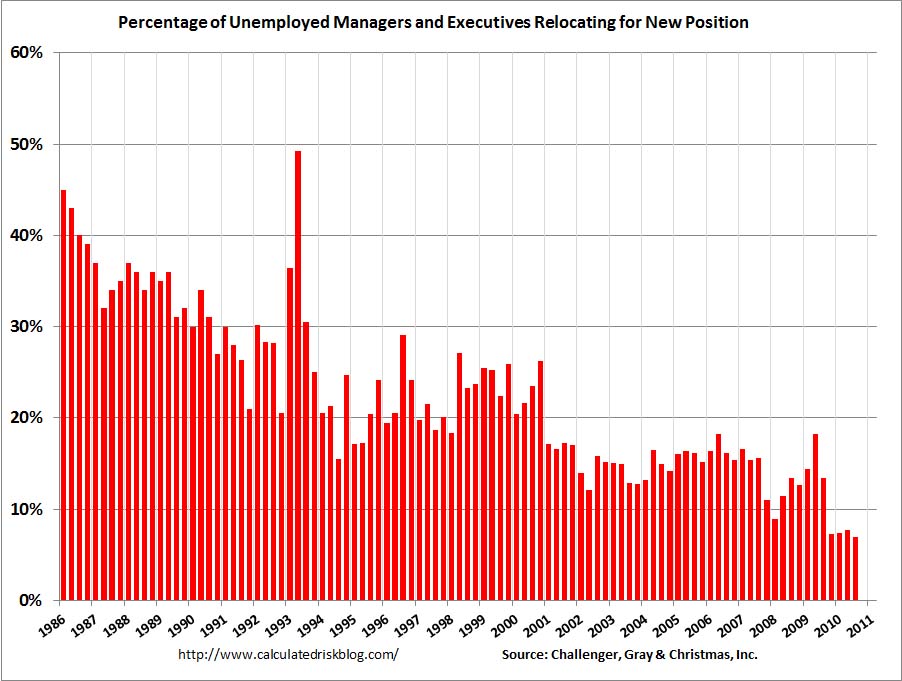
Scary Chart of the Day – 10/29/10

Calculated Risk: Housing Bust impacting Manager Mobility

One of the strengths of the U.S. labor market has been the flexibility associated with labor mobility at all levels of employment – households could easily move from one region to another for better employment. The sharp decline in house prices, leaving homeowners with significant negative equity, appears to be limiting this flexibility.

Bad times for moving companies

It’s Saturday morning and I’m not sufficiently caffeinated, sitting in my office catching up on the news when I come across this chart.  So I get up and get another cup of Joe, sip and think a little more about just what this chart is telling me.

A lot.

If Your Leg Breaks Stop Taking Biphosphonates

The highlighted bold is me.  I keep reading this FDA recommendation just to make sure I understand what they are trying to say.  I think the recommendation says the FDA found no cause and effect between the use of biphosphonates and leg fractures so keep taking your medication.  But if your leg breaks, your physician will instruct you to stop taking the medication she prescribed for you to help prevent bone loss and fractures.

I’m glad the FDA cleared up this issue, don’t you?

Safety Alerts for Human Medical Products > Bisphosphonates (Osteoporosis Drugs): Label Change – Atypical Fractures Update

BACKGROUND: Atypical subtrochanteric femur fractures are fractures in the bone just below the hip joint. Diaphyseal femur fractures occur in the long part of the thigh bone. These fractures are very uncommon and appear to account for less than 1% of all hip and femur fractures overall. Although it is not clear if bisphosphonates are the cause, these unusual femur fractures have been predominantly reported in patients taking bisphosphonates.

RECOMMENDATIONS: Patients should continue to take their medication unless told to stop by their healthcare professional. FDA recommends that healthcare professionals should discontinue potent antiresorptive medications (including bisphosphonates) in patients who have evidence of a femoral shaft fracture. See the FDA Drug Safety Communication below for additional information.

FDA Warns Docs, Patients of Femoral Fracture Risk Linked to Some Bisphosphonates — AAFP News Now — American Academy of Family Physicians