Another View of the War in Mexico

Business owners and investors!I’ll be in San Antonio for the annual AHOU meeting.

I’m looking forward to seeing how the city has changed since my last visit.

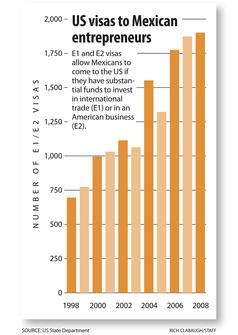
Who’s creating US jobs? Mexicans. / The Christian Science Monitor – CSMonitor.com

“In fiscal year 2008, the US issued E-1 and E-2 visas to 1901 Mexicans and their families, nearly three times the level of a decade before. “

Where are all of these Mexican immigrant investors going? San Antonio!

Don’t Take Plavix if You Are a Poor Metabolizer

A “poor metabolizer” does not effectively convert Plavix to its active form because of low CYP 2C19 activity.

How does someone figure out they are a “poor metabolizer”?

Read the FDA communication if you’re seriously interested in the answer to this question.

FDA Drug Safety Communication: Reduced effectiveness of Plavix (clopidogrel) in patients who are poor metabolizers of the drug

The U.S. Food and Drug Administration (FDA) has added a Boxed Warning to the label for Plavix, the anti-blood clotting medication. The Boxed Warning is about patients who do not effectively metabolize the drug (i.e. “poor metabolizers”) and therefore may not receive the full benefits of the drug.

CTE = Chronic Traumatic Encephalopathy

NFL Brain Collector Shows Violence in Slices of Gray Matter – Bloomberg.com

Healthy tau helps strengthen the neurons in the brain, like steel reinforcements in a concrete bridge. Repetitive trauma can lead to a change in tau, making it clump like tangles of yarn. The more tangles, the more the communication between cells is hampered. Functions such as memory and anger control can disappear; dementia and death can follow.

CTE is a unique pathological condition, according to Stern. The postmortem diagnosis of Alzheimer’s requires the presence of deformed tau and another protein, beta amyloid. The diagnosis of CTE requires only the presence of deformed tau.

Outsourcing v. Permanent Hires

Calculated Risk: Diffusion Index and Temporary Help

The thinking is that before companies hire permanent employees following a recession, employers will first increase the hours worked of current employees and also hire temporary employees. Since the number of temporary workers increased sharply, some people think this might be signaling the beginning of an employment recovery.

However, there has been some evidence of a shift by employers to more temporary workers, and the saying may become “We are all temporary now!”, so use this increase with caution. For more, including some cautionary comments from a BLS economist on using temporary help, see Tom Abate’s article in the San Francisco Chronicle.

The problem, of course, is the fact that temps and perma-temps are the first to be terminated at the beginning of a business cycle downturn and the first to be hired when the cycle turns back upwards.  If you’re a temp, that is.  Read the entire SF Chronicle article.  It’s a good, short read.

Proximal PAD BAD

Medical News: Proximal PAD Portends Worse Outcomes – in Cardiovascular, Peripheral Artery Disease from MedPage Today

A proximal location significantly increases the risk of poor outcomes in peripheral arterial disease (PAD), independent of risk factors and comorbidities, a review of records on 400 patients showed.

Proximal (aortoiliac) involvement tripled the risk of cardiovascular events compared with distal disease. The findings contrast with evidence of poorer limb prognosis in patients with distal PAD, according to an article published online in the Journal of the American College of Cardiology.

HbgA1c – Not Just For DM Anymore

Newer Blood Test Predicts Diabetes, Heart Disease – BusinessWeek

For the current study, Selvin and her colleagues measured A1C from more than 11,000 stored blood samples from the Atherosclerosis Risk in Communities Study, which began in 1990. None of the study volunteers had diabetes or cardiovascular disease at the time the blood samples were taken.

The researchers then compared the A1C levels to fasting blood sugar levels and to the 15 years of overall health follow-up information gathered for the previous study.

During that time, 2,251 people were diagnosed with diabetes, nearly 1,200 were diagnosed with heart disease and 358 people had an ischemic (non-bleeding) stroke, according to the study.

As expected, the researchers found that elevated A1C levels were associated with an increased risk of being diagnosed with diabetes. Those with an A1C of less than 5 percent had a 48 percent reduced risk of diabetes, while people whose A1Cs were between 5 and 5.5 percent had a normal risk of diabetes. From there, however, the risk quickly went up. Those with an A1C of 5.5 to 6 percent had an 86 percent increased risk of diabetes. For those between 6 and 6.5 percent, the risk more than quadrupled. For people with levels above 6.5 percent, the odds of being diagnosed were more than 16 times higher than for someone with levels under 5.5 percent. These results were similar to those for fasting glucose levels, the study authors noted.

Where fasting glucose and A1C differed greatly, however, was in the prediction of future heart disease and stroke risk. While fasting glucose failed to predict future risk, the study found that A1C levels accurately did so.

People with A1Cs under 5.5 percent had an average risk of heart disease and stroke, but for people with an A1C between 5.5 and 6 percent, the risk went up 23 percent. For those with an A1C between 6 and 6.5 percent, the risk of cardiovascular disease jumped to 78 percent. When A1C went over 6.5 percent, the risk of cardiovascular disease went up nearly twofold.

Results of the study are published in the March 4 issue of the New England Journal of Medicine.