Author: SupremeCmdr
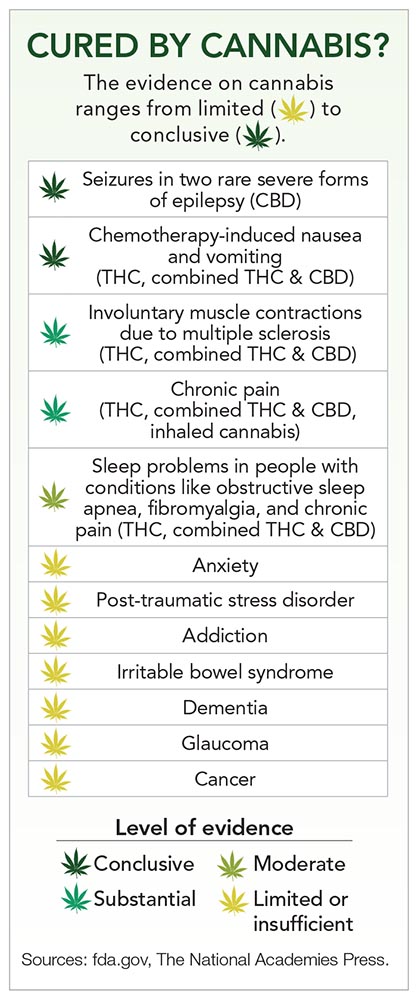
Cured by Cannabis!
The potential benefits and risks of cannabis
The information in this post first appeared in the March 2019 issue of Nutrition Action Healthletter.
Nice article summarizing the medical evidence for cannabis health benefits.
Optimal Cholesterol Level
Opiods + Marijuana = Bad
Cannabis Plus Opioids in Chronic Pain: Not a Great Combo
Previous research by Humphreys and colleagues showed that people who used medical cannabis also had higher rates of opioid use and misuse. “This is one of many examples where claims about the benefits of medical cannabis are not supported by evidence,” Humphreys told MedPage Today. The current study had several limitations: it relied on cross-sectional, self-reported data and was subject to possible selection bias and confounding. It also did not assess the frequency or quantity of cannabis or opioid use, or the type of chronic pain.
Gout + CKD = Bad
Stress related disorders and risk of cardiovascular disease: population based, sibling controlled cohort study
BMJ 2019; 365 doi: https://doi.org/10.1136/bmj.l1255 (Published 10 April 2019) Cite this as: BMJ 2019;365:l1255
Conclusion Stress related disorders are robustly associated with multiple types of cardiovascular disease, independently of familial background, history of somatic/psychiatric diseases, and psychiatric comorbidity.
This study is Open Access and a PDF can be downloaded at the link above.
Rising Despair
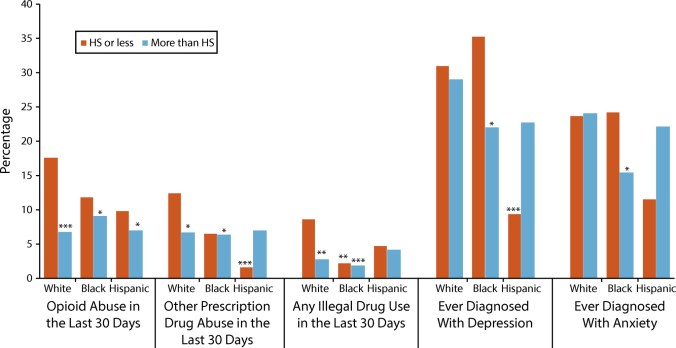
Cross-Sectional Weighted Prevalence of Despair by Race/Ethnicity and Education: United States, 2016–2017
Note. HS = high school. The figure shows results for wave V of the study. The average age was 37 years. Non-Hispanic White with high school or less education was the reference category. We conducted a χ2 test of independence to compare proportions in each group to the reference category. *P < .05; **P < .01; ***P < .001.
The Depths of Despair Among US Adults Entering Midlife
Conclusions. Results suggest that generally rising despair among the young adult cohort now reaching midlife that cuts across racial/ethnic, educational, and geographic groups may presage rising midlife mortality for these subgroups in the next decade.
Our study had potential limitations. We measured despair using several indicators of mental and emotional health and substance use. These indicators do not completely capture all domains of despair; for example, we were unable to account for economic anxiety, reports of physical pain, or hopelessness. We did not examine mortality.
Still Not a Vegan
Diet rich in animal protein is associated with a greater risk of early death
Heli E K Virtanen, Sari Voutilainen, Timo T Koskinen, Jaakko Mursu, Petra Kokko, Maija P T Ylilauri, Tomi-Pekka Tuomainen, Jukka T Salonen, Jyrki K Virtanen. Dietary proteins and protein sources and risk of death: the Kuopio Ischaemic Heart Disease Risk Factor Study. The American Journal of Clinical Nutrition, 2019; DOI: 10.1093/ajcn/nqz025
Marta Guasch-Ferré, Ambika Satija, Stacy A. Blondin, Marie Janiszewski, Ester Emlen, Lauren E. O’Connor, Wayne W. Campbell, Frank B. Hu, Walter C. Willett, Meir J. Stampfer. Meta-Analysis of Randomized Controlled Trials of Red Meat Consumption in Comparison With Various Comparison Diets on Cardiovascular Risk Factors. Circulation, 2019; 139 (15): 1828 DOI: 10.1161/CIRCULATIONAHA.118.035225
Put the Phone Down (you’re getting fat)
If your attention gets diverted in different directions by smartphones and other digital devices, take note: Media multitasking has now been linked to obesity.
Digital device overload linked to obesity risk
Let’s order lunch in!
Want to Keep That Weight Off? (give up computers, video games, and television)
In the years following bariatric surgery, a person’s overall eating behaviors and the amount of time spent watching television, playing video games and using a computer for recreation are a better indication of long-term weight loss success than specific weight control practices like counting calories.
Reducing sedentary behavior; avoiding fast food; addressing problematic eating behaviors — including eating continuously, eating when full, loss of control and binge eating; and promoting self-weighing at least weekly were all behavioral targets the research team identified that patients should strive for and doctors should promote as part of post-surgical patient care.
Analysis identifies patients most at risk for weight regain after bariatric surgery


You must be logged in to post a comment.